


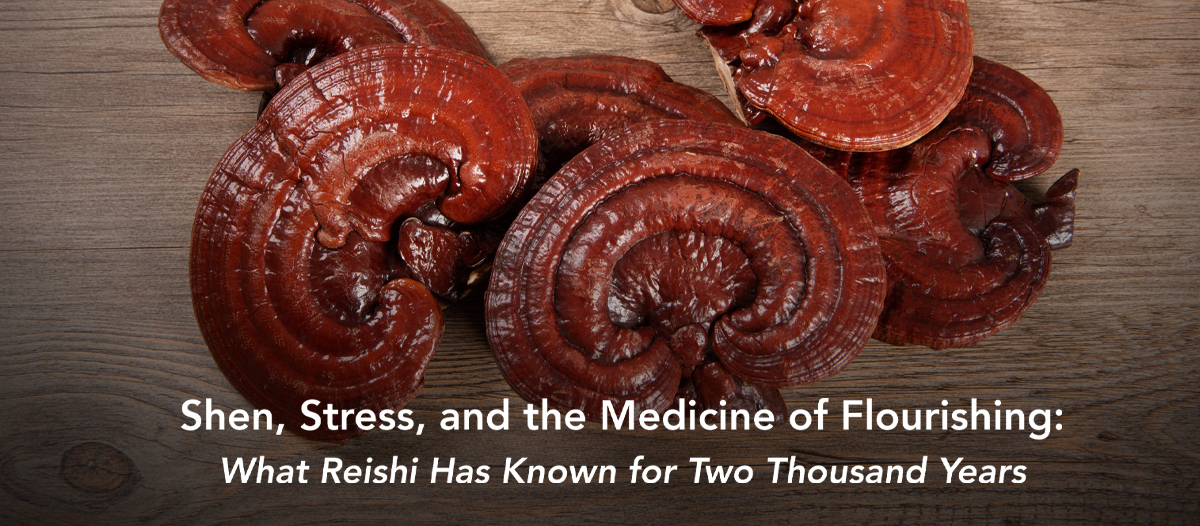
Shen, Stress, and the Medicine of Flourishing:
What Reishi Has Known for Two Thousand Years
By Mark J Kaylor
There is a moment most of us know, though we rarely name it. It is the moment when the noise inside finally quiets. When the shoulders drop. When a breath comes easily and the mind, for once, is not already somewhere else. That quality of settled, clear presence is not simply the absence of stress. Ancient physicians in China had a word for it, and they considered it one of the most important dimensions of health.
They called it Shen.
A Word Without a Clean Translation
Shen is commonly translated as “spirit” or “mind,” but neither word captures it fully. Shen is better understood as the luminous awareness behind a calm face. It is the quality of light in someone’s eyes when they are genuinely present. When Shen is intact and nourished, a person moves through difficulty with clarity rather than reactivity. Sleep comes. The mind is at rest even when life is not.
When Shen is disturbed, the picture is familiar to anyone living in the modern world. Sleep becomes elusive. The mind races at night and feels scattered by day. The heart feels vaguely restless without a clear cause. What is striking is that traditional physicians did not view these experiences as inconveniences or character weaknesses. They were clinical observations pointing to something that could be addressed at its root.
And Reishi (Ganoderma lucidum) was one of their most trusted tools for doing exactly that.
A Superior Herb for a Different Kind of Medicine
The Shennong Bencao Jing, one of the oldest materia medica texts in Chinese medicine, organized herbs into three categories. The superior herbs were something distinct from the rest. They were taken over time to cultivate vitality, calm the mind, and brighten the spirit. This was not crisis medicine. It was the medicine of flourishing. And Reishi was placed at the very top of this category.
This distinction matters more than it might initially appear. We live in a culture that tends to reach for intensity as the measure of effectiveness. The classical herbal tradition understood something different: that the herbs and practices most capable of supporting genuine health over a lifetime often work quietly, cumulatively, and in deep alignment with the body’s own intelligence.
Reishi was not a remedy for emergencies. It was revered as a tonic for people who wanted to age well, think clearly, sleep soundly, and meet the demands of their lives without being depleted by them.
What Modern Research Is Beginning to Confirm
The mechanisms that classical physicians described intuitively are now being mapped with increasing precision. Several lines of research are particularly relevant.
Triterpenes and the Stress Response. The hypothalamic-pituitary-adrenal (HPA) axis is the body’s central stress-response system. Research has identified Reishi’s triterpenes as potential modulators of HPA axis activity. Rather than suppressing the stress response, triterpenes appear to support a more measured and appropriate reaction to stressors. This supports what the classical physicians called the capacity to meet life without being consumed by it. The modern framework calls it resilience.
Polysaccharides and Restful Sleep. The relationship between Reishi and sleep has attracted serious research attention. A 2012 study published in the Journal of Ethnopharmacology found that water-soluble Reishi extracts significantly increased total sleep time and non-REM sleep in animal models, with effects appearing to be mediated through the gut-brain axis. The gut microbiome is increasingly understood to influence neurochemical pathways that play a meaningful role in sleep quality. Reishi’s prebiotic beta-glucans may support this important pathway.
Beta-glucans and Immune Tone. Reishi’s immunomodulatory beta-glucans are among the most extensively studied compounds in functional mushroom research. These polysaccharides help support a well-calibrated immune response. Healthy immune tone is increasingly recognized as relevant to sleep quality, emotional resilience, and overall vitality.
Resilience, Not Numbness
There is a principle threading through all of this research that deserves more attention than it usually receives.
Reishi does not work through stimulation. It does not work through sedation. It works through support, helping the body find and maintain its own equilibrium rather than creating a substitute for one.
This matters in a cultural moment that tends to measure the effectiveness of a remedy by how dramatically it changes how you feel. The herbs and practices that build genuine, lasting wellbeing are rarely dramatic in their action. They work the way deep sleep works, or the way a long friendship works. Quietly. Cumulatively. Profoundly.
The classical physicians who described Reishi as a nourisher of Shen were using the only vocabulary available to them to articulate something they had observed across generations of practice. What they did not have was the language of HPA axis modulation or gut microbiome signaling. What they had was centuries of careful observation, and they reached conclusions that modern research is now beginning to support.
The Ground of Genuine Wellbeing
Shen is not a metaphor. It is a clinical observation about a quality of integrated, luminous aliveness that can be cultivated and nourished. And Reishi, for more than two thousand years, has been one of the most trusted means of nourishing it.
The capacity for calm, clear presence is not a luxury. It is a foundation. Reishi has been supporting that quality of aliveness for two thousand years, and the research is beginning to explain why.
References:
- Shennong Bencao Jing (The Divine Farmer’s Classic of Materia Medica). Compiled c. 200 CE. See Yang S (trans.), Blue Poppy Press, 1998.
- Cui XY, Cui SY, Zhang J, et al. Extract of Ganoderma lucidum prolongs sleep time in rats. J Ethnopharmacol. 2012;139(3):796-800.
- Zhu KX, Nie SP, Li C, et al. Ganoderma lucidum polysaccharides regulate gut microbiota and sleep behavior in rats via the gut-brain axis. Int J Mol Sci. 2019;20(17):4140.
- Batra P, Sharma AK, Khajuria R. Probing Lingzhi or Reishi medicinal mushroom Ganoderma lucidum (higher Basidiomycetes): a bitter mushroom with amazing health benefits. Int J Med Mushrooms. 2013;15(2):127-43.
- Lin ZB. Cellular and molecular mechanisms of immuno-modulation by Ganoderma lucidum. J Pharmacol Sci. 2005;99(2):144-153.

Mark J. Kaylor is a passionate advocate for holistic health and natural remedies, with a focus on extending both lifespan and healthspan. As the founder of the Radiant Health Project and host of Radiant Health Podcast, Mark blends in-depth research with traditional wisdom to empower others on their journey to vibrant health. Through his writing and speaking, he shares insights into the transformative power of herbs, nutrition, and lifestyle practices.
The Radiant Health Project is a not-for-profit initiative dedicated to cutting through wellness industry hype and sharing evidence-informed, traditional wisdom for genuine health.
Disclaimer: All information and results stated here is for educational and entertainment purposes only. The information mentioned here is not specific medical advice for any individual and is not intended to be used for self-diagnosis or treatment. This content should not substitute medical advice from a health professional. Always consult your health practitioner regarding any health or medical conditions.
Leave A Comment