


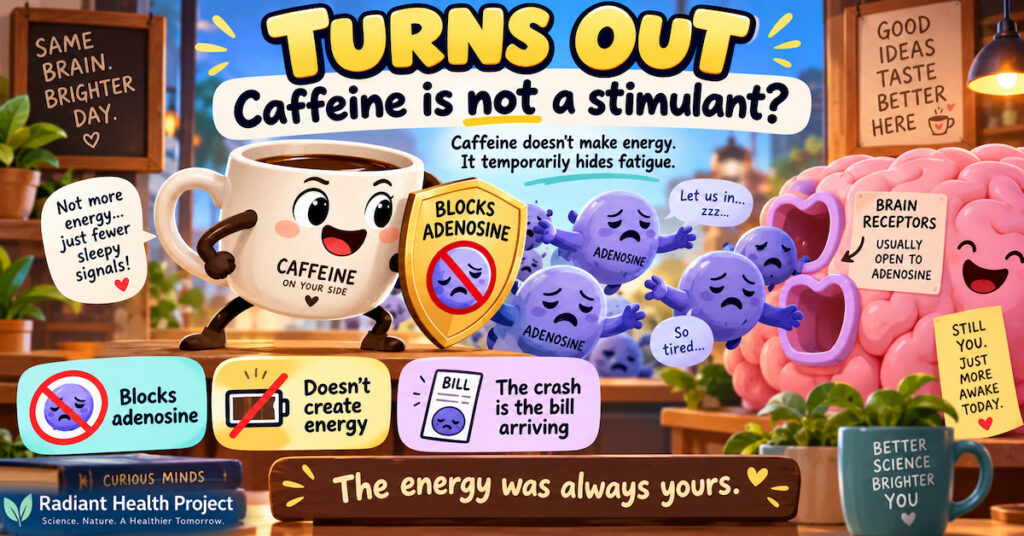
Turns Out caffeine is not a stimulant?
By Mark J Kaylor
Turns out the jolt you feel from your morning coffee may have less to do with caffeine revving you up, and more to do with it switching off the signal that tells you you’re tired.
Your brain continuously produces a chemical called adenosine as a byproduct of normal activity. The longer you’re awake, the more it accumulates, and the more your brain registers it as fatigue. Adenosine is essentially your brain keeping score.
Caffeine works by fitting into adenosine receptors without activating them. It doesn’t generate energy. It doesn’t restore what sleep deprivation has depleted. It temporarily blocks the signal telling you to slow down. The tiredness doesn’t go away. Caffeine just stops you from feeling it.
When it wears off, the adenosine that accumulated while caffeine was blocking the receptors floods back all at once. The crash isn’t caffeine leaving. It’s the bill arriving.
None of this makes your morning coffee a problem. But it does reframe what it actually is: a temporary intervention in how your brain perceives its own fatigue, not a source of energy in any meaningful sense.
The energy was always yours. Caffeine just changes what you notice about how it’s doing.

Mark J. Kaylor is a passionate advocate for holistic health and natural remedies, with a focus on extending both lifespan and healthspan. As the founder of the Radiant Health Project and host of Radiant Health Podcast, Mark blends in-depth research with traditional wisdom to empower others on their journey to vibrant health. Through his writing and speaking, he shares insights into the transformative power of herbs, nutrition, and lifestyle practices.
The Radiant Health Project is a not-for-profit initiative dedicated to cutting through wellness industry hype and sharing evidence-informed, traditional wisdom for genuine health.
Disclaimer: All information and results stated here is for educational and entertainment purposes only. The information mentioned here is not specific medical advice for any individual and is not intended to be used for self-diagnosis or treatment. This content should not substitute medical advice from a health professional. Always consult your health practitioner regarding any health or medical conditions.
Leave A Comment