Unlocking Your Fullest Potential
Radiant health isn’t just about the absence of disease; it’s about reaching your highest potential in every aspect of life. When your body is resilient, your mind is clear, and your spirit is grounded, you’re empowered to live fully and joyfully.
Your Journey to Radiant Health
The path to radiant health is not a quick fix — it’s a lifestyle, a commitment to nurturing your body, mind, and spirit through intentional choices. By embracing natural medicine and holistic principles, you can achieve a level of vitality that transforms not only your health but also your outlook on life. Start your journey today by prioritizing nourishing foods, mindful living, and the powerful support of tonic herbs. In doing so, you’ll discover the boundless potential of radiant health — a life of energy, resilience, and joy.

The Three Faces of Stress: Five Tools for Stress Relief That Work Right Now
Not all stress is the same. The body knows this even when our language doesn’t. The jolt of an unexpected crisis feels nothing like the slow erosion of chronic pressure, and neither of those resembles the quiet exhaustion of a mind that keeps returning to the same worry. Each has its own face, its own biology, and its own path through. This three-part series explores all three. – READ MORE
“Turns Out…”
Science keeps surprising us. Tucked inside research journals and buried in studies few people ever read are small, genuine discoveries about herbs, nutrients, nutraceuticals, and the remarkable ways the body heals and thrives. “Turns Out” is where those findings get to breathe. Each piece is short, grounded in real research, and focused on one thing worth knowing — the kind of thing you’d text a friend. No hype, no headlines stretched past what the evidence actually says. Just good science, written in plain language. Turns out there’s always more to discover.
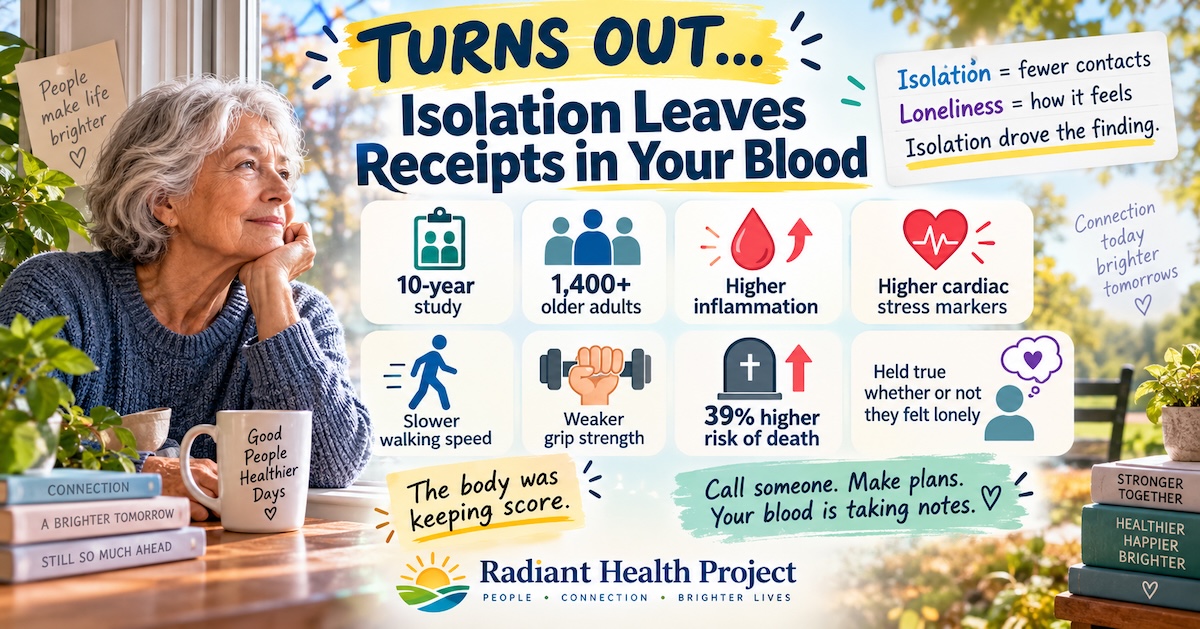
Turns out… what a father eats, weighs, and does before conception can shape his children’s health for life — and it has nothing to do with his DNA sequence.
New research from Washington State University, published in the Proceedings of the National Academy of Sciences, found that paternal metabolic information influencing offspring health is established during sperm development in the testis, before sperm even leave the body. The biological instructions a father passes to his children are written long before conception happens.
This is epigenetics at work. Paternal diet and obesity are associated with greater risks of metabolic dysfunction in offspring through epigenetic alterations in sperm — changes not to the genetic code itself, but to how that code gets read. Stress in fathers before conception correlates with altered sperm RNA profiles and methylation patterns, with behavioral and metabolic effects detected across generations.
The implications run in both directions. Fathers who exercised before conception had offspring with better metabolic function, improved energy production, better blood sugar control, and greater physical endurance.
For generations, preconception health focused almost entirely on mothers. That story is being rewritten. A father’s body, in the months before conception, is already composing a first chapter for the life that follows.
Turns out, fatherhood begins before the baby does.
Fathers May Influence Their Children’s Health Before They’re Even Conceived.” Medical Xpress, 9 June 2026, https://medicalxpress.com/news/2026-06-fathers-children-health-theyre.html.

The Headline That Will Scare You:
What a Major New Study on Glucosamine and Alzheimer’s Actually Says
By Mark J Kaylor
Somewhere in your social media feed right now, or maybe in a text from a well-meaning friend, a headline is circulating. It reads something like this:
“Popular Joint Supplement Linked to Alzheimer’s Progression”
If you or someone you love takes glucosamine for joint pain, that headline probably just landed somewhere in your chest. Maybe it sent you to the cabinet to look at the bottle. Maybe it made you wonder whether you have been quietly doing harm.
Take a breath. The study is real, it is important, and it deserves your attention. But the headline, as headlines almost always do, is telling a partial story. The full story is more nuanced, more instructive, and ultimately more useful to you.
Let’s walk through it carefully.
What the Research Actually Found
A study published in June 2026 in Nature Metabolism, one of the most rigorous journals in biomedical science, made a significant discovery about how Alzheimer’s disease progresses at the metabolic level. Researchers from the University of Florida, using cutting-edge spatial imaging technology, identified something they call hyperglycosylation as a driver of Alzheimer’s disease.
Glycosylation is a normal biological process in which sugar molecules attach to proteins in the brain. It plays an essential role in how neurons communicate, how brain proteins fold and stabilize, and how the immune system functions in the central nervous system. In healthy brains, this process is carefully regulated. In Alzheimer’s disease brains, it runs out of control. The brain becomes, in effect, over-sugared at a cellular level, and that excess appears to actively worsen the disease.
This is a meaningful and potentially landmark finding about the biology of Alzheimer’s. And it has implications that researchers then decided to test in a real-world population.
Glucosamine, the widely used joint supplement, is a building block that feeds directly into this glycosylation pathway. It crosses the blood-brain barrier and incorporates into brain glycans. That made it a logical candidate to investigate: if hyperglycosylation is harmful in Alzheimer’s disease, might glucosamine supplementation make things worse by supplying more raw material to an already overactive process?
To answer that question, the researchers looked at electronic health records from more than 50,000 patients diagnosed with Alzheimer’s disease and related dementias. What they found was sobering:
- Among patients with established dementia, those who used glucosamine had a 25% higher mortality risk over a 10-year follow-up period.
- Among patients with mild cognitive impairment (MCI), those who used glucosamine were 25% more likely to progress to full Alzheimer’s disease.
Those are real numbers from a large dataset. They deserve to be taken seriously.
Now, Here Is What the Headline Left Out
The study also tested glucosamine in cognitively healthy animals and looked at what happened in the MCI patient group with regard to survival. The results were strikingly different.
In healthy mice without Alzheimer’s pathology, glucosamine supplementation produced no hyperglycosylation in the brain and no cognitive impairment. The normal brain appears to have regulatory mechanisms that buffer against glucosamine’s effects on glycan metabolism. When those mechanisms are intact, extra glucosamine does not appear to push the system into dangerous territory.
In the human MCI cohort, glucosamine use was not associated with significantly worsened survival. The signal only became clear in people with established, diagnosed dementia.
This is a critical distinction. The study’s authors make it themselves. The harm observed was specific to brains already in the grip of active neurodegeneration, where the glycosylation machinery was already dysregulated and running hot. Adding more glucosamine to that environment appears to pour fuel on a fire that is already burning.
For people with healthy cognition taking glucosamine for a creaky knee, this study does not provide evidence of harm. That does not mean the question is fully settled, and it does not mean future research will not find something worth attending to. But the data as it stands does not support the alarm that many headlines implied.
Why This Matters Beyond the Supplement
This study is a useful lens through which to examine something that happens constantly in health media: a real and important finding gets extracted from its context, stripped of its nuance, and broadcast in a way that is technically accurate but functionally misleading.
The finding that glucosamine is associated with worse outcomes in Alzheimer’s patients is real. The implication that millions of healthy people are quietly accelerating their cognitive decline with a joint supplement is not what the data shows.
These are very different things. But in the economy of social media engagement, nuance is a liability. A careful headline does not travel. A frightening one does.
This creates a particular problem in health and wellness communication because the people most likely to share alarming health news are the people who care most about health. They are not trying to mislead anyone. They are trying to help. But the information they are sharing has often been processed through so many filters, and abbreviated so many times, that what comes out the other end bears only a superficial resemblance to what the science actually said.
The skill this moment calls for is not dismissal. The underlying research here is genuinely important. The skill it calls for is the ability to slow down, ask who was studied, what exactly was measured, what comparisons were made, and whether the population in the study is the same population the headline implies.
That is not a technical skill. It is a habit of mind. And it is one of the most protective things you can develop in an age of abundant, fast-moving health information.
What You Should Actually Do With This Information
If you are cognitively healthy and taking glucosamine for joint support, this study does not give you a clear reason to stop. It does give you a reason to file this in the category of things worth watching as the science develops, and to mention it to your doctor the next time the topic arises.
If you have been diagnosed with mild cognitive impairment or any form of dementia, or if you are caring for someone who has, this finding is worth a direct conversation with your physician before continuing glucosamine supplementation. The signal in this study is real for that population, and the precautionary logic is sound: if your brain’s glycosylation system is already dysregulated, adding more substrate to that pathway is a reasonable thing to reconsider.
In either case, the takeaway is not panic. It is attention. It is the kind of engaged, curious relationship with health research that asks questions before drawing conclusions.
That is what radiant health actually looks like in practice: not a life spent in fear of the next alarming headline, but a steady capacity to look clearly at evidence, understand its limits, and make thoughtful choices from that understanding.
A Note on the Research Itself
This study, published in Nature Metabolism and led by Ramon C. Sun and colleagues at the University of Florida, represents a genuine advance in our understanding of Alzheimer’s disease. The identification of hyperglycosylation as an active driver of neurodegeneration, rather than merely a byproduct of it, opens a new lane of therapeutic investigation. Researchers are now looking at glycan biosynthesis as a potential target for intervention, which could eventually lead to new approaches to slowing or preventing cognitive decline.
That is the story underneath the story. It is less shareable than a supplement scare, but it is far more consequential. And it is worth knowing.

Mark J. Kaylor is a passionate advocate for holistic health and natural remedies, with a focus on extending both lifespan and healthspan. As the founder of the Radiant Health Project and host of Radiant Health Podcast, Mark blends in-depth research with traditional wisdom to empower others on their journey to vibrant health. Through his writing and speaking, he shares insights into the transformative power of herbs, nutrition, and lifestyle practices.
The Radiant Health Project is a not-for-profit initiative dedicated to cutting through wellness industry hype and sharing evidence-informed, traditional wisdom for genuine health.
Disclaimer: All information and results stated here is for educational and entertainment purposes only. The information mentioned here is not specific medical advice for any individual and is not intended to be used for self-diagnosis or treatment. This content should not substitute medical advice from a health professional. Always consult your health practitioner regarding any health or medical conditions.

Timeless Adaptogen: Ashwagandha’s Role in Relieving Stress and Promoting Radiant Health
Ashwagandha, a revered herb in Ayurvedic medicine, has stood the test of time as one of nature’s most powerful adaptogens. Known botanically as Withania somnifera, this small shrub belongs to the Solanaceae family and thrives in the arid regions of India, the Middle East, and parts of Africa. Commonly called Indian ginseng or winter cherry, Ashwagandha derives its name from the Sanskrit words “ashva” (horse) and “gandha” (smell), referring to the fresh root’s unique odor and its association with imparting horse-like vitality and strength. Read More

Belonging Is Biology. The Science of Connection and Health
Decades of research now confirm what many of us sense intuitively: the people around us are one of the most powerful determinants of our health. From heart disease and dementia to inflammation, stress, and longevity, social connection shapes our biology at every level. Tracing the science from a small Italian immigrant community in Pennsylvania to the world’s longest happiness study to the ancient wisdom of Traditional Chinese Medicine, this piece makes the case that radiant health is not a solo pursuit. It blossoms in belonging. Read More

Cistanche: The Desert Herb of Longevity and Vitality
Cistanche, known as the “ginseng of the desert,” has long been used in traditional Chinese medicine (TCM) as a potent herbal remedy for vitality and longevity. This powerful adaptogen, derived from a desert plant that thrives in arid environments, is gaining recognition in modern science for its potential to support healthy aging, improve energy levels, and boost overall wellness. Read More

Hidden Toxins Lurking in Your Home: What you can’t see may be impacting your health more than you think
You’ve probably noticed it before: the sharp chemical smell of a newly painted room, the headache that follows hours in a new car, the vague sense that something in the air isn’t quite right. These aren’t just passing discomforts. For many of us, hidden toxins are quietly accumulating in the spaces where we sleep, breathe, and eat. Unlike industrial spills or obvious pollution, these exposures are silent, subtle, and chronic, slowly eroding health, energy, hormones, and immune resilience over time. Read More
Leave A Comment