


Turns Out: The Avocado Edition
By Mark J Kaylor
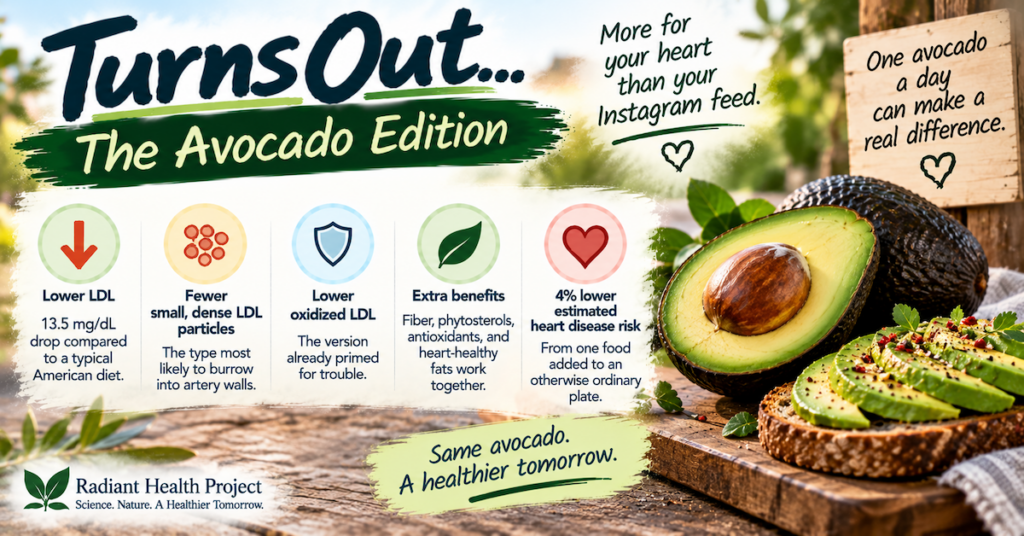
Turns out one avocado a day doesn’t just lower your LDL number; it changes what kind of LDL you’re carrying.
Researchers at Penn State put 45 adults with elevated cholesterol through three different heart-healthy diets, each matched for fat and calories, with only one including a daily Hass avocado. The avocado diet didn’t just outperform the others on total LDL. It uniquely reduced the small, dense LDL particles most likely to burrow into artery walls, along with oxidized LDL, the version already primed for trouble. Compared to a diet built to mimic average American eating, LDL dropped by 13.5 mg/dL.
The researchers point out that avocados bring more to the table than good fats. Fiber, phytosterols, and a quiet cast of antioxidants seem to be doing their own work alongside the monounsaturated fats getting all the credit.
Four percent lower estimated heart disease risk, from one food added to an otherwise ordinary plate. Not a dramatic shift. A modest one. But real, measured, and repeatable.
Turns out the avocado on your toast might be doing more for your arteries than for your Instagram feed.

Mark J. Kaylor is a passionate advocate for holistic health and natural remedies, with a focus on extending both lifespan and healthspan. As the founder of the Radiant Health Project and host of Radiant Health Podcast, Mark blends in-depth research with traditional wisdom to empower others on their journey to vibrant health. Through his writing and speaking, he shares insights into the transformative power of herbs, nutrition, and lifestyle practices.
The Radiant Health Project is a not-for-profit initiative dedicated to cutting through wellness industry hype and sharing evidence-informed, traditional wisdom for genuine health.
Disclaimer: All information and results stated here is for educational and entertainment purposes only. The information mentioned here is not specific medical advice for any individual and is not intended to be used for self-diagnosis or treatment. This content should not substitute medical advice from a health professional. Always consult your health practitioner regarding any health or medical conditions.
Leave A Comment