


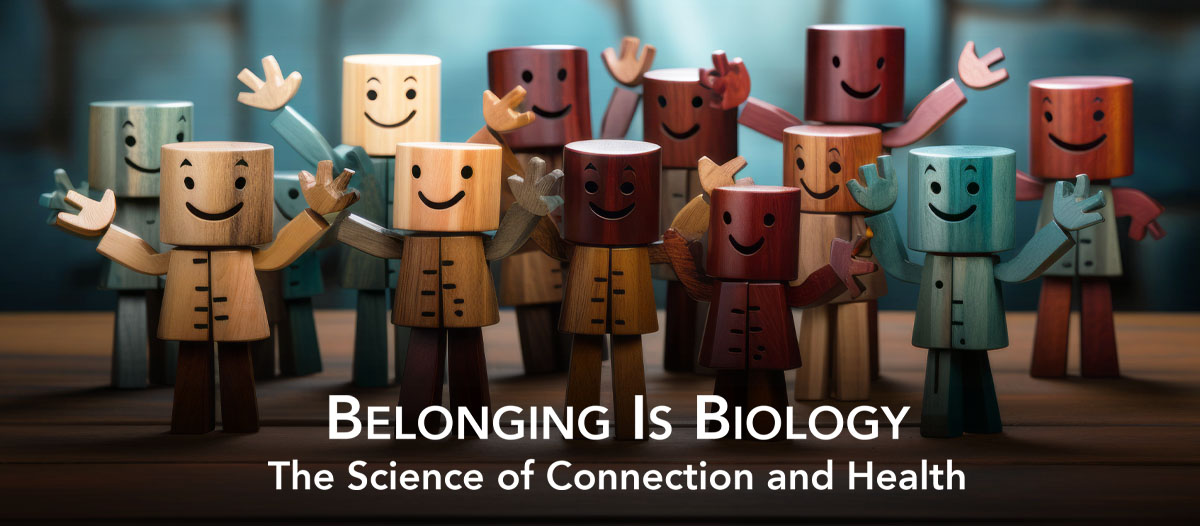
Belonging Is Biology
The Science of Connection and Health
By Mark J Kaylor
AT A GLANCE
Decades of research now confirm what many of us sense intuitively: the people around us are one of the most powerful determinants of our health. From heart disease and dementia to inflammation, stress, and longevity, social connection shapes our biology at every level. Tracing the science from a small Italian immigrant community in Pennsylvania to the world’s longest happiness study to the ancient wisdom of Traditional Chinese Medicine, this piece makes the case that radiant health is not a solo pursuit. It blossoms in belonging.
Think about a moment when you truly felt held by the people around you. Maybe it was a meal that stretched on for hours, or a neighbor who checked in without being asked, or the quiet comfort of knowing that someone would pick up the phone. That feeling is not a luxury. Research now tells us it may be one of the most powerful medicines available to us.
For decades, health science focused almost entirely on what we eat, how much we move, and how well we sleep. These things matter. But a growing body of evidence points to something that may matter just as much: the quality of our connections with other people.
A Town That Shouldn’t Have Been Healthy
In the 1960s, researchers encountered a puzzle in a small Pennsylvania town. Roseto was an Italian immigrant community where men worked brutal shifts in slate quarries, families ate pasta, sausage, and fried food, smoked cigarettes, and drank plenty of wine. By every conventional health measure, they should have been struggling. Instead, they were thriving. Heart disease rates were half the national average for people over 65. In men under 55, there were zero recorded deaths from heart attacks. None.
Researchers spent years trying to find the explanation in diet, genetics, water supply, and geography. None of it held up. When they tracked Italian immigrants from the same region who had settled elsewhere in the United States, those individuals had perfectly ordinary heart disease rates. It was not the food. It was not the genes.
What set Roseto apart was community. Multigenerational households. Neighbors who functioned as extended family. Regular communal gatherings. And every evening, people stepping outside together for the passeggiata, the simple Italian tradition of an after-dinner stroll. When Roseto gradually became more individualistic and less communally oriented, heart disease rates rose to match those of surrounding towns. The researchers had predicted exactly this. Scientists now call what the Rosetans had the “Roseto Effect.” What follows is a closer look at what that effect actually does inside us.
Longer Life and Reduced Mortality
The numbers here are worth sitting with. A landmark meta-analysis led by researcher Julianne Holt-Lunstad examined data from over 308,000 people across 148 studies and found that people with strong social relationships had a 50% greater likelihood of survival compared to those with poor or insufficient social ties. The magnitude of that finding placed social isolation in the same risk category as smoking 15 cigarettes a day, ranking it ahead of obesity and physical inactivity as a predictor of early death.
These are not soft findings. They hold across age groups, cultures, and health conditions. The people who live longest are not necessarily the ones who eat the best or exercise the most. They are, with remarkable consistency, the ones most deeply embedded in the lives of others.
Protection Against Chronic Disease
The Blue Zones, communities around the world where people regularly live past 100, have been studied extensively for the secrets behind their longevity. Researchers expected to find specific diets, exercise habits, or genetic advantages. What they found instead was a set of shared lifestyle patterns, and one of the most consistent across every Blue Zone was strong social integration.
In Sardinia, in Okinawa, in Costa Rica’s Nicoya Peninsula, and in Loma Linda, California, people were embedded in tight communities of family and friendship. They were needed. They were known. Connection was not something they scheduled. It was woven into the daily texture of their lives.
Beyond longevity research, social connection is associated with reduced risk of heart disease, stroke, type 2 diabetes, and certain cancers. The mechanisms are multiple and reinforcing, involving stress hormones, inflammation, immune function, and health behaviors. Connection is not upstream of health. In many important ways, it is health.
Stress Regulation
When we feel connected to others, our nervous system responds differently to the pressures of daily life. The presence of trusted people, even the simple knowledge that trusted people are available, measurably reduces the body’s stress response.
Research shows that social support lowers cortisol and adrenaline levels under stress, reduces cardiovascular reactivity, and helps the nervous system return more quickly to calm after a difficult event. Research has even found that people asked to estimate the steepness of a hill perceive it as significantly less steep when standing next to a friend. Connection literally changes how we experience difficulty.
The chronic stress that erodes health over time, that quiet, grinding activation of the body’s alarm system, is significantly buffered by belonging. We were built to face the world with others. When we do, our bodies reflect that.
Mental Health and Emotional Resilience
Strong social connection is one of the most robust protective factors in mental health research. People with close relationships are less likely to experience depression, anxiety, and post-traumatic stress. When difficult events do occur, they recover more fully and more quickly.
The Harvard Study of Adult Development, the longest running study of adult happiness ever conducted, followed participants for over 85 years and across generations. Its central finding was consistent and clear: the quality of relationships was the single strongest predictor of wellbeing and long life. Not wealth, not professional success, not cholesterol levels. Relationships.
Participants who were most satisfied in their relationships at age 50 were the healthiest at age 80. Connection offers something like an emotional immune system. Not protection from difficulty, but the resilience to move through it.
Immune Function and Inflammation
The link between social connection and immune health is more direct than most people realize. Chronic loneliness and social isolation trigger a biological state researchers call the “threat response.” In this state, the immune system shifts toward inflammation, the body’s first-line defense against physical harm, even when no physical harm is present.
This makes evolutionary sense. Social disconnection in our ancestral environment was genuinely dangerous. An isolated human was a vulnerable human. The body responds to isolation with the same low-grade alarm it activates in the face of physical threat.
The result is elevated levels of inflammatory markers including interleukin-6 and C-reactive protein, both associated with accelerated aging, heart disease, depression, and cognitive decline. Conversely, people with strong social bonds tend to show lower inflammatory markers, stronger antibody responses to vaccines, and faster wound healing. Connection, among many other things, is an immune system intervention.
Cognitive Health and Dementia Risk
The brain was shaped by millions of years of social living, and it appears to require social engagement to function at its best. Research consistently shows that people with rich social lives have better cognitive function, sharper memory, and significantly reduced risk of dementia.
A meta-analysis drawing on data from nearly 40,000 people found that those with good social connections had roughly half the rate of dementia compared to those with poor social connections. The mechanisms are multiple: the cognitive stimulation of conversation and shared problem-solving, the stress-buffering effects of belonging, and the downstream reduction in inflammation, a known driver of neurodegeneration.
There is also growing evidence that meaningful social engagement is protective even after early Alzheimer’s-related changes begin in the brain. Connection, it seems, offers a kind of resilience that extends all the way into our neurology.
Healthier Behaviors and Lifestyle Choices
We do not just feel better in community. We behave better. People embedded in supportive social networks exercise more, eat more nutritiously, smoke and drink less, sleep better, and are more likely to seek medical care when needed.
This happens through multiple channels. The people around us model behaviors. They hold us accountable, gently or otherwise. They provide practical support during difficulty. And belonging to a group that values certain habits makes those habits feel natural rather than effortful.
This is one reason why group-based health interventions consistently outperform individual ones. The social scaffolding is not incidental to the change. It is central to it.
Meaning, Purpose, and Safer Communities
Connection does not just protect us biologically. It gives life its texture and weight. Research on meaning and purpose consistently points to relationships as the primary source of both. Feeling that we matter to others, that our presence makes a difference, is one of the most powerful contributors to psychological well-being and longevity.
At the community level, the effects extend outward. Neighborhoods with high social cohesion have lower crime rates, stronger civic engagement, and better outcomes for children. The Roseto researchers noted that beyond the absence of heart disease, there was also an absence of suicide, drug addiction, and serious crime. These were not separate phenomena. They were expressions of the same underlying condition: people who genuinely belonged to each other.
The Heart of the Matter
In Traditional Chinese Medicine, the Heart is understood as the seat of Shen, a concept that encompasses spirit, consciousness, and luminous presence. Shen is not only about the individual. It is nourished through genuine connection, through being seen, through belonging. When Shen is strong, it shows: in the quality of attention, the warmth behind the eyes, the felt sense of someone who is truly here.
The research on connection and health, as precise and extensive as it now is, points toward something that Chinese medicine understood long before the studies existed: we are not fundamentally separate beings who occasionally choose to connect. We are relational creatures to the core. Our health reflects this at every level.
The passeggiata in Roseto was not a wellness intervention. It was simply people being people together, evening after evening. And that, it turns out, was medicine enough.
REFERENCES
- Social Relationships and Mortality Risk: A Meta-Analytic Review
Supports: The section on Longer Life and Reduced Mortality; provides the landmark finding that strong social relationships are associated with a 50% greater likelihood of survival, comparable in magnitude to the risk reduction from quitting smoking.
Holt-Lunstad J, Smith TB, Layton JB (2010). PLOS Medicine, 7(7): e1000316.
https://doi.org/10.1371/journal.pmed.1000316
- The Good Life: Lessons from the World’s Longest Scientific Study of Happiness
Supports: The sections on Mental Health and Emotional Resilience and Meaning and Purpose; provides the 85-year longitudinal finding that relationship quality is the single strongest predictor of wellbeing and healthy aging.
Waldinger RJ, Schulz M (2023). Simon & Schuster, New York.
https://www.robertwaldinger.com/the-good-life
- Social Isolation and Loneliness in Older Adults: Review and Commentary of a National Academies Report
Supports: The section on Cognitive Health and Dementia Risk; documents the meta-analytic finding that social isolation is associated with approximately 50% increased risk of dementia.
Donovan NJ, Blazer D (2020). The American Journal of Geriatric Psychiatry, 28(12), 1233-1244.
https://pmc.ncbi.nlm.nih.gov/articles/PMC7437541/
- Blue Zones: 9 Lessons for Living Longer From the People Who’ve Lived the Longest
Supports: The section on Protection Against Chronic Disease; documents the consistent presence of strong social integration across all five Blue Zone communities as a shared longevity factor.
Buettner D (2008). National Geographic Society, Washington, D.C.
- The Roseto Story: An Anatomy of Health
Supports: The introductory section and the section on Meaning, Purpose, and Safer Communities; documents the 50-year study of Roseto, Pennsylvania, and the social cohesion findings that became known as the Roseto Effect.
Wolf S, Bruhn JG (1993). University of Oklahoma Press, Norman, OK.

Mark J. Kaylor is a passionate advocate for holistic health and natural remedies, with a focus on extending both lifespan and healthspan. As the founder of the Radiant Health Project and host of Radiant Health Podcast, Mark blends in-depth research with traditional wisdom to empower others on their journey to vibrant health. Through his writing and speaking, he shares insights into the transformative power of herbs, nutrition, and lifestyle practices.
The Radiant Health Project is a not-for-profit initiative dedicated to cutting through wellness industry hype and sharing evidence-informed, traditional wisdom for genuine health.
Disclaimer: All information and results stated here is for educational and entertainment purposes only. The information mentioned here is not specific medical advice for any individual and is not intended to be used for self-diagnosis or treatment. This content should not substitute medical advice from a health professional. Always consult your health practitioner regarding any health or medical conditions.
Leave A Comment