


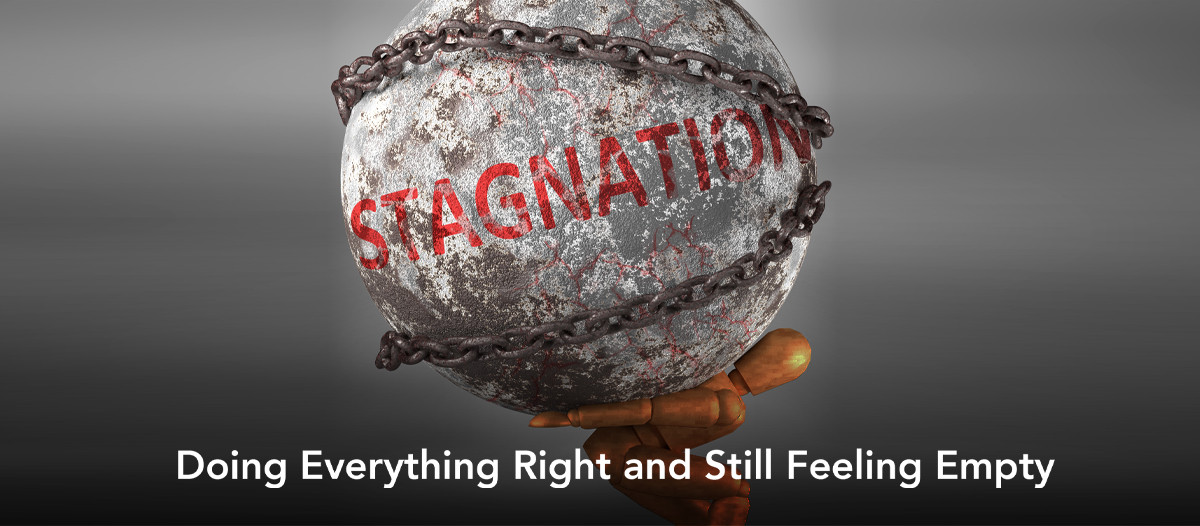
Doing Everything Right and Still Feeling Empty
by Mark J Kaylor
A client sat across from me not long ago and said something I hear in some form almost every week. “I have the job. I have the marriage. I have the house. I don’t understand why I feel like this.”
She wasn’t in crisis. She wasn’t depressed in any clinical sense she could name. She was, by any external measure, doing everything right. And still, underneath all of it, there was a flatness she couldn’t explain and almost felt guilty admitting to, because what right did she have to feel empty when her life looked so full?
I hear versions of this constantly. Sometimes it’s a man who built the business he set out to build and now stares at the number in his bank account without feeling much of anything. Sometimes it’s someone who chose the safe path over the true one so long ago that she can’t quite remember what the true path even was. What they share isn’t failure. It’s presence gone missing from a life that, on paper, succeeded.
This Isn’t a Regret Waiting for Later
We tend to talk about this as something that happens at the end of a life, the deathbed regret, the “if only I had.” That framing has its place, but it does something unhelpful too. It puts the ache safely in the future, somewhere you can worry about it later. What I see in the room, session after session, is that the ache isn’t waiting for later. It’s happening now, today, in people who are nowhere near done living.
In Traditional Chinese Medicine, there’s a concept called Qi, the vital energy meant to move freely through the body and through a life. When something blocks that movement, whether it’s an emotion that was never expressed, a decision that keeps getting deferred, or a want that got quietly filed away, the result is called stagnation, meaning Qi that has stopped flowing the way it should. Stagnation isn’t only a poetic idea. It shows up as real, felt experience: tightness, fatigue, a kind of low-grade static that no amount of achievement seems to clear. The flatness my client described isn’t a personality trait or a mood to push through. It’s stagnation, at the scale of a whole life instead of a single stressful week.
Three Shapes, Not Three Types
In my experience, this shows up in three different shapes. I want to be careful here, because it would be tidy, and false, to describe these as three types of people, or three stages you move through in order. Real people are rarely that neat.
The first shape is what I’d call the sophisticated deferral. This person knows exactly what they want and exactly why they’re not doing it yet. The excuse is well built. “When the kids are older.” “After this next promotion.” The want is alive and conscious, just endlessly postponed.
The second shape is quieter. Here, the want itself has gone dim, not suppressed on purpose, just unfed for so long that the signal faded, the way a muscle that isn’t used stops sending strong signals to the brain. Ask this person what they want and you’ll often get silence, not because they’re hiding it, but because they’ve genuinely lost the thread.
The third shape is the one that surprises people most: the success shaped absence. This is someone who has built an impressive, competent, externally admirable life, and still feels the flatness underneath it. The scaffolding is real. The room inside it is empty.
Here’s the part I want to be honest about. Most people aren’t cleanly one of these. Someone might be living the sophisticated deferral in their career, the quiet want in their marriage, and the success shaped absence in their health, all in the same season of life. Forcing this into a clean progression would mean doing exactly what a lot of frameworks do: making the theory look elegant at the cost of describing the actual, textured, inconsistent way people live. You are probably some shifting blend of all three, depending on which room of your life we’re standing in.
Why It Matters to Notice Early
What I can say with more confidence is this: none of these three shapes stay still if they’re left alone. In TCM, stagnation that goes unaddressed doesn’t just sit there. It tends to deepen, becoming more fixed and harder to move the longer it’s ignored. The same seems true here. A deferral you’ve lived with for one year still has flexibility in it. A deferral you’ve lived with for twenty has often hardened into identity, into “that’s just not who I am,” which is a much harder thing to work with than a postponed decision. The point isn’t to frighten anyone. It’s the same principle as any early intervention: the sooner a pattern is noticed, the more room there still is to move.
The Most Honest Report: Shen
There’s another concept from Chinese medicine worth naming here: Shen, which roughly translates to spirit, or luminous presence, and which practitioners are trained to read in a person’s eyes. It isn’t a metaphor. Anyone can see it. You’ve met people whose eyes are bright and present, and you’ve met people whose eyes have gone flat, not from illness, but from years of not quite being present for their own life. That flatness is often the most honest report of what’s going on underneath. If you want a simple way to check in on yourself or someone you love, that’s it. Not “are things going well,” but “is anyone actually home.”
What Actually Moves It
I don’t think the way out of this is a five step plan, and I’d be suspicious of anyone who offered you one. What actually moves stagnant Qi is usually smaller and less dramatic than that: attention paid to what’s actually there instead of what should be there, small honest movements instead of grand reinventions, and a willingness to let the want come back into focus before you have any idea what you’ll do about it. You don’t have to know the destination to start letting the wanting be true again. Sometimes that’s the whole first step, and it’s enough.
Key Takeaways
- The ache of an unlived life isn’t a future regret. It’s a present stagnation, happening in the body and the day, not reserved for looking back from old age.
- Qi is the vital energy meant to move freely through a life. When something blocks it, whether an emotion, a decision, or a want, the result is stagnation, felt as flatness rather than named as a diagnosis.
- The three orientations, the sophisticated deferral, the quiet want, and the success shaped absence, are shapes people move between, often several at once in different areas of life, not a ladder climbed in order.
- Left unaddressed, stagnation tends to deepen and harden, so noticing it early leaves the most room to move.
- Shen, the luminous presence read in the eyes, is often the most honest report of whether someone is truly inhabiting their own life.
- Radiant health isn’t the absence of struggle. It’s the felt aliveness of a life being actually lived, want and all.

Mark J. Kaylor is a passionate advocate for holistic health and natural remedies, with a focus on extending both lifespan and healthspan. As the founder of the Radiant Health Project and host of Radiant Health Podcast, Mark blends in-depth research with traditional wisdom to empower others on their journey to vibrant health. Through his writing and speaking, he shares insights into the transformative power of herbs, nutrition, and lifestyle practices.
The Radiant Health Project is a not-for-profit initiative dedicated to cutting through wellness industry hype and sharing evidence-informed, traditional wisdom for genuine health.
Disclaimer: All information and results stated here is for educational and entertainment purposes only. The information mentioned here is not specific medical advice for any individual and is not intended to be used for self-diagnosis or treatment. This content should not substitute medical advice from a health professional. Always consult your health practitioner regarding any health or medical conditions.
Leave A Comment