


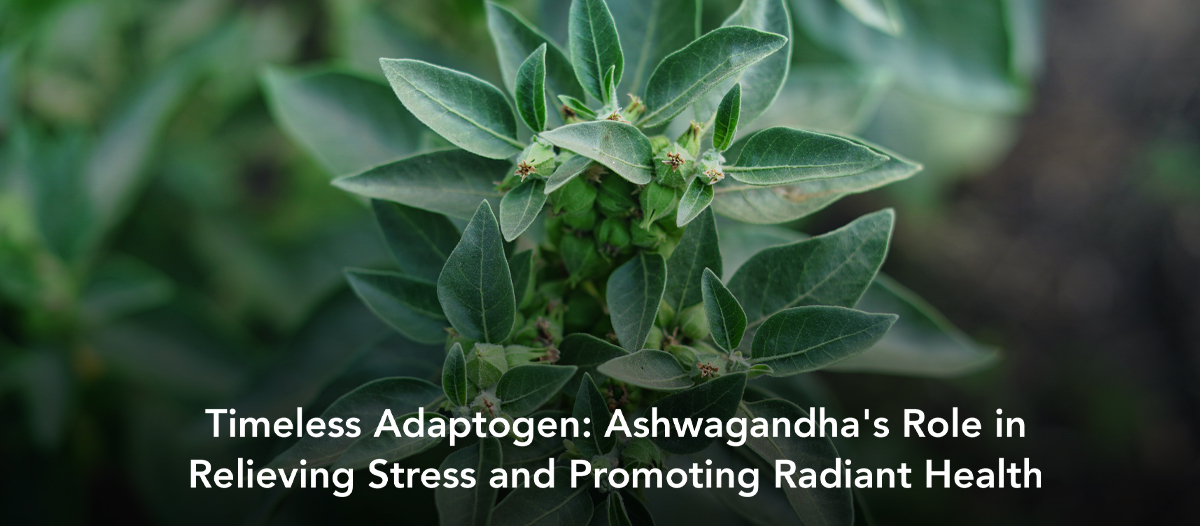
Timeless Adaptogen: Ashwagandha’s Role in
Relieving Stress and Promoting Radiant Health
By Mark J Kaylor
Quick Summary
Ashwagandha has been central to Ayurvedic healing for more than 3,000 years, and modern science keeps finding reasons why. One of the most research-backed adaptogens available, it works by helping your body regulate the stress response rather than simply suppressing it. That distinction matters. This blog traces ashwagandha’s roots in traditional medicine, surveys its well-documented benefits across stress, cognition, physical performance, hormonal health, immune function, and more, and offers practical guidance on quality, dosage, and safety. If you’ve been curious about ashwagandha, or if you’re already using it and want to understand it more deeply, you’re in the right place.
Ashwagandha, a revered herb in Ayurvedic medicine, has stood the test of time as one of nature’s most powerful adaptogens. Known botanically as Withania somnifera, this small shrub belongs to the Solanaceae family and thrives in the arid regions of India, the Middle East, and parts of Africa. Commonly called Indian ginseng or winter cherry, ashwagandha derives its name from the Sanskrit words “ashva” (horse) and “gandha” (smell), referring to the fresh root’s characteristic earthy aroma and its traditional association with horse-like vitality and strength. That image, of robust, sustained energy rather than a quick jolt, is still the most honest shorthand for what ashwagandha offers.
Ayurveda’s Perspective on Ashwagandha
In Ayurveda, ashwagandha holds the honored designation of rasayana, a class of herbs considered so deeply rejuvenating that they were traditionally reserved for royalty, elders, and those recovering from serious illness. Rasayanas are understood not merely as treatments but as practices of renewal, working at the level of Ojas, the subtle essence that underlies vitality, immunity, and mental clarity.
Ashwagandha is considered tridoshic, meaning it can support balance across all three doshas (Vata, Pitta, and Kapha), though its application is always individualized. For Vata imbalances marked by anxiety, dryness, and depletion, ashwagandha is traditionally prepared with warm milk or ghee to amplify its grounding, nourishing qualities. Its gentle heating nature helps move stagnant Kapha, while its adaptogenic steadiness supports Pitta without fanning its fire. This versatility is rare among herbs and helps explain why ashwagandha has remained a cornerstone of Ayurvedic practice across centuries and continents.
A True Tonic and Adaptogen
Ashwagandha belongs to a special category of plants called adaptogens: herbs that help the body adapt to stress while supporting overall function and resilience. The term is modern, but the concept is ancient. What distinguishes adaptogens from stimulants or sedatives is their capacity to work with the body’s own regulatory intelligence rather than overriding it. Ashwagandha doesn’t push you up or pull you down; it helps restore your innate capacity to find equilibrium.
This is not a minor distinction. In a culture that reaches first for caffeine or pharmaceuticals when the system feels off, ashwagandha offers something genuinely different: a plant that has co-evolved with human physiology over millennia, meeting chronic stress not with force but with support. That’s the adaptogen promise, and ashwagandha delivers on it more consistently than almost any other herb in this class.
Benefits of Ashwagandha
Stress and Anxiety
Most of us know chronic stress not as a concept but as a lived experience: the low hum of tension that never quite resolves, the sleep that doesn’t fully restore, the sense that the body is braced for something that never arrives. Ashwagandha addresses this at a physiological level that few herbs can match.
Its primary mechanism involves modulating the hypothalamic-pituitary-adrenal (HPA) axis, the command center of the stress response, and reducing circulating cortisol. This isn’t suppression so much as recalibration. Multiple meta-analyses, including a comprehensive 2025 review of 15 clinical trials, confirm significant reductions in perceived stress, anxiety scores, and cortisol levels among ashwagandha users compared to placebo. The active compounds most responsible are withanolides, a class of steroidal lactones unique to the Withania genus, which modulate key stress pathways including GABA-ergic signaling, the same calming circuitry targeted by many anti-anxiety medications, but without the dependency risks.
Sleep
Sleep is where restoration happens, and chronic stress is one of its greatest enemies. Elevated cortisol at night disrupts the transition into deep sleep, fragments REM cycles, and leaves you waking unrefreshed regardless of hours in bed. Ashwagandha addresses the root of this pattern rather than just the symptom.
Clinical research shows that ashwagandha root extract can meaningfully improve sleep onset latency, total sleep time, and sleep efficiency. A 2024 randomized controlled trial found that even modest doses produced significant improvements in sleep quality in adults with mild-to-moderate stress. Its sleep benefits appear to work through at least two pathways: cortisol normalization and enhancement of GABAergic activity, the neurochemistry of calming. This makes ashwagandha particularly well-suited for people whose sleep struggles are rooted in an overactive stress response rather than an inherent sleep disorder.
Cognitive Function and Brain Health
There is a quality of mental aliveness (sharp attention, fluid memory, the sense that your mind is working with you rather than against you) that chronic stress erodes quietly over time. Ashwagandha supports the restoration of that quality through several converging mechanisms.
Its withanolides protect neurons from oxidative damage, reduce neuroinflammation, and support the health of the hippocampus, the brain region most central to memory consolidation. Ashwagandha also promotes neurogenesis, the formation of new neurons, a process once thought impossible in adults but now understood to be an ongoing feature of a healthy brain. In preclinical models of Alzheimer’s disease, ashwagandha has shown the ability to reduce beta-amyloid plaque formation and inhibit tau hyperphosphorylation, two of the pathological hallmarks of neurodegeneration. Human studies confirm improvements in reaction time, attention, and working memory, particularly in individuals under cognitive load.
Physical Performance and Recovery
Ashwagandha has earned a legitimate place in sports nutrition, not as a stimulant or shortcut, but as an herb that supports the biological conditions for peak performance. By enhancing mitochondrial efficiency and reducing oxidative stress during exertion, it helps the body produce energy more cleanly and recover more completely.
Clinical studies have demonstrated significant improvements in VO2 max, muscular strength, and post-exercise recovery among participants supplementing with ashwagandha. It reduces serum creatine kinase levels, a marker of exercise-induced muscle damage, and increases the activity of antioxidant enzymes including superoxide dismutase and catalase. These effects benefit not just competitive athletes but anyone whose physical demands regularly outpace their recovery. That description fits most adults living with chronic stress.
Hormonal Balance
The endocrine system is exquisitely sensitive to chronic stress, and ashwagandha’s influence here is broad. For the thyroid, research shows it can increase production of both T4 and T3 hormones, offering meaningful support for individuals with subclinical hypothyroidism. For men, it has been shown to boost testosterone by stimulating luteinizing hormone activity, with documented improvements in energy, mood, libido, and lean muscle mass. A 2025 randomized controlled trial confirmed its efficacy and safety for women’s sexual health, reporting improvements in arousal, lubrication, orgasm, and overall satisfaction. Its broader effect of reducing cortisol also supports hormonal balance systemically, since elevated cortisol suppresses both thyroid and reproductive hormones.
Mental Health
Ashwagandha’s reach extends into serious mental health territory. A 2025 systematic review and meta-analysis published in BJPsych Open examined its effects across diagnosed mental health conditions and found evidence of benefit in anxiety disorders and depression, with a reasonable tolerability profile. Its mechanisms here overlap with stress adaptation: modulating the HPA axis, balancing serotonin and GABA, reducing neuroinflammation. Research has also explored its potential in OCD, with early trials suggesting benefit as an adjunct to conventional therapy. For individuals navigating mental health challenges who are interested in integrative approaches, ashwagandha is one of the more rigorously studied options available.
These findings should be understood as complementary to professional care, not a substitute for it. But for people looking to support their mental resilience alongside whatever else they’re doing, ashwagandha offers something genuine.
Immune Support
The immune system and the stress response are deeply intertwined, and ashwagandha’s immunomodulating effects flow naturally from its adaptogenic core. By reducing systemic inflammation through inhibition of pro-inflammatory cytokines like IL-6 and TNF-alpha, and by increasing natural killer cell activity and white blood cell production, ashwagandha helps keep immune function appropriately calibrated. This matters because chronic stress produces immune dysregulation in two directions: suppression of protective responses and amplification of inflammatory ones. Ashwagandha addresses both. It supports the immune system’s intelligence rather than simply stimulating it.
Cancer Support
Preliminary research on ashwagandha’s anti-cancer properties is genuinely interesting, though it warrants careful framing. In laboratory and animal models, withanolides have demonstrated the ability to induce apoptosis (programmed cell death) in cancer cells and disrupt angiogenesis, the process by which tumors develop blood supply. Ashwagandha has also shown promise in reducing the immune-suppressing and fatigue-inducing side effects of chemotherapy and radiation. These findings position it as a potentially meaningful complementary tool in integrative oncology, though human clinical trials remain limited. Anyone working with a cancer diagnosis should consult with their oncology team before incorporating ashwagandha.
Blood Sugar Regulation
Chronic stress and elevated cortisol are among the primary drivers of insulin resistance, and ashwagandha’s ability to calm the stress response has direct metabolic implications. Research shows it enhances glucose uptake in muscle cells, reduces intestinal glucose absorption, and improves insulin sensitivity. Clinical studies have documented reductions in both fasting glucose and hemoglobin A1c in individuals supplementing with ashwagandha, markers that reflect blood sugar management over time. For those managing metabolic health or navigating the early stages of insulin resistance, ashwagandha is worth considering as part of a broader lifestyle approach.
Anti-Inflammatory Effects
Chronic low-grade inflammation sits at the root of most of the conditions that shorten and diminish life: cardiovascular disease, neurodegeneration, metabolic dysfunction, and more. Ashwagandha’s withanolides inhibit key inflammatory mediators including C-reactive protein (CRP) and interleukin-6 (IL-6), offering protection that operates system-wide. This isn’t a targeted anti-inflammatory like a pharmaceutical; it’s more like addressing the conditions that allow chronic inflammation to take hold in the first place. That distinction reflects ashwagandha’s nature as a tonic rather than a treatment.
Longevity and Healthy Aging
Radiant health isn’t simply about living longer; it’s about remaining vital, curious, and fully present for as long as possible. Ashwagandha supports this in several ways: by reducing oxidative stress, protecting mitochondrial function, and potentially modulating telomerase activity, the enzyme responsible for maintaining telomere length, the protective caps on chromosomes that serve as a biological clock of cellular aging. These mechanisms suggest that ashwagandha’s benefits compound over time, making it a worthy consideration for a long-term wellness practice rather than a short-term supplement course.
Hair and Skin
The effects of chronic stress on appearance are not vanity concerns; they are signals from inside the body. Elevated cortisol degrades skin elasticity, accelerates hair loss, and may contribute to premature greying by disrupting melanin production in hair follicles. Ashwagandha’s cortisol-lowering and anti-inflammatory effects translate into real benefits for both skin and hair health, including improved scalp circulation and enhanced skin hydration. These benefits are downstream of the deeper work the herb is doing on the stress response.
Dosage and Practical Use
For most adults seeking general stress support and resilience, 300–600 mg daily of a standardized root extract is the well-studied range. Ashwagandha is typically taken with food; some find it works best in the evening given its calming properties, while others prefer morning. Traditional Ayurvedic preparations involve the root powder in warm milk with a touch of honey or ghee, a preparation that likely enhances absorption through the fat-soluble withanolides.
Clinical benefits, particularly for stress and sleep, tend to emerge within two to four weeks of consistent use, with continued improvement over longer periods. This is a tonic herb; it rewards a sustained relationship.
Safety and Contraindications
Ashwagandha is among the better-studied herbs in terms of safety. A 2025 prospective observational study following 191 adults through 12 months of continuous use found no clinically significant adverse effects, with adverse event rates comparable to those seen in placebo groups in other herb studies. It is generally well-tolerated at therapeutic doses.
That said, a few cautions are worth noting. Pregnant women should avoid ashwagandha due to its potential to stimulate uterine contractions. Individuals with hyperthyroidism should use it cautiously, as it can increase thyroid hormone levels. Those with autoimmune conditions should consult a healthcare provider, since ashwagandha can stimulate immune activity. Rare side effects at standard doses include mild gastrointestinal discomfort. As always, working with a knowledgeable practitioner is the wisest approach, particularly if you’re managing a health condition or taking medications.
Root or Leaf?
The traditional use of ashwagandha is rooted, literally, in the root. Ayurvedic texts describe the root as the primary therapeutic part, and the vast majority of clinical research has been conducted on root-based extracts. Some modern formulations include leaves, which contain a somewhat different withanolide profile, but these are less thoroughly studied and may not confer the same breadth of benefit. For maximum confidence in what you’re getting, look for root-based products.
On Quality: Why Extract Standardization Matters
The ashwagandha market has grown rapidly, and quality varies considerably. The most important distinction is between whole root powder and standardized extracts. Standardized extracts, which guarantee specific concentrations of withanolides, the primary active compounds, are what most clinical research has used and what delivers predictable therapeutic benefit.
KSM-66, a full-spectrum root extract standardized to at least 5% withanolides, is among the most extensively clinically studied ashwagandha extracts available and remains a reliable benchmark. Sensoril (standardized to withanolide glycoside conjugates) and Shoden (standardized to 35% withanolide glycosides) are two other well-researched options. The key is that you know what you’re getting. An unlabeled generic “ashwagandha root powder” at bargain prices likely lacks the standardization that makes the research applicable to what’s in the bottle.
Ashwagandha, for Your Journey to Radiant Health
There is something quietly profound about a plant that has been in continuous therapeutic use for more than three millennia and continues to earn validation from modern research. Ashwagandha doesn’t cure anything. What it does is support your body’s own capacity to regulate, recover, and thrive, to come back to itself after the inevitable stresses of being alive in the world.
That capacity, the body’s innate intelligence, its drive toward equilibrium and aliveness, is what we mean by radiant health. Ashwagandha is one of the most time-tested, evidence-backed tools we have for supporting it. That’s not hype. It’s a recognition that some things stand up to scrutiny across centuries. This is one of them.
Key Takeaways
• Ashwagandha is one of the most thoroughly researched adaptogens available, with a clinical and traditional track record spanning more than three thousand years.
• Its primary mechanism is modulating the HPA axis to reduce cortisol and recalibrate the stress response, working with the body’s own regulatory intelligence rather than overriding it.
• Well-documented benefits include stress and anxiety reduction, improved sleep quality, cognitive protection and enhancement, physical performance and recovery support, hormonal balance (thyroid, testosterone, women’s health), immune modulation, and anti-inflammatory effects.
• Emerging research highlights ashwagandha’s role in blood sugar regulation, healthy aging and telomere protection, mental health (including depression, anxiety disorders, and OCD as an adjunct), and skin and hair health as downstream effects of cortisol normalization.
• Ashwagandha is a tonic herb: its benefits deepen with consistent, long-term use. Two to four weeks is typically when effects become noticeable; longer-term use yields more.
• Root-based, standardized extracts (KSM-66, Sensoril, Shoden) are the quality benchmark. Research-backed benefits depend on known withanolide concentrations, not generic root powder.
• Safety is well-established at standard doses; main cautions are pregnancy, hyperthyroidism, and autoimmune conditions. As with all therapeutic herbs, working with a knowledgeable practitioner is advisable.
• Radiant health is a quality of aliveness, not the absence of disease. Ashwagandha supports that quality by helping your body meet the demands of life with more resilience, recovery, and presence.
For further reading:
Dar NJ, Hamid A, Ahmad M. Pharmacologic overview of Withania somnifera, the Indian Ginseng. Cell Mol Life Sci. 2015 Dec;72(23):4445-60. doi: 10.1007/s00018-015-2012-1. Epub 2015 Aug 26. PMID: 26306935; PMCID: PMC11113996.
Kaur, Narinderpal & Junaid, Niazi & Raman, Bains. (2013). A Review on Pharmacological Profile of Withania somnifera (Ashwagandha). Research and Reviews : Journal of Botanical Sciences. 2. 6-14.
Ozeer, F.Z., Nagandran, S., Wu, Y.S. et al. A comprehensive review of phytochemicals of Withania somnifera (L.) Dunal (Solanaceae) as antiviral therapeutics. Discov Appl Sci 6, 187 (2024). https://doi.org/10.1007/s42452-024-05845-x
Mikulska P, Malinowska M, Ignacyk M, Szustowski P, Nowak J, Pesta K, Szeląg M, Szklanny D, Judasz E, Kaczmarek G, Ejiohuo OP, Paczkowska-Walendowska M, Gościniak A, Cielecka-Piontek J. Ashwagandha (Withania somnifera)-Current Research on the Health-Promoting Activities: A Narrative Review. Pharmaceutics. 2023 Mar 24;15(4):1057. doi: 10.3390/pharmaceutics15041057. PMID: 37111543; PMCID: PMC10147008.
Mishra, L.C. & Singh, B.B. & Dagenais, Simon. (2000). Scientific basis for the therapeutic use of Withania somnifera (Ashwagandha): A Review. Alternative medicine review : a journal of clinical therapeutic. 5. 334-46.

Mark J. Kaylor is a passionate advocate for holistic health and natural remedies, with a focus on extending both lifespan and healthspan. As the founder of the Radiant Health Project and host of Radiant Health Podcast, Mark blends in-depth research with traditional wisdom to empower others on their journey to vibrant health. Through his writing and speaking, he shares insights into the transformative power of herbs, nutrition, and lifestyle practices.
The Radiant Health Project is a not-for-profit initiative dedicated to cutting through wellness industry hype and sharing evidence-informed, traditional wisdom for genuine health.
Disclaimer: All information and results stated here is for educational and entertainment purposes only. The information mentioned here is not specific medical advice for any individual and is not intended to be used for self-diagnosis or treatment. This content should not substitute medical advice from a health professional. Always consult your health practitioner regarding any health or medical conditions.
Leave A Comment