


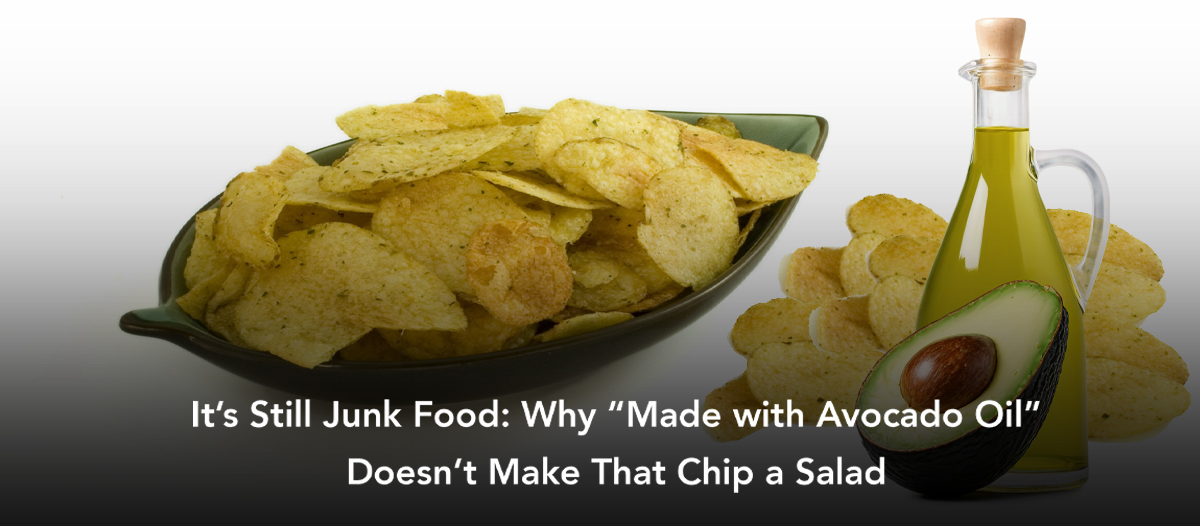
It’s Still Junk Food
Why “Made with Avocado Oil” Doesn’t Make That Chip a Salad
By Mark J Kaylor
QUICK SUMMARY
Today’s food marketing is sneakier than ever, dressing up junk food in wellness buzzwords like “keto,” “avocado oil,” and even “mushroom-powered.” But don’t be fooled. A chip is still a chip. A soda with “real sugar” is still a soda. This blog calls out the health halos and industry spin to help you cut through the hype, and reclaim the power of real food.
Let’s play a game. You’re walking through your favorite grocery store or scrolling a health food website, trying to make better choices. You spot a bag of potato chips—but wait! These aren’t just any chips. They’re “Made with Avocado Oil.” The package is earth-toned, maybe even matte-finished. The font looks hand drawn. There’s a non-GMO seal and a little heart icon telling you this snack loves you back.
You grab it, feeling a little proud. After all, you’re not buying junk food.
But here’s the truth:
It’s still junk food.
It just got a wellness makeover.
Dressing Up the Usual Suspects
This isn’t a new trick. Food companies have long been masters of disguise. In the ‘90s, we were sold “fat-free” cookies as health food, even though they were loaded with sugar and artificial thickeners. In the early 2000s, the phrase “made with whole grains” exploded on breakfast cereals so sweet they might as well have been dessert. Even gummy bears got into the game with their brief stint as a source of vitamin C.
Now it’s 2026, and the game has simply evolved.
Today, the marketing spotlight shines on buzzwords like “keto-friendly,” “adaptogen-infused,” “paleo-approved,” and “clean label.” And the industry is playing to our aspirations, not our intelligence. They know we want to feel good about what we eat, so they give us snacks that sound healthy, without making them actually be healthy.
The New Health Halo
Let’s call out a few of the modern food illusions. Because once you see them, you can’t unsee them.
Take soda “made with real cane sugar.” That sounds wholesome, right? Maybe even old-fashioned, like something your great-grandmother might have served at a summer picnic. But the metabolic effect of cane sugar isn’t significantly different from high fructose corn syrup. It’s still a direct hit to your blood sugar, your liver, and your energy levels, just with a prettier origin story.
Or look at mushroom coffee. As someone who deeply loves mushrooms for their healing properties, this one stings a little. But let’s be honest: that splash of Lion’s Mane in your canned cold brew? If it’s under 500 mg (and it usually is), it’s not doing much. It’s more like a prop in the background of a wellness scene. You’d be better off adding some real mushroom extract to your morning routine, and skipping the sugar-laced “elixir” altogether.
Then there’s collagen in candy bars, probiotics in chips, and turmeric in soda. Just enough to make the label glow, but not enough to make a meaningful difference.
- Avocado Oil Potato Chips
Still deep fried. Still salty. Still a processed potato. Just made with a pricier oil. - Keto Cookies
Often full of processed starches, erythritol, and fiber isolates. Just because it won’t spike your blood sugar doesn’t mean it nurtures your health. - Protein Ice Cream
High-protein doesn’t cancel out the fact that it’s still a frozen dessert full of gums, isolates, and flavorings. - Collagen Gummies, Probiotic Chips, Adaptogen Soda
Same story. Trace amounts of trendy ingredients, nowhere near therapeutic levels, just enough to earn a buzzword on the label.
Call it what it is: aspirational junk food.
A Chip by Any Other Name
The core problem isn’t the ingredient swap. Avocado oil is certainly a better choice than hydrogenated soybean oil. Natural sweeteners like coconut sugar or date syrup are marginally better than high fructose corn syrup. But when the rest of the product is still ultra-processed, refined, and engineered for overconsumption, these tweaks are like putting a compostable bow on a sugar bomb.
Junk food is defined not just by what it contains, but by what it lacks. Fiber. Nutrients. Life force. Any resemblance to something grown or harvested from nature. It’s food that’s been broken down, remixed, sweetened, dyed, flavored, and fluffed until it’s more chemistry than cuisine.
Swapping in a trendy oil or a sprinkling of mushrooms doesn’t change the basic math. That snack still spikes your blood sugar, disrupts your hunger cues, and leaves you hungrier than when you started. It’s still engineered to be addictive, not nourishing. It’s still junk food.
The Illusion of Wellness
What makes this all more insidious is the illusion of wellness. Food companies know we want to feel like we’re making smarter choices. So they give us permission. “Yes, you deserve a treat,” the packaging says. “You’re taking care of yourself. Look at you, buying the chip with the omega-3s!”
But real change, real nourishment, doesn’t come from choosing a marginally better version of the same processed foods. It comes from shifting how we eat, not just what we eat. It comes from returning to whole, vibrant foods. From cooking. From slowing down. From reclaiming our food system from a marketing machine that thinks we’re too distracted to notice the difference between healing and hype.
How Much Is Enough to Matter?
Let’s get real. If a product brags that it’s “made with” an amazing health booster, here are the questions to ask:
- How much is in there? If it doesn’t list a milligram or percentage, it’s probably not much.
- Is it the active part of the plant or extract? Whole mushrooms are great, but therapeutic extracts are often what studies are based on.
- Does the rest of the product undo the benefit? If your soda has Reishi and 25g of sugar, guess which one your liver will notice first?
Keep This in Mind When You Shop
Michael Pollan, as always, put it perfectly:
“Don’t eat anything that claims to be healthy on the front of the package.”
It’s a simple rule, but it slices through a mountain of hype. If a food needs to convince you it’s healthy, chances are… it’s not.
Because truly nourishing food doesn’t brag. It doesn’t need to.
Reclaiming Real Food
There’s nothing wrong with the occasional indulgence. But don’t let a trendy label make the decision for you.
Instead, let’s come back to basics:
- Eat foods with simple ingredients you recognize
- Shop the perimeter, not the processed center aisles
- Support brands that prioritize transparency and substance over spin
- And remember: Real food doesn’t need to be fortified—it’s already complete.
Supplements by Marketers, Not Healers
Before we wrap this up, let’s step briefly beyond the grocery aisle.
Because it’s not just food products getting dressed up in wellness language. Supplements are getting the same marketing makeover.
More and more, what ends up in capsules, powders, and elixirs isn’t the result of careful formulation by experienced herbalists, clinicians, or health experts. Instead, it’s designed by marketing departments chasing trends. If an ingredient is trending on social media or riding the wave of a few buzzy studies, chances are you’ll see it plastered across the next wave of product labels, whether it belongs there or not.
The result?
Supplements that are more about optics than outcomes.
You get formulas that are overloaded with too many ingredients (so the label looks impressive), underdosed (so costs stay low), and poorly combined (so there’s no synergy or strategy). Some include hot herbs or nutrients that conflict with one another or dilute each other’s effects. Others are so stuffed with what’s popular that they forget to ask what’s necessary or effective.
This health-by-hype approach may sell product, but it doesn’t serve people.
True supplement formulation is an art and a science. It requires deep knowledge of biochemistry, physiology, herb energetics, and how nutrients interact in the body. It takes intention, restraint, and respect, not just for ingredients, but for the people taking them.
If a supplement’s main appeal is the font on the label, the influencer who’s promoting it, or the fact that it contains every trendy plant under the sun (in fairy dust amounts) … step back and ask:
Was this made for healing, or for headlines?
A Radiant Reminder
The path to radiant health doesn’t need a flashy label or a buzzy trend. In fact, it probably won’t have one. It’s built on whole foods. Simple meals. Real ingredients. And the kind of nourishment that marketing departments can’t fake.
Real nourishment doesn’t come from a clever slogan or trendy ingredient. It comes from whole, vibrant foods that fuel life, healing, and longevity.
Let the marketers keep spinning.
We’ll keep choosing truth.
Because on the Journey to Radiant Health, we know better.
So the next time you see a “healthified” snack that feels a little too good to be true, just smile and remember:
It’s still junk food. And you deserve better.
KEY TAKEAWAYS
- Food companies have a long history of using trendy health claims to rebrand junk food.
- Swapping one ingredient (like sugar for agave) doesn’t make ultra-processed food healthy.
- “Made with” doesn’t mean meaningful. Many hot ingredients are added in tiny, ineffective amounts.
- Real food doesn’t need a marketing team.
- Radiant health is built on real food: whole, vibrant, and alive with the nourishment that no health claim can replicate.

Mark J. Kaylor is a passionate advocate for holistic health and natural remedies, with a focus on extending both lifespan and healthspan. As the founder of the Radiant Health Project and host of Radiant Health Podcast, Mark blends in-depth research with traditional wisdom to empower others on their journey to vibrant health. Through his writing and speaking, he shares insights into the transformative power of herbs, nutrition, and lifestyle practices.
The Radiant Health Project is a not-for-profit initiative dedicated to cutting through wellness industry hype and sharing evidence-informed, traditional wisdom for genuine health.
Disclaimer: All information and results stated here is for educational and entertainment purposes only. The information mentioned here is not specific medical advice for any individual and is not intended to be used for self-diagnosis or treatment. This content should not substitute medical advice from a health professional. Always consult your health practitioner regarding any health or medical conditions.
Leave A Comment