


Worth Knowing:
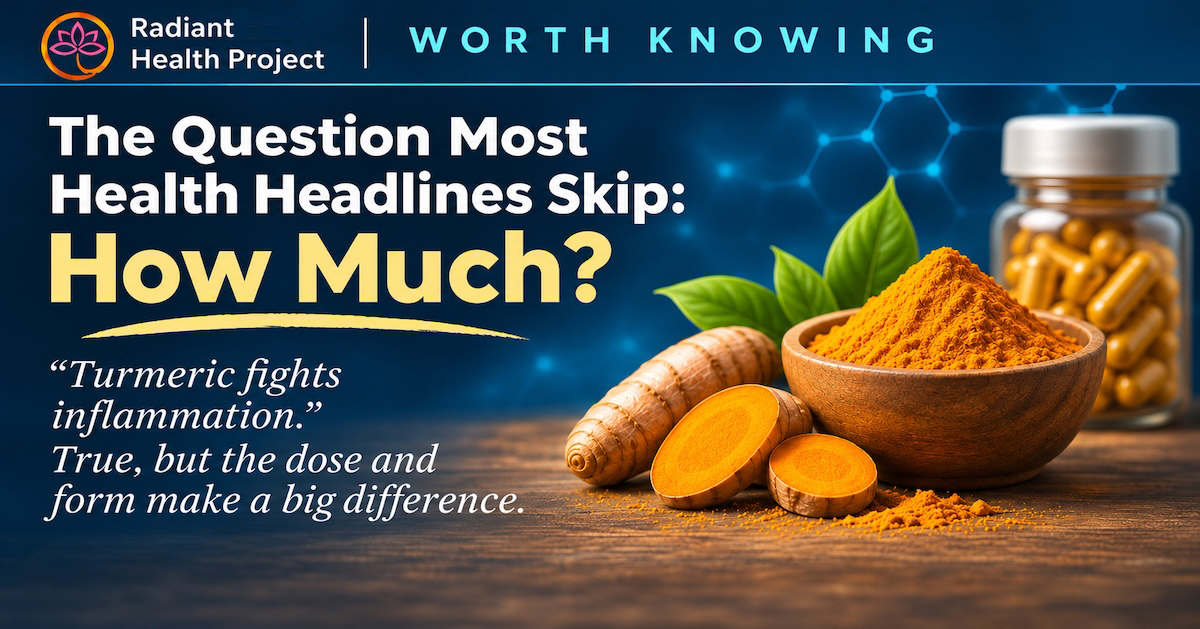
The Question Most Health Headlines Skip: How Much?
By Mark J Kaylor
“Turmeric fights inflammation.” You read it, nod, and shake a little extra into tonight’s curry. It feels like a small, smart choice, and it might be. But there’s a detail the headline left out.
Most of the research behind that claim didn’t use Turmeric the spice. It used curcumin, one compound from the root, concentrated into capsules, often around 1,000 mg a day. Store-bought ground Turmeric runs roughly 1.5 to 3 percent curcumin, so a teaspoon holds about 45 to 90 mg, a small fraction of that.
That doesn’t make the spice in your kitchen pointless. Turmeric has been used daily for thousands of years, as a whole plant, often with fat and Black Pepper. And a handful of small studies using about a teaspoon of whole Turmeric a day have found shifts in inflammation and oxidative stress markers, with a fraction of the curcumin the extract trials use. The whole plant may not follow the same math as its best-known compound.
Dose isn’t the only detail that goes missing. Form matters, as Turmeric shows. So does duration: a benefit seen after twelve weeks of daily use is a different promise from one you’d feel tomorrow. And more isn’t automatically better; some things help at one amount and cause trouble at another.
So when a claim catches your eye, ask: how much, in what form, and for how long?
Five hundred years ago, Paracelsus put it simply: the dose makes the poison. It also makes the medicine.
References
1. Curcumin Content of Store-Bought Turmeric
Supports: Ground Turmeric averages roughly 1.5% curcumin, ranging up to about 3%
Tayyem RF, Heath DD, Al-Delaimy WK, Rock CL. Curcumin content of turmeric and curry powders. Nutrition and Cancer. 2006;55(2):126-131. DOI: 10.1207/s15327914nc5502_2
https://doi.org/10.1207/s15327914nc5502_2
2. Curcumin Doses Used in Clinical Trials
Supports: Extract trials for arthritis supported efficacy at about 1,000 mg of curcumin a day (note: first author is affiliated with a supplement manufacturer)
Daily JW, Yang M, Park S. Efficacy of turmeric extracts and curcumin for alleviating the symptoms of joint arthritis: a systematic review and meta-analysis of randomized clinical trials. Journal of Medicinal Food. 2016;19(8):717-729. DOI: 10.1089/jmf.2016.3705
https://doi.org/10.1089/jmf.2016.3705
3. Whole Turmeric Powder at About a Teaspoon a Day
Supports: 2 g/day of whole Turmeric powder (about 46 mg curcumin) improved glucose, lipid, oxidative stress and inflammation markers alongside metformin; small, open-label, 4-week trial in 60 men
Maithili Karpaga Selvi N, Sridhar MG, Swaminathan RP, Sripradha R. Efficacy of turmeric as adjuvant therapy in type 2 diabetic patients. Indian Journal of Clinical Biochemistry. 2015;30(2):180-186. DOI: 10.1007/s12291-014-0436-2

Mark J. Kaylor is a passionate advocate for holistic health and natural remedies, with a focus on extending both lifespan and healthspan. As the founder of the Radiant Health Project and host of Radiant Health Podcast, Mark blends in-depth research with traditional wisdom to empower others on their journey to vibrant health. Through his writing and speaking, he shares insights into the transformative power of herbs, nutrition, and lifestyle practices.
The Radiant Health Project is a not-for-profit initiative dedicated to cutting through wellness industry hype and sharing evidence-informed, traditional wisdom for genuine health.
Disclaimer: All information and results stated here is for educational and entertainment purposes only. The information mentioned here is not specific medical advice for any individual and is not intended to be used for self-diagnosis or treatment. This content should not substitute medical advice from a health professional. Always consult your health practitioner regarding any health or medical conditions.
Leave A Comment