


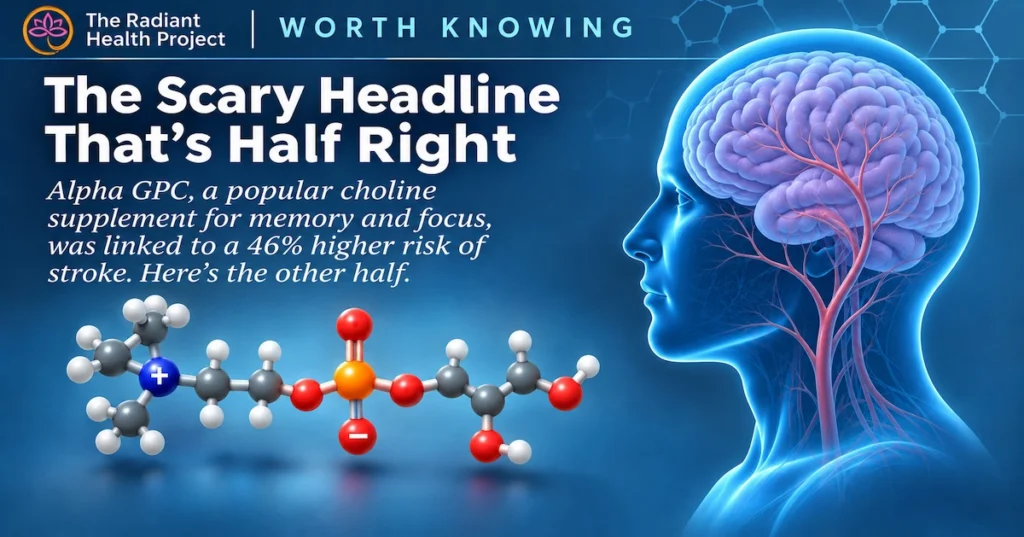
The Scary Headline That’s Half Right
By Mark J Kaylor
Maybe you saw it a few years back: Alpha GPC, a popular choline supplement for memory and focus, linked to a 46 percent higher risk of stroke. It deserves a closer look.
The finding came from a 2021 Korean study of more than 12 million adults. Alpha GPC users did have more strokes over ten years, and longer use tracked with higher risk. A mouse study suggested why: gut bacteria can turn its choline into TMAO, a compound tied to artery damage.
Here’s what the headline left out. In Korea, Alpha GPC is a prescription drug, given mostly to older adults already noticing memory changes, and early blood vessel disease is one of the things that causes those changes. Many users may have been on the road to stroke before their first capsule. When researchers set aside strokes in the first four years, the added risk shrank from 46 percent to 27 percent. And a 2025 Korean study of over 500,000 people with mild memory decline found fewer strokes among users who didn’t progress to dementia.
Both studies observe rather than test, so neither settles the question. The sensible middle: if you have high blood pressure, heart disease, or other vascular risk, or plan on high doses for years, talk it over with your practitioner. For healthy people using moderate amounts, the evidence gives no clear cause for alarm, though it hasn’t fully cleared it either.
When a number sounds frightening, ask two questions: who was studied, and why were they taking it?
References
1. The Korean Cohort Behind the 46 Percent Headline
Supports: Stroke risk among 12 million adults, the dose pattern, and the drop to 27 percent after excluding early strokes
Lee G, Choi S, Chang J, et al. Association of L-α Glycerylphosphorylcholine With Subsequent Stroke Risk After 10 Years. JAMA Netw Open. 2021;4(11):e2136008. doi:10.1001/jamanetworkopen.2021.36008
https://doi.org/10.1001/jamanetworkopen.2021.36008
2. Gut Bacteria, TMAO, and Arteries in Mice
Supports: The proposed TMAO mechanism linking Alpha GPC to artery damage
Wang Z, Hazen J, Jia X, et al. The Nutritional Supplement L-Alpha Glycerylphosphorylcholine Promotes Atherosclerosis. Int J Mol Sci. 2021;22(24):13477. doi:10.3390/ijms222413477
https://pmc.ncbi.nlm.nih.gov/articles/PMC8708068/
3. The Larger Study That Pointed the Other Way
Supports: Lower stroke risk among Alpha GPC users with mild cognitive impairment who did not progress to dementia
Kim HK, Park S, Kim SW, et al. Association Between L-α Glycerylphosphorylcholine Use and Delayed Dementia Conversion: A Nationwide Longitudinal Study in South Korea. J Prev Alzheimers Dis. 2025;12(4):100059. doi:10.1016/j.tjpad.2025.100059

Mark J. Kaylor is a passionate advocate for holistic health and natural remedies, with a focus on extending both lifespan and healthspan. As the founder of the Radiant Health Project and host of Radiant Health Podcast, Mark blends in-depth research with traditional wisdom to empower others on their journey to vibrant health. Through his writing and speaking, he shares insights into the transformative power of herbs, nutrition, and lifestyle practices.
The Radiant Health Project is a not-for-profit initiative dedicated to cutting through wellness industry hype and sharing evidence-informed, traditional wisdom for genuine health.
Disclaimer: All information and results stated here is for educational and entertainment purposes only. The information mentioned here is not specific medical advice for any individual and is not intended to be used for self-diagnosis or treatment. This content should not substitute medical advice from a health professional. Always consult your health practitioner regarding any health or medical conditions.
Leave A Comment