


Turns Out the Cleanest Part of Your Glass Bottle Is the Glass
By Mark J Kaylor
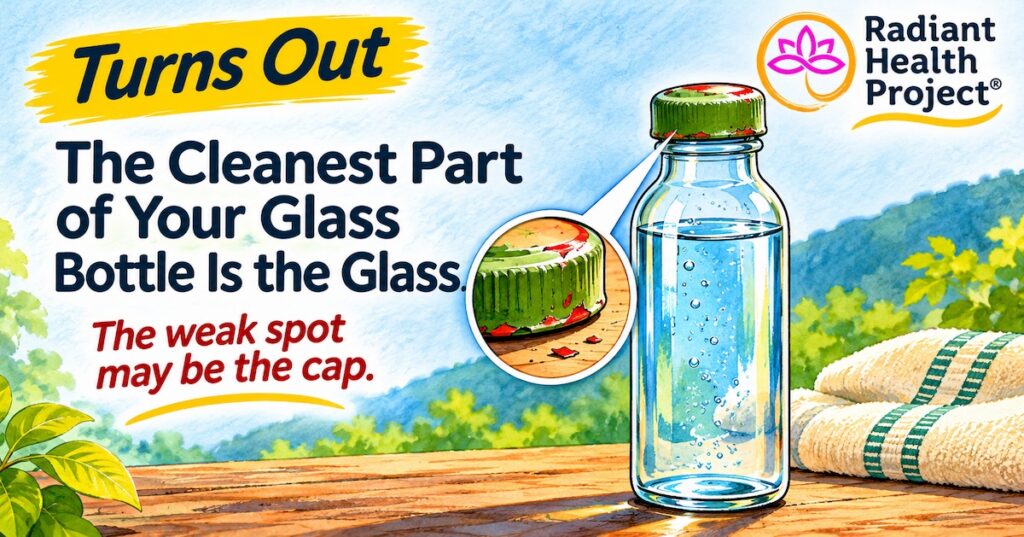
Turns out choosing glass over plastic may not keep plastic out of your drink, at least not when the bottle wears a painted metal cap.
When France’s food safety agency tested water, sodas, lemonade, iced tea, beer and wine, the researchers expected glass to come out cleanest. It didn’t. Glass-bottled sodas, lemonades, iced teas and beers averaged around 100 microplastic particles per liter, roughly 5 to 50 times more than the same drinks in plastic bottles or cans.
The particles matched the paint on the outside of the caps in color, shape and type of plastic. Tiny scratches, likely from caps rubbing together in storage, seem to release flakes that end up in the drink. Water stayed low across the board: about 4.5 particles per liter in glass and 1.6 in plastic.
Two things belong alongside this. The study counted larger microplastics, not the far smaller nanoplastics that other research finds in plastic-bottled water in the hundreds of thousands per liter. And just cleaning the caps before bottling cut contamination by more than half.
So glass still earns its place on the shelf. The weak spot is the lid.
Turns out the cleanest part of your glass bottle is the glass.
References
1. Glass-bottled drinks carry more microplastics, traced to cap paint
Supports: particle counts by drink and container, cap-paint source, cap-cleaning reduction
Chaïb, I., et al. (2025). Microplastic contaminations in a set of beverages sold in France. Journal of Food Composition and Analysis, 107719.
https://doi.org/10.1016/j.jfca.2025.107719
2. Plastic-bottled water holds hundreds of thousands of nanoplastic particles per liter
Supports: the nanoplastic caveat
Qian, N., Gao, X., Lang, X., et al. (2024). Rapid single-particle chemical imaging of nanoplastics by SRS microscopy. Proceedings of the National Academy of Sciences, 121(3), e2300582121.

Mark J. Kaylor is a passionate advocate for holistic health and natural remedies, with a focus on extending both lifespan and healthspan. As the founder of the Radiant Health Project and host of Radiant Health Podcast, Mark blends in-depth research with traditional wisdom to empower others on their journey to vibrant health. Through his writing and speaking, he shares insights into the transformative power of herbs, nutrition, and lifestyle practices.
The Radiant Health Project is a not-for-profit initiative dedicated to cutting through wellness industry hype and sharing evidence-informed, traditional wisdom for genuine health.
Disclaimer: All information and results stated here is for educational and entertainment purposes only. The information mentioned here is not specific medical advice for any individual and is not intended to be used for self-diagnosis or treatment. This content should not substitute medical advice from a health professional. Always consult your health practitioner regarding any health or medical conditions.
Leave A Comment