


Turns Out Intermittent Fasting’s Best Trick Is the Closed Kitchen
By Mark J Kaylor
Turns out much of intermittent fasting’s success comes down to something simple: a shorter eating window usually means eating less.
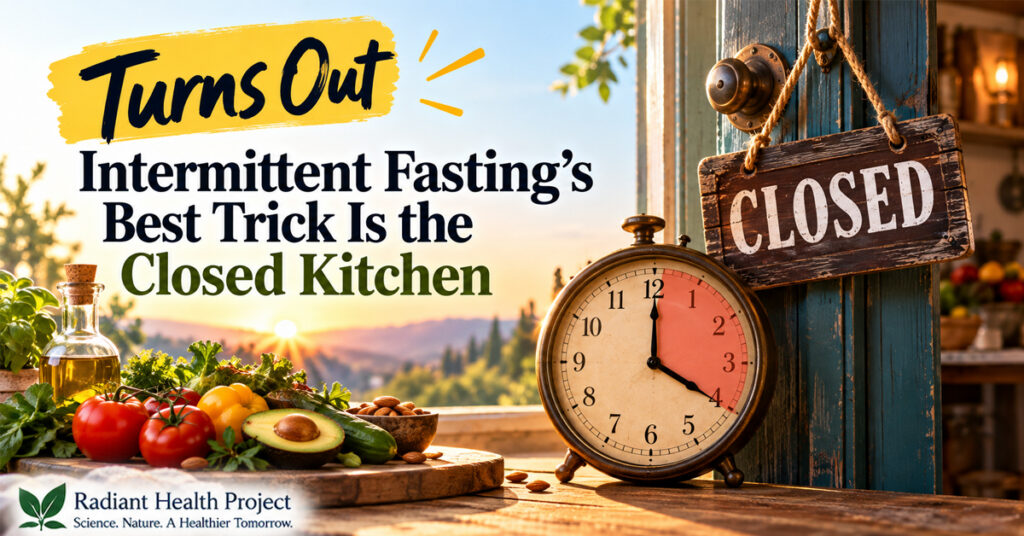
In a year-long trial published in the New England Journal of Medicine, researchers in China randomly assigned 139 adults with obesity to one of two plans. Both groups followed the same daily calorie target. One group also ate only between 8 a.m. and 4 p.m.
After 12 months, the time-restricted group had lost about 17.6 pounds on average, and the calorie-only group about 13.9. That gap wasn’t statistically significant, and the groups looked similar on body fat, blood pressure, and metabolic markers. The authors concluded that eating fewer calories explained most of the benefit.
That’s good news if fasting suits you. “The kitchen closes at four” is a simple rule, and simple rules are easier to keep than counting every bite. The clock is a useful tool. It just doesn’t seem to have much extra magic of its own.
The trial was too small to rule out a modest extra benefit, so the question isn’t fully closed.
Turns out the best part of fasting may be the “closed” sign.
Reference: Liu D, Huang Y, Huang C, et al. Calorie restriction with or without time-restricted eating in weight loss. New England Journal of Medicine. 2022;386(16):1495-1504.

Mark J. Kaylor is a passionate advocate for holistic health and natural remedies, with a focus on extending both lifespan and healthspan. As the founder of the Radiant Health Project and host of Radiant Health Podcast, Mark blends in-depth research with traditional wisdom to empower others on their journey to vibrant health. Through his writing and speaking, he shares insights into the transformative power of herbs, nutrition, and lifestyle practices.
The Radiant Health Project is a not-for-profit initiative dedicated to cutting through wellness industry hype and sharing evidence-informed, traditional wisdom for genuine health.
Disclaimer: All information and results stated here is for educational and entertainment purposes only. The information mentioned here is not specific medical advice for any individual and is not intended to be used for self-diagnosis or treatment. This content should not substitute medical advice from a health professional. Always consult your health practitioner regarding any health or medical conditions.
Leave A Comment