


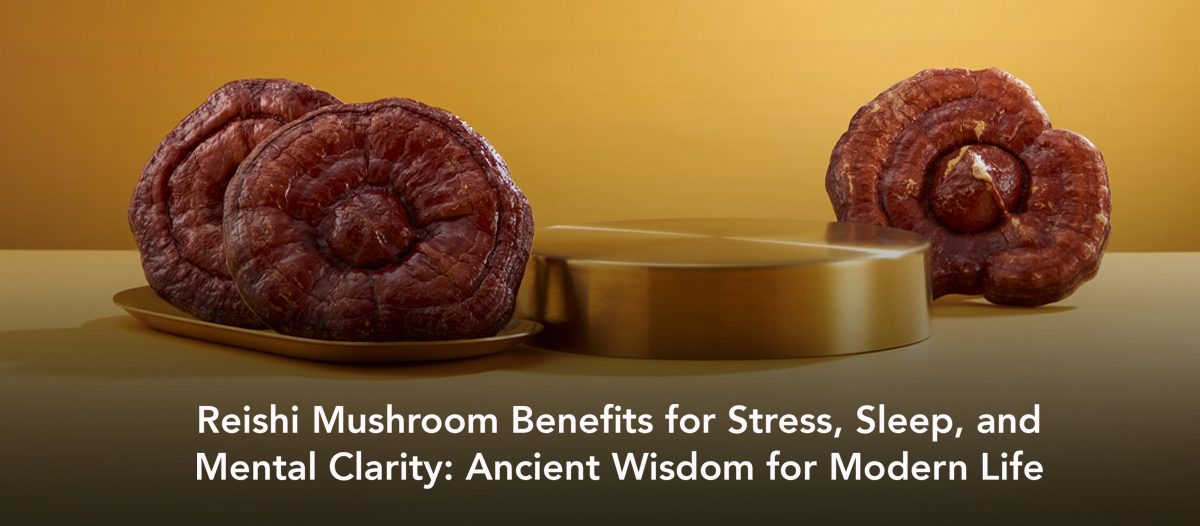
Reishi Mushroom Benefits for Stress, Sleep, and Mental Clarity: Ancient Wisdom for Modern Life
Quick Summary
Reishi, or *Lingzhi*, has long been revered in traditional Chinese medicine as the ultimate Shen tonic — the “mushroom of spiritual potency.” This piece explores what Shen truly means: the radiant spirit that animates our consciousness, emotion, and purpose. It delves into the Three Treasures (Jing, Qi, and Shen), explains how modern stressors disturb Shen, and highlights how Reishi was historically used to calm, center, and illuminate the mind and heart. Drawing on both classical wisdom and emerging research, it shows how Reishi helps harmonize the nervous system, support emotional balance, and promote restful sleep. Beyond supplementation, it calls for a holistic approach — living in alignment with the practices that cultivate inner peace, connection, and radiant health.
Reishi Mushroom Benefits for Stress, Sleep, and Mental Clarity: Ancient Wisdom for Modern Life
by Mark J Kaylor
You know that feeling when you’re going through the motions of life but something essential feels… off? Like your body’s fine but your soul feels jet-lagged. Maybe you’re eating well, exercising, checking all the wellness boxes, but you still feel scattered, anxious, or just not quite yourself. There’s this sense that something deeper needs attention, but you can’t quite put your finger on it.
Ancient Chinese medicine had a name for what might be slipping away: Shen. And for over two thousand years, one remedy stood above all others for nourishing it: Reishi mushroom, known in China as Lingzhi, the “mushroom of immortality.”
Before we get lost in the supplement hype and marketing claims flooding the wellness world today, let’s explore what traditional medicine actually understood about Shen and why cultivating it was considered the foundation of radiant health.
Understanding Shen: The Spirit That Animates Us
In traditional Chinese medicine, Shen is often translated as “spirit” or “mind,” but honestly, these translations don’t do justice to this rich concept. Think of Shen as the animating force behind your consciousness itself. It’s the light in your eyes when you’re truly present, the clarity you feel when your mind is sharp, the emotional steadiness that lets you ride life’s waves without capsizing.
The Three Treasures: Jing, Qi, and Shen
To really get what Shen is about, we need to understand where it fits in the bigger picture. Traditional Chinese medicine talks about the Three Treasures (“San Bao”), which are basically the fundamental forces that make us, well, us:
Jing (Essence): Think of this as your inherited vitality, the reserves you got from your parents. It’s like your biological savings account that you slowly spend throughout life. Jing is tied to reproduction, growth, and aging. When you’re young, you’ve got plenty. As you age, it naturally depletes. It’s stored in the kidneys and represents the densest, most physical aspect of the Three Treasures.
Qi (Vital Energy): This is the day-to-day energy that keeps you going. It’s more dynamic than Jing and flows throughout your body, powering everything you do. You build Qi through breathing, eating well, and living in balance. You know that feeling when you’re energized and things just flow? That’s good Qi. When you’re exhausted or sick? Your Qi is running low or getting stuck.
Shen (Spirit): This is the most refined of the three. Here’s the key thing: Shen emerges when Jing and Qi are transformed and refined. You can’t have strong, stable Shen if your foundation (Jing) is depleted or your daily energy (Qi) is a mess. This is why traditional physicians insisted that you can’t just meditate your way to spiritual health if you’re exhausted and running on empty.
These three work together like a ladder. Jing is the foundation, Qi is the energy that flows through your days, and Shen is the consciousness that emerges from it all. When they’re all balanced and abundant, you experience what the ancients called radiant health: that elusive state where you feel physically strong, mentally clear, emotionally stable, and spiritually connected.
This framework helps us see why you can’t just treat the mind or spirit in isolation. True emotional and spiritual wellbeing needs a solid physical foundation. It’s all connected.
Signs of Strong Shen
So what does it actually feel like when your Shen is strong? Think of it as having a skilled conductor leading your inner orchestra. When your Shen is balanced, you might notice:
– Your mind is clear and focused, but you’re not wired or anxious.
– You can feel your emotions fully without getting swept away by them.
– There’s a sense of purpose, like you’re connected to something bigger than your daily to-do list.
– Sleep comes easily and your dreams feel meaningful rather than chaotic.
– Stress happens, but you bounce back without getting stuck in overwhelm.
– People seem drawn to you; there’s a natural presence or ease about you.
Traditional physicians recognized that Shen lived in the heart and depended on good quality blood and Qi flowing through. But Shen wasn’t just about physiology. It was about the integration of everything: body, mind, and spirit working as one harmonious whole.
When Shen Becomes Disturbed: The Cost of Imbalance
Here’s what’s fascinating: ancient physicians understood that even in their time, life could scatter and weaken Shen. Too much worry, chronic stress, emotional trauma, not enough sleep, being disconnected from nature — all of these were recognized as threats to Shen. Sound familiar? The symptoms they described could’ve been written yesterday:
– That anxious, restless feeling where your mind just won’t shut up.
– Tossing and turning at night, or waking up from weird, unsettling dreams.
– Forgetting things constantly and struggling to focus.
– Emotions all over the place, or worse, feeling numb and disconnected.
– A sense that life feels meaningless or empty.
– Physical symptoms like heart palpitations or that fluttery feeling in your chest.
The ancients understood something we’re only now rediscovering: when Shen is disturbed, everything suffers. You can meal prep like a champion and hit the gym every day, but if your Shen isn’t nourished, true vitality stays out of reach. This insight — that mental, emotional, and spiritual health can’t be separated from physical health — might be one of traditional medicine’s greatest gifts to our modern world.
Reishi: The Premier Shen Tonic
So here’s where Reishi comes in. In classical Chinese texts, it’s called *Lingzhi*, which literally means “spiritual potency” or “divine mushroom.” For thousands of years, this woody mushroom that grows on decaying hardwood trees was so highly prized that it showed up in ancient art as a symbol of longevity, wisdom, and spiritual enlightenment. Taoist monks reportedly used it during meditation, and it was mostly reserved for emperors and spiritual teachers.
The Traditional Understanding
The “Shennong Ben Cao Jing” (“Divine Farmer’s Classic of Materia Medica”, ca. 200 CE) placed Reishi among the “superior herbs”— those safe for long-term use, meant not to treat symptoms but to cultivate life itself. It was praised for “calming the spirit, nourishing the heart, easing the mind, and strengthening wisdom and memory.” Physicians prescribed it to quiet the overactive mind, promote restful sleep, enhance clarity, build emotional resilience, and support meditation and longevity.
These weren’t your typical medicine cabinet remedies. They had special qualities:
- Safe to take long-term without side effects
- They nourished and supported life rather than just attacking symptoms
- They worked gently, building effects over time
- They supported your body’s own wisdom rather than forcing changes
Reishi was specifically praised for “calming the spirit,” “nourishing the heart,” “easing the mind,” and boosting wisdom and memory. Physicians back then would prescribe it for:
- Quieting an overactive, worried mind
- Supporting deep, restful sleep with meaningful dreams
- Sharpening memory and mental clarity
- Building emotional resilience so life’s ups and downs don’t knock you over
- Supporting meditation and spiritual practices
- Promoting longevity and aging with grace
Reishi wasn’t a quick fix. Traditional physicians knew it worked subtly and cumulatively, harmonizing rather than forcing change. It was something to integrate into daily life — to cultivate balance, patience, and presence over time.
Bridging Ancient Wisdom and Modern Science
Today, modern science is catching up to what Taoist healers intuited centuries ago. Research shows Reishi’s triterpenes and polysaccharides can modulate the nervous system, regulate stress hormones, and improve sleep quality — the physiological side of a calm Shen. Studies indicate it supports healthy cortisol rhythms, enhances parasympathetic activity (the rest-and-digest response), and may even promote neurogenesis and antioxidant protection in the brain.
Scientists have identified several compounds in Reishi that might explain why it worked the way ancient physicians said it did:
Triterpenes: These show anti-inflammatory and calming properties in studies. There’s some evidence they might help modulate stress response and support healthy cortisol rhythms, though honestly, a lot of this research is still in early stages.
Polysaccharides: The beta-glucans and other complex sugars in Reishi appear to support immune function and might protect brain cells, at least according to lab studies.
Antioxidants: Reishi’s got various compounds that help neutralize oxidative stress, which we’re increasingly seeing plays a role in both physical illness and mental health struggles.
Today, research is actually backing up many of these ancient insights. Studies show Reishi’s compounds can modulate the nervous system, help regulate stress hormones, and improve sleep quality (basically, the physiological side of a calm Shen). Its anti-inflammatory and adaptogenic effects help balance the HPA axis (that’s your stress response system), supporting the kind of resilience the ancients called “inner harmony.” Research also shows it enhances parasympathetic tone, which is that “rest-and-digest” state where your body can actually heal and your emotions stabilize.
What the research suggests Reishi might support:
- Better stress response and nervous system regulation
- Improved sleep quality for some people
- More balanced immune function
- Healthy inflammatory response
- Stronger antioxidant defenses
- Better HPA axis and cortisol balance
- More parasympathetic nervous system activity
A 2012 study in “Phytotherapy Research” found Reishi triterpenes supported cortisol balance and improved sleep quality. A 2021 review in “Frontiers in Pharmacology” highlighted its neuroprotective and adaptogenic effects, noting potential benefits for mood and cognition.
Of course, much of this research is still early — many studies are preclinical or small-scale. But the overlap between traditional insight and emerging evidence is striking. Reishi appears to do biochemically what Shen tonics were always meant to do energetically: restore harmony between body, mind, and spirit.
A Practical Approach to Reishi as a Shen Tonic
So let’s say you’re interested in trying Reishi to support emotional balance, mental clarity, and overall well-being. Here’s how to approach it with quality in mind:
Quality Matters Enormously
Not all Reishi products are created equal, and honestly, the market is a bit of a mess. You’ve got everything from high-quality extracts to basically sawdust in a capsule. Many products use “myceliated grain” (mushroom grown on grain) instead of actual fruiting bodies, or they’re using cheap extracts with barely any active compounds.
Here’s what to look for:
- Products using actual fruiting body extracts, not myceliated grain
- Dual extraction (hot water for polysaccharides, alcohol for triterpenes)
- Third-party testing showing what’s actually in there
- Companies that are transparent about where it comes from and how they process it
Red flags to watch out for:
- Super cheap products (good Reishi extraction takes work and money)
- Wild claims about curing diseases (if it sounds too good to be true…)
- Vague about what part of the mushroom they’re using
- No information about extraction methods or what compounds are actually present
Traditional Preparation
The classic method — simmering dried Reishi slices into a tea or combining with alcohol extraction — was as much ritual as remedy. The process itself can become a meditative act, gently reconnecting us to slowness and intention.
Integration, Not Isolation
Reishi works best when part of a holistic approach: meditation, adequate sleep, nature connection, creativity, community, and movement. True Shen nourishment asks that we live with presence, not just supplement it.
Realistic Expectations
Reishi acts gradually. Over weeks or months, people often notice calmer thoughts, deeper sleep, smoother emotional recovery, and subtle yet profound shifts in inner peace. It’s tonic medicine in the truest sense.
The Commercialization Concern
The explosion of the “medicinal mushroom” industry has brought both visibility and distortion. Wild Reishi is overharvested, low-quality products flood the market, and ancient wisdom gets reduced to marketing soundbites. This rush for profit risks diluting both the medicine and the message.
We can — and must — do better. Supporting sustainable cultivation, ethical sourcing, and authentic education honors both the fungi and the lineage it came from.
Cultivating Radiant Health: The Shen Perspective
Take a breath and notice: where does your Shen feel today — scattered, dim, or steady and luminous? In the Radiant Health tradition, cultivating Shen isn’t a luxury; it’s how vitality, meaning, and harmony return to their rightful place at the center of health.
Nourishing Shen means caring for your inner life with as much attention as your diet or exercise routine. A calm mind, an open heart, emotional resilience, and a sense of meaning aren’t luxuries — they’re the foundation of genuine health and vitality. Reishi, used wisely and with patience, can support this process, but its true gift lies in reminding us that balance is cultivated, not consumed.
A Final Word on Authenticity
If you explore Reishi, bring both openness and discernment to the journey. Listen to your own experience rather than marketing hype. Give it time to work in that subtle, cumulative way traditional medicine understood. And remember, no single substance, no matter how revered by the ancients, can replace the fundamental practices that actually nourish your spirit: good rest, real connections with people who matter, time in nature, creative expression, and living with intention and compassion.
The ancients treasured Reishi not because it was a quick fix or miracle cure. They valued it because it supported the patient cultivation of the qualities that actually make life worth living: clarity, balance, resilience, and that mysterious radiance we call Shen.
*To nourish Shen is to remember who we truly are — luminous beings learning how to live in balance once again.
Key Takeaways:
– Shen represents the radiant spirit — our consciousness, presence, and inner peace.
– The Three Treasures (Jing, Qi, Shen) work together; balanced Shen reflects strong essence and energy.
– Modern stress, disconnection, and depletion scatter Shen, leading to anxiety, restlessness, and imbalance.
– Reishi (Lingzhi) was revered as the supreme Shen tonic, calming the spirit, nourishing the heart, and promoting clarity.
– Scientific studies suggest Reishi supports stress regulation, sleep, mood, and nervous system balance.
– Quality and integrity in sourcing and extraction are crucial — seek fruiting body dual-extracts from trusted, transparent brands.
– Nourishing Shen isn’t only about herbs — it’s a way of living in harmony: resting deeply, connecting with nature, creating, loving, and cultivating presence.

Mark J. Kaylor is a passionate advocate for holistic health and natural remedies, with a focus on extending both lifespan and healthspan. As the founder of the Radiant Health Project and host of Radiant Health Podcast, Mark blends in-depth research with traditional wisdom to empower others on their journey to vibrant health. Through his writing and speaking, he shares insights into the transformative power of herbs, nutrition, and lifestyle practices.
Disclaimer: All information and results stated here is for educational and entertainment purposes only. The information mentioned here is not specific medical advice for any individual and is not intended to be used for self-diagnosis or treatment. This content should not substitute medical advice from a health professional. Always consult your health practitioner regarding any health or medical conditions.