


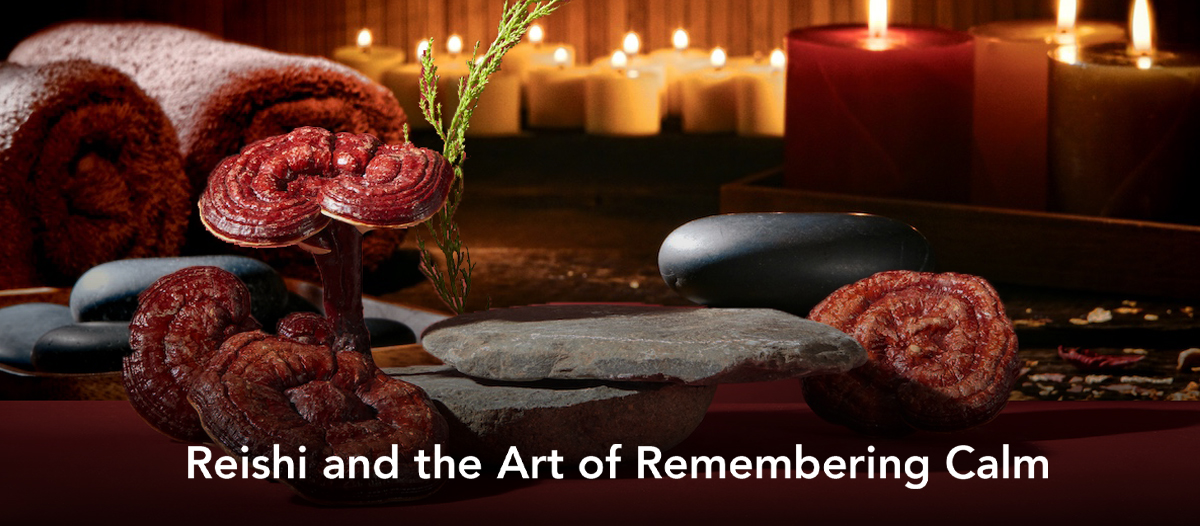
Reishi and the Art of Remembering Calm
Quick Summary
Reishi, known for centuries as the Mushroom of Immortality and the “Herb of Spiritual Potency,” is more than an immune tonic. In both ancient tradition and modern research, Reishi emerges as a bridge between body and spirit, a harmonizer that quiets inflammation, restores nervous system balance, supports immune intelligence, and helps the heart remember its natural calm.
Reishi and the Art of Remembering Calm
by Mark J Kaylor
The Still Point
There’s a kind of quiet the world rarely gives us anymore.
A deep, unhurried calm that doesn’t come from escape, but from balance, the kind of stillness Reishi has been teaching for over two thousand years.
In the classical texts of Traditional Chinese Medicine, Lingzhi was revered as the herb of spiritual restoration, a Shen tonic that steadies the heart, clarifies the mind, and reconnects us to our inherent vitality. It was said to bring a person into harmony with Heaven and Earth, an herbal expression of balance itself.
The Unsettled Heart
Many of us live in survival mode, running on stress chemistry and stimulation.
Our systems adapt, but not without cost; sleep grows shallow, patience thins, the heart feels guarded.
Traditional Chinese Medicine recognized this state long ago: when the Heart becomes overheated or depleted, the Shen, the spirit that governs consciousness, clarity, and emotional equilibrium, flickers.
Reishi, they taught, nourishes the Shen. It doesn’t stimulate energy; it stabilizes it. It helps the spirit return home.
Where Ancient Wisdom Meets Modern Science
Modern research now echoes what ancient physicians intuited.
Reishi (Ganoderma lucidum) is a complex pharmacopeia within a single organism, containing over 400 identified bioactive compounds, including triterpenes, polysaccharides, beta-glucans, sterols, and peptides, each contributing to its broad spectrum of effects.
Stress and Sleep Regulation
- Triterpenes found in Reishi modulate the hypothalamic-pituitary-adrenal (HPA) axis, helping regulate cortisol output and blunt the physiological stress response.
- In animal studies and small human trials, Reishi extracts improved sleep quality and reduced time to fall asleep, likely through gentle GABAergic modulation and autonomic nervous system balancing.
Inflammation and Immune Intelligence
- Reishi’s beta-glucans and polysaccharides act as biological response modifiers, enhancing communication among macrophages, dendritic cells, NK cells, and T-cells.
- Yet, unlike stimulants, they normalize cytokine activity rather than indiscriminately boost it. This dual modulation explains its reputation as both an immune activator and harmonizer.
- Triterpenoids further inhibit NF-κB and COX-2 pathways, contributing to lower chronic inflammation levels, a key factor in metabolic, cardiovascular, and neurodegenerative health.
Neuroprotection and Emotional Balance
- Experimental studies suggest Reishi polysaccharides and triterpenes protect neurons from oxidative and excitotoxic stress, promote neurogenesis, and enhance antioxidant enzyme activity.
- A 2021 study in Frontiers in Pharmacology found that Reishi extract reduced depressive-like behavior and normalized neuroinflammatory markers in mice subjected to chronic stress.
- These effects align perfectly with its Shen-tonic role: quieting internal turbulence, restoring clear awareness.
Metabolic and Cardiovascular Support
- Reishi’s compounds have been shown to help maintain healthy cholesterol ratios, support liver detoxification pathways, and enhance endothelial function.
- These systemic effects reinforce the body’s ability to maintain homeostasis, what TCM calls the balance between Yin and Yang.
The Medicine of Remembering
What if calm isn’t something to achieve but to remember?
What if vitality comes not from pushing harder, but from aligning with rhythms your body already knows?
Reishi doesn’t force peace, it reminds the system how to find it again.
It’s a mushroom that whispers, not shouts.
When taken consistently, it helps the nervous system unlearn urgency, allowing energy to move smoothly and the heart-mind connection to rekindle. The result isn’t sedation, but coherence, a deep, embodied calm that feels both grounded and awake.
Working with Reishi
Reishi works best over time; it is, after all, a teacher of patience.
- Form: Choose a dual-extracted (hot water and alcohol) supplement made from the fruiting body, not mycelium grown on grain. This ensures the full triterpene and polysaccharide profile.
- Timing: My personal preference is towards the end of your day when winding down, and then again at bedtime.
- Consistency: Its effects are cumulative, often subtle at first, deepening with weeks of use.
- Dosage recommendations: Typical dosage range (e.g., 1-3 grams dried mushroom equivalent, or 300-600mg extract)
- Important Drug Interactions:While Reishi is generally well-tolerated by most people, it’s essential to understand potential risks and interactions before use. Reishi may increase the risk of bleeding when taken with anticoagulant or antiplatelet medications. Avoid using if taking immunosuppressant medications, Reishi’s immune-stimulating properties may counteract the intended effects of treatment.
- Fruiting body vs. mycelium on grain:Authentic Reishi supplements use the mushroom’s fruiting body (the actual mushroom), which typically contains 30-40% beta-glucans. In contrast, some products use mycelium grown on grain substrates (rice or oats), which cannot be separated from the grain during processing, resulting in products that are 35-40% starch with only 5-7% beta-glucans, sometimes as low as zero. Traditional use over thousands of years has always involved fruiting bodies grown on wood, where the mushroom must develop higher concentrations of medicinal compounds like beta-glucans, triterpenes, and sterols as natural defense mechanisms. Look for products labeled “fruiting body” or “fruited body” with verified beta-glucan content, and avoid vague terms like “mycelium biomass,” or “myceliated grain.”
Pairing Reishi with reflective practices, breathwork, gratitude journaling, and stillness, strengthens its Shen-tonic effects. It’s not just chemistry; it’s communion.
Radiant Stillness
There is a kind of quiet that does not come from escape. It arrives when the body feels safe, the mind loosens its grip, and the heart remembers how to shine. Reishi tends to this remembering. It does not push or numb. It escorts you back to a steadier rhythm where energy flows cleanly and the spirit is clear.
If you sit with Reishi over time, the changes are often subtle at first. Sleep has a little more depth. Edges soften. Reactions become responses. The immune system feels less like a guard on high alert and more like a wise sentinel that knows when to act and when to rest. This is not sedation. It is coherence. It is the felt sense that your system is working with itself again.
Let Reishi be part of a larger devotion to calm: unhurried meals, a few honest breaths before you speak, a short walk without your phone, five quiet minutes in the evening to notice what the day left behind. These simple acts amplify what Reishi teaches. They make space for the light of Shen to show through the ordinary moments of a life.
May your days gather that light. May you grow familiar with the stillness that remains when you stop trying to earn your own wholeness. And may Reishi be a faithful companion as you remember what radiant health feels like from the inside out.
Reishi Reflection
The medicine of Reishi is subtle, but profound.
It asks nothing of us except to slow down long enough to listen.
In that listening, calm returns, and in calm, the light of Shen begins to shine again.
Key Takeaways
- Reishi is both grounding and elevating — it nourishes the physical body while soothing and stabilizing the Shen (spirit).
- Scientific research validates its traditional uses, showing adaptogenic, anti-inflammatory, immunomodulatory, neuroprotective, and cardiometabolic benefits.
- Reishi’s greatest medicine may be its reminder: that true vitality begins when the body and spirit remember how to move together in harmony.
- For best results: Choose fruiting body, dual-extracted preparations; take consistently; and pair with practices that cultivate stillness.
References
- Wachtel-Galor, S., & Benzie, I. F. F. (2011). Ganodermalucidum (Lingzhi or Reishi): A medicinal mushroom. In I. F. F. Benzie & S. Wachtel-Galor (Eds.), Herbal Medicine: Biomolecular and Clinical Aspects (2nd ed.). CRC Press.
Human clinical signals
- Tang W et al. Randomized, double-blind, placebo-controlled trial of a G. lucidum polysaccharide extract (Ganopoly) in adults with neurasthenia (8 weeks). Improvements in fatigue, well-being, and CGI severity vs placebo. J Med Food. 2005;8(1):53-58.
- Chen S-N et al. Randomized, double-blind, placebo-controlled trial in healthy adults: Reishi β-1,3/1,6-glucan (12 weeks) increased T-cell subsets and NK activity; well tolerated. Foods.2023;12(3):659.
Sleep / mood (mechanistic + translational)
- Yao C et al. G. lucidum mycelial acidic fraction promoted sleep in mice via gut-microbiota and serotonergic pathways. Sci Rep. 2021;11:13660. (Mechanistic, but often cited in sleep discussions.) Nature
- Li H et al. G. lucidum polysaccharides reduced depressive-like behavior in mice via Dectin-1–mediated neuroimmune modulation. Brain Res Bull. 2021. (Preclinical.) PubMed
- Qiu Y et al. Review of anti-insomnia mechanisms of Ganoderma; summarizes available RCT signals and preclinical pathways. Front Pharmacol. 2021. (Useful as a cautious umbrella source for human sleep claims.) PMC
Cardiometabolic / endothelial (supporting)
- Sargowo D et al. Review on G. lucidum polysaccharide peptide and endothelial protection/atherosclerosis (animal and mechanistic evidence). Acta Med Indones. 2017. PMC

Mark J. Kaylor is a passionate advocate for holistic health and natural remedies, with a focus on extending both lifespan and healthspan. As the founder of the Radiant Health Project and host of Radiant Health Podcast, Mark blends in-depth research with traditional wisdom to empower others on their journey to vibrant health. Through his writing and speaking, he shares insights into the transformative power of herbs, nutrition, and lifestyle practices.
Disclaimer: All information and results stated here is for educational and entertainment purposes only. The information mentioned here is not specific medical advice for any individual and is not intended to be used for self-diagnosis or treatment. This content should not substitute medical advice from a health professional. Always consult your health practitioner regarding any health or medical conditions.