


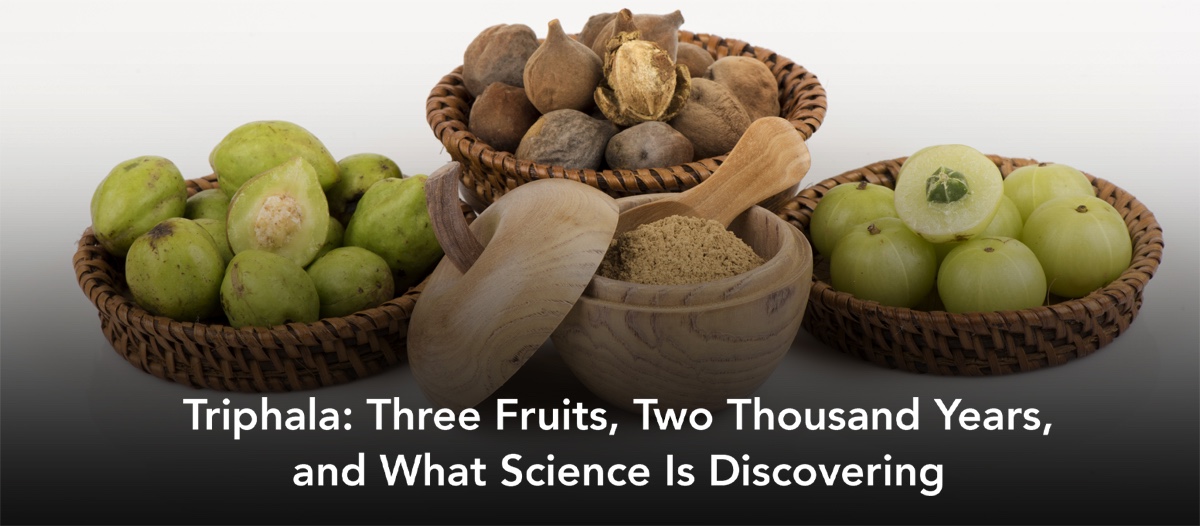
Triphala: Three Fruits, Two Thousand Years, and What Science Is Discovering
By Mark J Kaylor
One of Ayurveda’s oldest formulas is also one of its most studied. Here is what the ancient texts say, what researchers have found, and why this humble combination of three fruits may be one of the most elegant examples of holistic medicine in the world.
AT A GLANCE
• Triphala combines three dried fruits used together in Ayurveda for more than 2,500 years.
• Traditionally classified as a rasayana, meaning a deep rejuvenating tonic for the whole body.
• Modern research has validated benefits for digestion, blood sugar, cholesterol, and oral health.
• Prebiotic effects on the gut microbiome represent a major and unexpected scientific finding.
• Promising preclinical evidence for neuroprotection, eye health, immune modulation, and cancer prevention.
• Well-tolerated at standard doses; mild laxative effect is the most commonly reported side effect.
What Is Triphala?
The name says it all. Triphala is Sanskrit for “three fruits,” and for more than two and a half millennia, those three fruits have been combined into one of the most versatile and enduring formulas in the history of medicine.
The three fruits are:
Amalaki (Phyllanthus emblica, Indian gooseberry) — the cooling, nourishing fruit, rich in vitamin C and powerful antioxidants. In Ayurvedic tradition, Amalaki is considered a rasayana in its own right and has a strong affinity for Pitta, the dosha associated with heat, inflammation, and metabolism.
Bibhitaki (Terminalia bellerica) — the astringent, drying fruit associated with clearing Kapha, the dosha linked to heaviness, congestion, and accumulation. It supports the respiratory tract and is known in classical texts for strengthening the lungs and voice.
Haritaki (Terminalia chebula) — the warming, toning fruit considered “the king of medicines” in Tibetan medicine. Its primary affinity is for Vata, the dosha governing movement and elimination. Haritaki is especially revered for its action on the colon.
Together, these three fruits are believed to harmonize all three of Ayurveda’s biological forces simultaneously, making Triphala what practitioners call tridoshic, meaning it is balancing for every constitutional type. This quality is exceptional even within Ayurvedic medicine, and it is one of the reasons Triphala has remained in continuous use for so long.
The combination also matters in another way. Research comparing Triphala to its individual components consistently finds that the three together are more potent than any one fruit used alone. This is synergy in its most literal sense: the formula is greater than the sum of its parts.
A Brief Word About Ayurveda
To understand Triphala, it helps to have a sense of the tradition it comes from.
Ayurveda, which translates as “the science of life,” is one of the world’s oldest intact medical systems, originating in the Indian subcontinent over 3,000 years ago. Its foundational texts, including the Charaka Samhita and the Ashtanga Hridayam, were compiled roughly 2,000 years ago and still inform clinical practice in India today.
Where modern Western medicine tends to focus on identifying and eliminating a specific pathogen or malfunction, Ayurveda centers on understanding the whole person: their constitution, their environment, the quality of their digestion, the state of their mind, and the balance of the life forces flowing through their body. Disease, in this framework, is not just something that happens to a person. It is the result of imbalance accumulated over time.
Ayurveda describes three fundamental biological forces, or doshas: Vata (governing movement and the nervous system), Pitta (governing metabolism, digestion, and transformation), and Kapha (governing structure, lubrication, and immunity). Every person has a unique ratio of these three forces, and maintaining that balance is the foundation of health.
This context matters when we examine Triphala, because its longevity in clinical use is not merely cultural tradition. It reflects generations of careful observation of what actually works, documented and refined over centuries. When modern science begins to validate those observations, it becomes one of the most compelling stories in all of medicine.
The Concept of Rasayana: Deep Renewal from the Inside Out
Within Ayurveda, Triphala holds a particularly honored position as a rasayana. This term is one of the most important in the entire system, and it deserves some attention.
Rasa in Sanskrit refers to essence, flavor, the primary juice of life. Ayana means path or movement. A rasayana, then, is something that moves through the deepest tissues, nourishing and renewing them at their most fundamental level.
Rasayanas are not primarily acute treatments. They are not taken for a week to address a specific symptom and then set aside. They are deep tonics, prescribed for sustained periods, sometimes a year or more, for the purpose of rebuilding vitality, sharpening the mind, supporting immunity, and extending healthy lifespan. They work at the level of what Ayurveda calls ojas, the subtle essence that underlies resilience, radiance, and the sense that one is genuinely thriving rather than merely getting by.
Classical texts describe the benefits of Triphala Rasayana in precise terms: enhanced medha (intellect and discernment), bala (strength and immune vitality), ayus (lifespan), and smrithi (memory). Traditionally prepared with honey and ghee and taken twice daily, it was considered one of the primary tools for what Ayurveda calls rejuvenation therapy, a systematic process of renewal designed not just to treat illness but to restore the body to its optimal functioning.
The rasayana concept has no perfect equivalent in modern medicine. It sits somewhere between adaptogen, anti-aging intervention, and deep constitutional tonic. What makes it remarkable is that Triphala’s multi-system activity, which modern pharmacology is now documenting in clinical trials, is exactly what a rasayana was always claimed to do: support virtually every major organ system simultaneously, gently and sustainably.
Traditional Uses: What Ayurveda Has Known for Millennia
The Digestive Foundation
Of all Triphala’s traditional applications, its role in supporting digestion is the most foundational. In Ayurvedic medicine, the health of agni, the digestive fire, is the cornerstone of all health. A strong, well-balanced agni means nutrients are absorbed, waste is efficiently eliminated, and ama, the residue of incomplete digestion, does not accumulate in the tissues. Triphala has been the primary Ayurvedic tool for tending this fire for centuries.
Classical practice uses Triphala for constipation, bloating, hyperacidity, and poor nutrient absorption. It is not considered a harsh laxative but rather a gentle regulating agent, one that normalizes bowel function rather than simply forcing elimination. Each of the three fruits contributes a different quality: Haritaki tones the colon and supports Vata-related elimination; Amalaki cools and soothes Pitta-related inflammation; Bibhitaki clears Kapha-related congestion and excess mucus.
Eye Health: A Specialized Branch
One of Triphala’s most specific traditional applications is in Ayurvedic ophthalmology, known as shalakya tantra. Classical texts designate Triphala as a chakshushya, an eye-promoting formulation, and call it the foremost medicine for diseases of the eye.
Practitioners have traditionally used diluted Triphala decoctions as eyewashes, and a specialized preparation called Triphala Ghrita (Triphala infused in clarified butter) has been used in a therapeutic eye-bathing procedure called tarpana. Classical applications include conjunctivitis, early-stage cataracts, and open-angle glaucoma.
Oral Health
Long before anyone had identified Streptococcus mutans as the primary bacterial driver of tooth decay, Ayurvedic practitioners were using Triphala powder and decoction as a tooth cleanser and oral rinse. Its astringent, antimicrobial, and anti-inflammatory properties were well understood empirically, and it was prescribed for dental caries, gum disease, and oral ulcers.
Liver Support and Jaundice
Triphala has been used across its history as a hepatic tonic, particularly for conditions associated with excess Pitta accumulation in the liver. Classical texts mention its use for jaundice and the general support of what Ayurveda considers the liver’s primary function: the transformation and purification of nutrients moving through the system.
Skin and Wound Care
Traditional formulations of Triphala in oil and ghee have been applied topically for skin conditions and slow-healing wounds. The combined antimicrobial and tissue-regenerating properties of its polyphenols were recognized and applied clinically long before their mechanisms were understood.
What Modern Science Is Finding: Ancient Claims Meet the Research
When researchers began subjecting Triphala to systematic scientific scrutiny, the results have been, by turns, confirming, expanding, and occasionally surprising. What follows is a plain-language tour of what the evidence shows, organized by health area.
Antioxidant Power: The Foundation of Everything
The most fundamental thing Triphala does, biochemically speaking, is scavenge free radicals and protect cells from oxidative damage. This is not a minor benefit. Oxidative stress is a root driver of aging and of virtually every major chronic disease, from heart disease to neurodegeneration to cancer.
Triphala’s primary active compounds, including gallic acid, ellagic acid, and the emblicanins unique to Amalaki, are among the most potent antioxidants found in any plant. They work not only by neutralizing free radicals directly but by restoring the body’s own antioxidant enzyme systems, including superoxide dismutase, catalase, and glutathione peroxidase. This is a meaningful distinction: rather than simply importing antioxidants, Triphala appears to help the body do better antioxidant work itself.
A 2025 randomized controlled trial found that Triphala supplementation significantly reduced oxidative stress markers and systemic inflammation in people experiencing post-COVID-19 symptoms, a condition now understood to involve sustained oxidative dysregulation. (Amerizadeh et al., 2025, PMC)
Gut Health and the Microbiome: A Major Surprise
Most people who know Triphala know it as a digestive supplement, and yes, it reliably supports regular, comfortable elimination. But the research on Triphala and the gut microbiome has opened an entirely new dimension of understanding.
Triphala’s polyphenols and tannins, rather than being fully absorbed in the upper digestive tract, travel to the colon where they become fermentable substrate for beneficial bacteria. In other words, Triphala feeds the microbiome. Studies using laboratory models, Drosophila models, and simulated GI tract systems have all found that Triphala increases populations of Bifidobacterium and Lactobacillus, two of the most consistently health-associated bacterial genera, while suppressing pathogenic species.
This prebiotic activity was not something ancient practitioners explicitly described, because the science of the microbiome did not exist. But it maps precisely onto what Ayurveda did claim: that Triphala nourishes the gut at a fundamental level, improves the transformation and absorption of nutrients, and reduces the accumulation of toxic residue. The mechanism was unknown; the outcome was observed correctly across centuries. (Mukherjee et al., 2021, PMC; Baxter et al., 2019)
Heart Health, Blood Sugar, and Weight
A 2021 systematic review analyzed 12 randomized controlled trials involving 749 patients and found consistent benefits across multiple cardiometabolic measures. Triphala significantly reduced LDL cholesterol, total cholesterol, and triglycerides. It reduced body weight, BMI, and waist circumference in people with obesity. And it significantly lowered fasting blood glucose in diabetic patients, with one year-long study showing a reduction of nearly 21 percent.
The mechanism behind the blood sugar benefit is elegant in its simplicity: Triphala inhibits the enzymes that break down carbohydrates into glucose in the intestine, slowing the conversion of starch to sugar and reducing post-meal blood sugar spikes. This is the same approach used by some pharmaceutical antidiabetic drugs, arising naturally from the formula’s polyphenol chemistry. No serious adverse events were reported across these trials. (Phimarn et al., 2021, PMC)
Oral Health: Holding Its Own Against Chlorhexidine
In a double-blind clinical trial, a 0.6% Triphala mouthwash was compared directly against 0.12% chlorhexidine, the gold standard antibacterial mouthwash used in conventional dentistry, over 21 days. Triphala produced comparable reductions in both plaque and gingival inflammation scores.
Perhaps more striking: studies have also shown Triphala mouthwash showing promise in reversing precancerous oral lesions called leukoplakia in young adults who use tobacco. This is a clinically significant finding in populations where such lesions are common and where early intervention can be genuinely life-altering. (Bajaj & Tandon, 2011)
Eye Health: Ancient Claims, Modern Validation
The classical claim that Triphala supports eye health is holding up under laboratory scrutiny. In an animal study using a model of selenite-induced cataracts, Triphala supplementation restored glutathione levels, reduced lipid peroxidation, and preserved antioxidant enzyme activity. At 14 days, treated animals showed no advanced cataracts while untreated controls had all developed mature cataracts by 30 days.
In human clinical research, the specialized preparation Triphala Ghrita used in tarpana procedures demonstrated significant improvement in dry eye syndrome symptoms, including grittiness, burning, and blurred vision. Preliminary research also points to possible protective effects against diabetic retinopathy and age-related macular degeneration through anti-inflammatory mechanisms. (Rooban et al., 2011, PMC; Shashirekha et al., 2021, PMC)
Brain and Nerve Protection
Neurodegeneration and cognitive decline are among the great fears of our time, and the research on Triphala’s neuroprotective properties, while still largely preclinical, offers genuine reason for interest.
In neuronal cell studies, Triphala polyphenols, particularly ellagic acid, protected brain cells against oxidative damage and promoted cell survival. The formula modulated inflammatory signaling pathways associated with neurodegenerative disease. Zebrafish studies confirmed protection against acrylamide-induced central nervous system oxidative stress.
A 2024 animal study found that Triphala improved cognitive function and reduced anxiety in chronically sleep-deprived mice through activation of the Nrf2/HO-1 antioxidant pathway, one of the body’s primary cellular defense systems. While human trials in this area are still limited, the mechanisms being identified align closely with what a rasayana has always been described as doing: protecting and nourishing the mind over time. (Deng et al., 2024, ScienceDirect; Velagapudi et al., 2021, PMC)
Immune Support: A Two-Way Balancing Act
Triphala functions as a bidirectional immunomodulator, a term that describes something capable of both amplifying immune responses when they are suppressed and tempering excessive immune activation when inflammation is running high. This nuanced activity is uncommon and genuinely clinically valuable.
Specific compounds in the formula, particularly chebulagic acid and chebulinic acid from Haritaki, inhibit TNF-alpha, one of the primary inflammatory cytokines involved in autoimmune and chronic inflammatory conditions. Clinical research has also shown Triphala increasing cytotoxic T cell and natural killer cell populations, the immune cells most directly responsible for identifying and eliminating abnormal cells. The word adaptogenic, frequently applied to Triphala, finds particular support in its immune activity. (Zhao et al., 2014, PMC)
Cancer Research: Significant Preclinical Promise
The anticancer research on Triphala is among the most compelling, while also being the area that requires the most careful context. Nearly all of the evidence is preclinical, meaning laboratory studies and animal models rather than human trials. That said, the mechanisms being identified are specific, biologically meaningful, and consistent across many studies.
Triphala has demonstrated selective cytotoxicity, meaning it kills cancer cells while sparing healthy ones, across multiple cancer cell lines in laboratory studies. Its mechanisms include triggering programmed cell death through the intrinsic mitochondrial pathway, suppressing oncogenes that drive uncontrolled cell division, and blocking the formation of new blood vessels that tumors require to grow. Gallic acid, found in all three component fruits, is considered the primary anticancer driver. In laboratory cell culture studies, chebulinic acid from Haritaki has shown activity against triple-negative breast cancer cells, one of the most difficult-to-treat subtypes. It is important to be clear: this is test-tube research, not human data. Cell culture findings are a starting point for scientific inquiry, not evidence that a supplement treats cancer in people.
In living animal models, oral Triphala administration significantly inhibited pancreatic tumor growth. A human clinical trial showed that Triphala supplementation increased cytotoxic T cell and natural killer cell populations compared to control. This is an interesting immune finding, though it is worth being clear that increased immune cell counts in a trial do not by themselves constitute evidence of cancer prevention in people.
This is an area that warrants continued large-scale human research. The preclinical evidence is substantive enough to take seriously and preliminary enough to approach with appropriate humility. (Aggarwal et al., 2015, PMC12089839; Baliga et al., 2012)
Wound Healing and Skin
Triphala ointment has been studied in laboratory and animal models for infected dermal wounds and has shown significant antibacterial activity against a broad range of organisms, including Staphylococcus aureus and Pseudomonas aeruginosa, alongside accelerated healing. The mechanism involves modulation of the entire wound repair cascade: cytokine signaling, growth factor production, collagen deposition, and cellular regeneration. What traditional practitioners observed empirically over centuries, researchers are now mapping at the molecular level. (Pattnaik et al., 2007, PubMed)
Using Triphala: Traditional Guidance and Modern Considerations
Triphala is widely available as a powder (churna), capsule, or tablet. Traditional Ayurvedic practice uses the powder, typically one to two teaspoons in warm water, often with honey or ghee, taken at night before bed. This allows the gentle laxative and digestive-regulating action to work during sleep, supporting elimination in the morning.
Modern clinical trials have used standardized capsule doses in the range of 500 to 1,000 mg per day, which is roughly equivalent to the traditional powder dose.
Traditional Ayurveda also prescribes a seasonal variation with Triphala, using Haritaki primarily in winter, Amalaki in summer, and Bibhitaki during the monsoon season. This reflects a sophisticated responsiveness to how the environment affects internal balance, a dimension of practice that modern standardized trials have not yet explored.
Triphala has a well-established safety record. The most commonly reported side effect is loose stools or mild cramping, typically at doses higher than recommended. Toxicology research has confirmed safety in both acute and longer-term dosing. It should be used with caution during pregnancy and lactation, and people taking blood thinners or blood sugar-lowering medications should consult a practitioner before beginning, as Triphala may affect both. (Mekjaruskul et al., 2022, PMC; Pharmacological Reports, 2021)
✨ SERIES NOTE
This post is the first in an ongoing series. In the issues ahead, we will take a closer look at each of Triphala’s three ingredients individually: Amalaki, Bibhitaki, and Haritaki each have their own remarkable story to tell. We will also explore other classical rasayanas, including Ashwagandha, Shatavari, and Guduchi, applying the same lens of traditional wisdom meeting contemporary science. The more deeply you look at these formulas, the more impressive the thread of knowledge running through them becomes.
A Radiant Health Perspective: The Whole That Exceeds Its Parts
There is a temptation, when reading the research on a formula like Triphala, to think of it the way we think of pharmaceuticals: this compound for that indication, this mechanism for that symptom. The research is structured that way because that is how clinical science works. But to reduce Triphala to its individual active compounds would be to miss the most important thing about it.
Triphala is not primarily an antioxidant supplement, or a blood sugar aid, or a prebiotic, or a laxative. It is all of these things simultaneously, and the reason it can be all of them simultaneously is that it addresses underlying conditions that generate problems across all of those systems. Oxidative stress. Chronic low-grade inflammation. Disrupted digestion and microbial imbalance. The slow accumulation of unprocessed waste in the body’s channels.
Ayurveda would say that Triphala supports agni, the transformative fire at the core of health, and purifies srota, the channels through which life force and nourishment flow. Modern science would say it up-regulates antioxidant enzyme systems, modulates inflammatory cytokines, and positively reshapes the gut microbiome. Both descriptions are pointing at the same reality from different angles.
What strikes us most deeply about Triphala, from a radiant health perspective, is what it represents as a concept. It is a formulation born from careful, multigenerational attention to how the body actually works and what it actually needs to flourish, not just survive. It was never designed to suppress symptoms. It was designed to cultivate vitality. The modern research is not so much discovering what Triphala does as it is confirming, with extraordinary detail and precision, what two and a half thousand years of practice already knew.
That is not a coincidence. That is the result of paying close attention to the body for a very long time. And it is, we think, one of the most encouraging stories in medicine: that the deep intelligence embedded in traditional healing systems is not mythology. It is waiting to be understood.
Radiant health is not just the absence of disease. It is the presence of light.
KEY TAKEAWAYS
• Triphala combines three fruits used synergistically in Ayurveda for over 2,500 years.
• As a rasayana, it was designed for deep renewal across all body systems, not quick symptom relief.
• Modern research confirms benefits for digestion, blood sugar, cholesterol, oral health, and the gut microbiome.
• Prebiotic effects on beneficial gut bacteria represent an entirely new dimension beyond classical claims.
• Preclinical evidence for neuroprotection, eye health, immune modulation, and cancer prevention is promising but still developing.
• Traditional systems like Ayurveda represent centuries of careful clinical observation worth taking seriously.
• Triphala embodies the radiant health ideal: cultivating vitality and wholeness, not merely managing disease.
Selected References
• Phimarn W, Sungthong B, Itabe H. Effects of Triphala on lipid and glucose profiles and anthropometric parameters: a systematic review. J Evid Based Integr Med. 2021;26. PMC8072855.
• Mukherjee PK, et al. Triphala: traditional understanding and modern research. J Ethnopharmacol. Various. PMC5567597.
• Zhao Z, et al. Immunomodulatory effects of Triphala and its individual constituents. J Ethnopharmacol. 2014. PMC4293677.
• Rooban BN, et al. Evaluation of anticataract potential of Triphala in selenite-induced cataract. J Ethnopharmacol. 2011. PMC3117320.
• Shashirekha HN, et al. Efficacy of Triphala Ghrita and Goghrita Manda Tarpana in dry eye syndrome. J Ayurveda Integr Med. 2021. PMC8415239.
• Deng Y, et al. Triphala ameliorates cognitive deficits and anxiety via activation of Nrf2/HO-1 antioxidant axis. J Ethnopharmacol. 2024. PubMed 39298824.
• Velagapudi R, et al. Protective effect of Triphala against oxidative stress-induced neuronal cell death. PMC8052154.
• Amerizadeh A, et al. Ameliorative effects of Triphala supplementation on oxidative stress in post-COVID-19 condition. 2025. PMC12536147.
• Aggarwal BB, et al. Triphala characteristics and potential therapeutic uses in modern medicine. PMC12089839.
• Mekjaruskul C, et al. Safety of the oral Triphala recipe from acute and chronic toxicity studies. PMC9503284.
• Pattnaik S, et al. Triphala promotes healing of infected full-thickness dermal wounds. PubMed 17662304.

Mark J. Kaylor is a passionate advocate for holistic health and natural remedies, with a focus on extending both lifespan and healthspan. As the founder of the Radiant Health Project and host of Radiant Health Podcast, Mark blends in-depth research with traditional wisdom to empower others on their journey to vibrant health. Through his writing and speaking, he shares insights into the transformative power of herbs, nutrition, and lifestyle practices.
The Radiant Health Project is a not-for-profit initiative dedicated to cutting through wellness industry hype and sharing evidence-informed, traditional wisdom for genuine health.
Disclaimer: All information and results stated here is for educational and entertainment purposes only. The information mentioned here is not specific medical advice for any individual and is not intended to be used for self-diagnosis or treatment. This content should not substitute medical advice from a health professional. Always consult your health practitioner regarding any health or medical conditions.