


The Three Treasures and Your Health:
Understanding Qi (Part 3A of 4)
by Mark J Kaylor
In Parts 1 and 2 of this series, we explored the foundational framework of the Three Treasures and examined Jing, your vital essence and constitutional reserve. Now we turn to Qi, perhaps the most misunderstood yet most frequently invoked concept in Traditional Chinese Medicine.
Qi is everywhere in TCM discourse, yet ask ten practitioners what it means and you’ll likely get ten different answers. Some translate it as “energy,” others as “life force” or “vital function.” The truth is that Qi resists simple translation because it describes something both concrete and subtle, something that Western medicine approaches from multiple angles without quite capturing the unified concept that TCM offers.
What Is Qi, Really?
At its most fundamental, Qi represents the dynamic, functional aspect of life. If Jing is your inherited wealth and biological potential, Qi is the currency you spend daily. It’s the capacity to move, transform, protect, and sustain life processes. Qi enables your heart to beat, your lungs to extract oxygen, your mind to think, and your immune system to defend against pathogens.
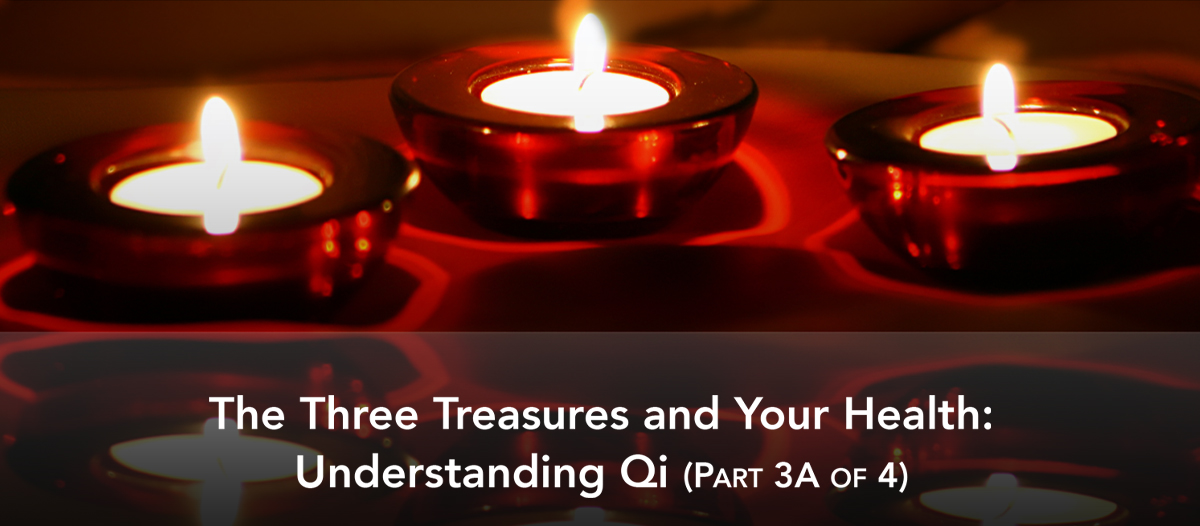
The candle analogy we introduced in Part 1 helps illuminate this relationship. If Jing is the wax of the candle, your substantial reserve that can be slowly consumed over time, then Qi is the flame itself. The flame requires the candle to burn, but it also requires oxygen, proper conditions, and ongoing maintenance. A candle with abundant wax but a weak flame provides little light and warmth. Conversely, a flame that burns too intensely consumes the wax rapidly, shortening the candle’s life. The art lies in maintaining a steady, bright flame that burns efficiently without depleting the candle prematurely. And as we’ll explore in Part 4, Shen is the light that flame produces, the radiance that illuminates everything around it.
Traditional texts describe Qi as arising from the combination of prenatal essence (Jing), the air we breathe, and the food we consume. This concept aligns remarkably well with modern biochemistry. Your mitochondria, those cellular powerhouses inherited through the maternal line, take nutrients from food and oxygen from air to produce ATP, the molecular currency of cellular energy. The parallel is striking: both traditional and modern frameworks recognize that vitality emerges from transforming what we take in from our environment, modulated by our inherited constitution.
But Qi encompasses more than just metabolic energy. It includes the regulatory, protective, and transformative functions that maintain health. Consider your body’s ability to maintain temperature, fight infection, digest food, circulate blood, and respond to stress. These aren’t separate systems operating independently but integrated functions that TCM views as expressions of Qi in different forms.
The Many Faces of Qi
Traditional Chinese Medicine recognizes different types and locations of Qi, each serving specific functions:
Yuan Qi (Original Qi) derives from Jing and represents your inherited vitality. It provides the spark that animates all other forms of Qi. Like the pilot light in a furnace, Yuan Qi must remain steady for all other functions to operate properly. This is why chronic stress, insufficient sleep, and sustained overwork are so depleting. They don’t just tire you temporarily; they draw on your Yuan Qi, forcing your body to metabolize reserves meant for long-term vitality.
Gu Qi (Grain Qi) arises from the food and drink you consume. Your digestive system transforms these substances into usable Qi, which then disperses throughout the body. This transformation requires robust digestive function, something TCM emphasizes far more than conventional wellness advice typically does. No amount of superfoods or expensive supplements can compensate for weak digestive capacity. The quality of transformation matters more than the quality of ingredients.
Zong Qi (Gathering Qi) accumulates in the chest and governs respiration and circulation. It propels blood through vessels and ensures rhythmic breathing. When Zong Qi is strong, your cardiovascular and respiratory systems function harmoniously. When it’s weak, you might experience shortness of breath, irregular heartbeat, or poor circulation. Practices that combine breath and movement, like Tai Chi or Qigong, specifically target Zong Qi cultivation.
Wei Qi (Defensive Qi) circulates on your body’s surface and serves as your first line of defense against external pathogens. Think of it as your energetic immune boundary. Wei Qi keeps you warm, protects against wind and cold, and helps you adapt to environmental changes. People with strong Wei Qi rarely catch colds; those with weak Wei Qi seem to catch everything going around. Interestingly, Wei Qi follows circadian rhythms, being most active during daytime and retreating inward at night. This is one reason why sleep is so critical for immune function.
Ying Qi (Nutritive Qi) flows through your blood vessels, nourishing organs and tissues. It works intimately with blood, which TCM considers inseparable from Qi. The saying “Qi is the commander of blood; blood is the mother of Qi” captures this relationship. Qi moves blood through vessels, while blood anchors and nourishes Qi. Deficiency of either affects the other.
Qi in Motion: The Functions That Sustain Life
Beyond these classifications, Qi performs five essential functions that maintain health:
Transformation and Transportation enable your body to convert food into nutrients, air into oxygen, and fluids into various body substances. Every biochemical process, every enzymatic reaction, every cellular uptake of nutrients represents Qi in its transformative function. When this function weakens, you see incomplete digestion, poor nutrient absorption, fluid retention, and accumulation of metabolic waste.
Protection and Defense keep pathogens at bay and maintain boundaries between self and environment. This isn’t just about immunity in the narrow sense but about your capacity to adapt to stress, regulate responses to allergens, and maintain appropriate inflammatory responses. Autoimmune conditions, in TCM thinking, often involve Qi that has turned inward, attacking the very body it should protect.
Warming maintains your basal temperature and supports metabolic processes that require heat. People with Qi deficiency often feel perpetually cold, particularly in their extremities. They need external warmth, struggle with cold weather, and may have sluggish metabolism. This warming function connects to mitochondrial activity and thyroid function in Western terms.
Holding and Containing keep organs in place, blood in vessels, and fluids where they belong. When this function weakens, you might experience organ prolapse, easy bruising, chronic bleeding, or excessive sweating. The body loses its capacity to maintain appropriate boundaries and structures.
Movement and Activity propel all physiological processes, from peristalsis to cardiac contraction to nerve transmission. When Qi becomes stagnant or moves improperly, you experience pain, digestive disturbances, emotional frustration, and various forms of dysfunction. Most pain, according to TCM, involves some element of Qi stagnation.
Signs Your Qi Needs Support
How do you know if your Qi needs attention? The body provides clear signals:
Persistent fatigue that rest doesn’t relieve suggests Qi deficiency. This differs from the exhaustion that comes after intense exertion. It’s the weariness that pervades your day, the feeling that everything requires more effort than it should.
Frequent minor illnesses indicate weak Wei Qi. You catch every cold making the rounds, recover slowly from infections, and seem perpetually on the edge of getting sick.
Digestive disturbances like bloating, irregular bowel movements, or poor appetite often reflect Qi deficiency in the digestive system. Food sits heavily, ferments, and fails to transform into proper nourishment.
Shortness of breath with minimal exertion, weak voice, or tendency to sigh repeatedly suggests Zong Qi deficiency affecting respiratory and cardiovascular function.
Spontaneous sweating during the day (rather than night sweats, which have different implications) indicates Wei Qi failing to hold fluids.
Feelings of coldness, particularly in extremities, point to insufficient warming function.
And perhaps most tellingly, a generalized sense that you’re running on empty, that your reserves have been depleted. This subjective experience often precedes measurable clinical findings.
Cultivating Qi: Practices That Work
Supporting your Qi doesn’t require expensive interventions or exotic practices. The fundamentals remain remarkably simple, though consistency matters more than intensity.
Nourish Your Digestive Fire
Your digestive system transforms food into Qi. Support this transformation by eating warm, cooked foods rather than excessive raw and cold foods, particularly if your digestion tends toward weakness. This doesn’t mean abandoning salads forever, but it does mean paying attention to how your body responds. Many people with weak digestion feel better with soups, stews, and cooked vegetables rather than raw foods, despite what trendy wellness advice suggests.
Eat at regular times in a relaxed environment. Distracted eating while working, driving, or scrolling through screens impairs digestive function. Your parasympathetic nervous system must be engaged for optimal digestion, and that requires actually paying attention to your meal.
Chew thoroughly. This seems almost too simple to mention, yet many people barely chew before swallowing. Chewing begins the digestive process and signals your body to prepare for incoming nutrients. It also slows your eating, helping prevent overconsumption.
Breathe With Intention
Breathing provides the raw material for Zong Qi and influences all other Qi functions. Yet most people breathe shallowly, using only the upper chest and missing the full capacity of their lungs.
Diaphragmatic breathing, where your belly expands on inhalation and contracts on exhalation, engages full lung capacity and massages internal organs. Practice this for even five minutes daily and notice how your energy shifts.
The 4-7-8 breathing pattern (inhale for 4 counts, hold for 7, exhale for 8) specifically cultivates Qi while calming the nervous system. The extended exhalation activates your parasympathetic response and helps clear stagnant Qi from the chest.
Outdoor breathing in natural settings provides additional benefits. Fresh air, particularly in the morning, strengthens Wei Qi and helps establish healthy circadian rhythms.
Move Your Body, Move Your Qi
Qi follows movement. Sedentary lifestyles create stagnation, which leads to pain, mood disturbances, and various dysfunctions. But movement for Qi cultivation differs from pure exercise intensity.
Walking, particularly in nature, moves Qi gently throughout the body without depleting reserves. This is vastly different from high-intensity training that may build muscle and cardiovascular capacity but can actually drain Qi if overdone.
Tai Chi and Qigong were developed specifically to cultivate Qi through coordinated movement, breath, and mental focus. Even simplified versions practiced regularly show measurable benefits for energy, balance, and immune function.
Stretching and gentle yoga release Qi stagnation in muscles and connective tissue. The goal isn’t extreme flexibility but rather opening channels and releasing tension.
The key is consistency over intensity. Fifteen minutes of daily movement benefits Qi more than sporadic vigorous exercise.
Protect Your Sleep
Sleep is when Wei Qi retreats inward to restore and repair. Chronic sleep deprivation weakens all forms of Qi, but particularly your defensive and restorative capacities.
TCM recommends being asleep by 11 PM, when the Liver and Gallbladder meridians are most active. These hours are considered crucial for restoration and detoxification. Modern research on circadian biology confirms that sleep quality differs depending on when you sleep, not just how long.
Create true darkness in your sleeping environment. Exposure to light, even small amounts, disrupts melatonin production and interferes with the inward movement of Wei Qi.
Establish a consistent sleep-wake schedule that aligns with natural light cycles. This supports all circadian-dependent processes, from hormone production to immune function to cellular repair.
Manage Stress and Emotion
Chronic stress and unprocessed emotions create Qi stagnation and depletion. The connection between emotional state and physical health is so fundamental to TCM that the two are considered inseparable.
Different emotions affect different organ systems and Qi flows. Anger causes Qi to rise inappropriately, creating tension in the upper body, headaches, and irritability. Worry causes Qi to knot, creating digestive disturbances and mental rumination. Fear causes Qi to descend, affecting kidney function and willpower.
The solution isn’t to suppress emotions but to process and move them. Physical activity, creative expression, social connection, and time in nature all help metabolize emotional energy before it stagnates into physical symptoms.
Meditation and mindfulness practices regulate Qi flow and calm the Shen (spirit). Even brief daily practice shows measurable effects on stress hormones, inflammation, and immune markers.
Work With Seasonal Rhythms
Qi fluctuates with seasonal cycles. Winter asks for conservation and rest; spring invites expansion and new activity; summer supports peak expression; autumn signals consolidation and letting go.
Working against these rhythms depletes Qi. Pushing hard in winter when energy naturally wants to conserve creates exhaustion. Remaining stagnant in spring when Qi wants to rise and expand leads to frustration and stagnation.
Pay attention to how your energy naturally shifts through the year and adjust your activities accordingly. This doesn’t mean hibernating in winter or avoiding all work in summer, but it does mean recognizing that your capacity for certain activities changes seasonally.
Traditional Herbal Allies
While lifestyle practices form the foundation of Qi cultivation, certain herbs and medicinal mushrooms offer targeted support for different aspects of Qi. Traditional Chinese Medicine has cultivated sophisticated understanding of these allies over millennia, recognizing how specific botanicals can tonify, regulate, and strengthen vital function. In Part 3B, we’ll explore these traditional tools and how to use them wisely, not as replacements for the fundamentals we’ve covered here, but as allies that can amplify your body’s capacity to generate and regulate vital energy.
The Relationship Between Jing, Qi, and Shen
Understanding Qi fully requires seeing how it bridges Jing and Shen within the Three Treasures framework.
Returning to our candle analogy: Jing is the wax, Qi is the flame, and Shen (which we’ll explore in Part 4) is the light produced. The wax provides substance and duration. The flame provides transformation and function. The light provides illumination and consciousness. You cannot have flame without wax to burn, and you cannot have light without flame to produce it. Yet each treasure has its own nature and qualities.
Jing provides the constitutional foundation and long-term reserves. Qi represents the daily currency and functional capacity. Shen embodies consciousness, awareness, and vitality of spirit. They exist in a dynamic relationship where each influences the others.
Strong Jing supports abundant Qi. When constitutional reserves are robust, generating and maintaining daily energy comes easily. But sustained Qi deficiency eventually draws on Jing reserves, depleting your constitutional foundation. This is why chronic overwork and stress accelerate aging.
Qi nourishes and supports Shen. When your daily energy is strong and flowing smoothly, your mind is clear, emotions are balanced, and spirit is vibrant. But Qi deficiency clouds thinking, disturbs emotions, and dims the light of consciousness. Conversely, disturbances of Shen (anxiety, obsessive thinking, emotional turmoil) can disrupt Qi flow and drain vitality.
The practical implication: supporting your Qi protects both your long-term reserves (Jing) and your present state of consciousness (Shen). It’s the middle ground where most daily health practices have their impact.
Beyond Simple Energy
The temptation is to reduce Qi to “energy” and think you understand it. But this simplification misses crucial aspects of the concept.
Qi includes energetic aspects, yes, but also regulatory, protective, transformative, and structural functions. It’s simultaneously the capacity to do work and the intelligence that directs that work appropriately. It’s both the fuel and the engine, the signal and the response.
Modern functional medicine approaches health through multiple lenses: metabolic function, immune regulation, hormonal balance, detoxification capacity, stress response, and so on. Each represents one facet of what TCM unifies as Qi. The advantage of the Qi framework isn’t that it’s more accurate than biochemistry but that it provides a unified functional perspective that makes patterns visible.
When someone presents with fatigue, digestive issues, frequent colds, and difficulty concentrating, Western medicine might see four separate problems requiring four different specialists. TCM recognizes a pattern of Qi deficiency with particular characteristics that suggests specific interventions.
This doesn’t make one approach superior to the other. They’re complementary ways of understanding the same reality. The wisdom lies in using each where it offers the most insight.
Moving Forward
In Part 3B, we’ll explore the herbs and medicinal mushrooms that traditional systems have used to support Qi, examining both their traditional applications and what modern research reveals about their mechanisms. Then, in Part 4, we’ll turn to Shen, the most subtle of the Three Treasures. Shen represents consciousness, vitality of spirit, and the ineffable quality that makes you uniquely you. It’s perhaps the most foreign concept to Western thinking yet also the most immediately recognizable when you encounter someone with radiant Shen.
For now, pay attention to your Qi. Notice what builds it and what depletes it. Observe how it fluctuates through the day, through your cycle, through the seasons. The body is always communicating. Qi is the language it speaks.
The practices that support Qi aren’t glamorous or exotic. They’re the fundamentals that wellness culture often overlooks in favor of more marketable interventions. Eating well. Breathing fully. Moving regularly. Sleeping deeply. Managing stress. Living in rhythm with natural cycles.
Simple doesn’t mean easy, and basic doesn’t mean unimportant. These practices form the foundation of vitality, the ground from which health grows naturally.
Your Qi is precious. Cultivate it wisely.
Further Reading
For those who want to explore Qi more deeply, these resources offer valuable perspectives ranging from traditional texts to contemporary research:
Classical Foundations:
The Yellow Emperor’s Classic of Internal Medicine (Huang Di Nei Jing) remains the foundational text of Chinese medicine, with extensive discussion of Qi, its various forms, and its role in health and disease. The Maoshing Ni translation offers accessibility while maintaining the spirit of the original.
The Web That Has No Weaver by Ted Kaptchuk provides perhaps the clearest Western explanation of TCM concepts including Qi. Kaptchuk bridges Eastern and Western thinking without oversimplifying either tradition.
Practical Application:
The Way of Qigong by Kenneth Cohen offers comprehensive coverage of Qigong practice, philosophy, and its applications for health. Cohen combines scholarly rigor with practical instruction and respects both traditional wisdom and scientific inquiry.
The Root of Chinese Qigong by Yang Jwing-Ming explores the theoretical foundations and practical applications of Qigong training, including detailed explanations of how different practices affect Qi cultivation.
Contemporary Integration:
Between Heaven and Earth: A Guide to Chinese Medicine by Harriet Beinfield and Efrem Korngold presents TCM concepts including Qi in language accessible to Western readers while maintaining depth and authenticity.
The Spark in the Machine by Daniel Keown attempts to explain TCM concepts including Qi through the lens of developmental biology and fascia research. While some connections are speculative, it offers intriguing bridges between traditional and modern perspectives.
Scientific Perspectives:
Research on adaptogenic herbs, particularly the work of Alexander Panossian and Georg Wikman, provides scientific framework for understanding how Qi-tonifying herbs actually work at molecular and systemic levels. Their papers on adaptogens and homeostasis offer rigorous examination of traditional concepts through contemporary research methods.
The growing body of research on Qigong and Tai Chi, particularly studies examining effects on immune function, inflammatory markers, and autonomic regulation, demonstrates measurable physiological changes from practices designed to cultivate Qi. PubMed searches for “Qigong” or “Tai Chi” combined with specific health outcomes yield extensive peer-reviewed literature.
Caution:
Approach popular books promising quick Qi cultivation or supernatural powers with healthy skepticism. Authentic understanding of Qi develops through study, practice, and time, not through marketing hype or mystical shortcuts. The most reliable resources treat the subject with intellectual rigor while respecting both its traditional context and scientific inquiry.

Mark J. Kaylor is a passionate advocate for holistic health and natural remedies, with a focus on extending both lifespan and healthspan. As the founder of the Radiant Health Project and host of Radiant Health Podcast, Mark blends in-depth research with traditional wisdom to empower others on their journey to vibrant health. Through his writing and speaking, he shares insights into the transformative power of herbs, nutrition, and lifestyle practices.
The Radiant Health Project is a not-for-profit initiative dedicated to cutting through wellness industry hype and sharing evidence-informed, traditional wisdom for genuine health.
Disclaimer: All information and results stated here is for educational and entertainment purposes only. The information mentioned here is not specific medical advice for any individual and is not intended to be used for self-diagnosis or treatment. This content should not substitute medical advice from a health professional. Always consult your health practitioner regarding any health or medical conditions.