


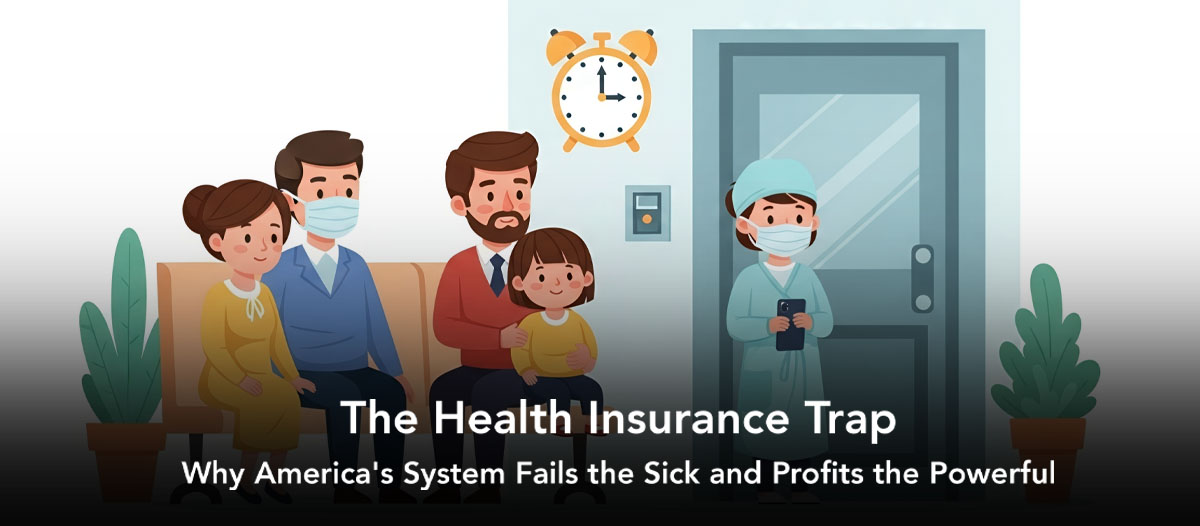
The Health Insurance Trap
Why America’s System Fails the Sick and Profits the Powerful
by Mark J Kaylor
Quick Summary
TikTok is overflowing with bold health claims, quick fixes, and viral wellness hacks. But when your health advice comes from an algorithm rather than evidence, or wisdom, the results can range from misleading to downright dangerous. In this article, we explore why TikTok is one of the worst places to seek health advice, and what to look for instead on your journey to radiant health.
🔑 Key Takeaways
- The U.S. is the only developed country without universal health care, despite spending more per person than any other nation.
- Health insurance companies and pharmaceutical corporations profit while patients suffer, often facing denied care, medical debt, and delayed treatment.
- The current system defines health care as a business, not a right. emphasizing billing codes and cost-containment over true healing.
- Administrative complexity and profit incentives have created a bloated, inefficient, and dehumanizing experience for both patients and providers.
- Political resistance to reform is driven by massive lobbying efforts and entrenched financial interests, not by evidence or public well-being.
- Most preventive and holistic approaches to health, like nutrition, emotional healing, herbal medicine, and time with care providers, are excluded or marginalized by the insurance model.
- A more humane and effective system is possible, one rooted in wholeness, prevention, and compassion, where radiant health is a right, not a privilege.
She did everything “right.”
A full-time job. A monthly premium. Annual checkups. But when the diagnosis came, a complex autoimmune condition, her insurance company refused the specialist. Then the treatment. Then the medication. In the fine print was a hidden truth: she wasn’t insured for healing. She was insured for denial.
This isn’t the exception. It’s the system working as designed.
A System Built to Profit, Not Health
In the United States, we don’t have a health care system. We have a health insurance industry. And that difference, between care and coverage, is the root of a national crisis.
Health insurance was originally created to protect people from financial ruin. But over time, it evolved into something else: a gatekeeper, an enforcer, a middleman that dictates what counts as “care” and who deserves it. In this model, profit isn’t a byproduct. It’s the purpose.
Healing, if it happens at all, is often incidental.
The Human Cost of an Inhumane System
Every interaction with the insurance system is a lesson in frustration:
- Confusing networks.
- Denials of medically necessary procedures.
- Hours on hold.
- Surprise bills for “out-of-network” specialists no one warned you about.
- Mental strain and trauma layered on top of illness.
But beyond inconvenience lies something deeper: a profound dehumanization. You’re no longer a person in need of care. You’re a cost center. A liability. A claim to be processed, delayed, and, when possible, denied.
Healing thrives on trust, on presence, on time. The U.S. system actively undermines these. And it shows in our outcomes: we spend more per person on health care than any other nation, yet rank near the bottom among developed countries in life expectancy, infant mortality, and chronic disease outcomes.

Who Profits from the Game?
While patients navigate denials and debt, executives count their earnings.
- The five largest U.S. health insurance companies made over $60 billion in profit in 2023.
- Some CEOs take home $20 million or more annually.
- Administrative costs, including billing and insurance paperwork, account for 25–30% of total health care spending, far higher than in other developed countries.
Behind closed doors, insurers negotiate secret rates with hospitals, obscure pricing, and structure policies that encourage underuse of care. Denial isn’t a failure of the system, it’s a feature.
The pharmaceutical industry and for-profit hospitals also benefit. The insurance model helps justify inflated prices by keeping patients unaware and disempowered. At every step, those with the most to gain are those furthest removed from the suffering.
And Who Loses?
- The chronically ill, who must constantly fight for care.
- The working poor, who can’t afford premiums, or the deductibles when they can.
- The middle class, squeezed by rising costs and shrinking coverage.
- The uninsured, who often face bankruptcy after a single emergency.
- Health care workers, buried in paperwork and burnout.
This is not a fringe problem. Medical debt is the leading cause of personal bankruptcy in the U.S. And even among the insured, over 40% delay or avoid care due to cost.
The sick lose. The system wins.
The American Exception
Among developed nations, the U.S. stands alone.
Other countries, Canada, the U.K., France, Germany, Japan, Australia, have universal or near-universal coverage. They treat health care as a public good, not a private investment opportunity. Their citizens live longer, face fewer health-related bankruptcies, and report higher satisfaction.
In these countries:
- You don’t lose your doctor because you lost your job.
- You don’t skip chemo because of a $5,000 deductible.
- You don’t go bankrupt because you had a heart attack.
And yet, when Americans advocate for these models, they are met with fear-based propaganda about “socialized medicine.” Meanwhile, U.S. per capita health care spending doubles or triples that of these countries, with worse outcomes.
The Politics of Prevention
So why hasn’t change come?
One reason: money.
- The health insurance lobby spends hundreds of millions of dollars annually to influence policy.
- Politicians on both sides of the aisle accept campaign contributions tied to preserving the status quo.
- Powerful players, from Big Pharma to private equity–owned hospital chains, have a vested interest in keeping the system complex, opaque, and profitable.
And so the rhetoric continues: “choice,” “freedom,” “personal responsibility.” But these are smokescreens. The real choice has been made, for us. And it wasn’t health. It was profit.
When Insurance Defines Health
Perhaps most dangerous of all: this system distorts our very understanding of healing.
Coverage determines what counts as care. Insurance rarely covers nutrition counseling, trauma therapy, herbal medicine, acupuncture, breathwork, or preventive education. Even time spent with your physician is rationed to 7–15 minutes.
This is not a healing model. It is a disease management industry. And it is failing us, not only physically, but spiritually, relationally, and culturally.

A More Radiant Possibility
What if health care was rooted in healing again?
What if instead of maximizing shareholder returns, we maximized compassion, dignity, and connection?
Imagine a system:
- Where prevention is prioritized.
- Where mental, emotional, and spiritual health are not sidelined.
- Where care providers are allowed to care.
- Where the human being, not the billing code, comes first.
- Where your worth is not measured by your wallet, or your diagnosis.
This is not a utopian dream. It’s a return to a value older than this broken system: the belief that health is a birthright, not a business.
True radiant health cannot exist in a model built on denial and exploitation. But it can flourish in a society courageous enough to reimagine what care really means.
Healing is not a commodity. It’s a calling.
And if we begin to reclaim that truth, together, we might just find our way to a health care system worthy of the name.
What would a system rooted in healing, not profit, look like to you?
We’d love to hear your thoughts. Share your vision in the comments or join the conversation on our Radiant Health Facebook page.
The health care system won’t change until we start talking about it.
Forward this to someone you trust. Start a conversation. Ask a question.
Healing begins when we reclaim our voices, and our vision.

Mark J. Kaylor is a passionate advocate for holistic health and natural remedies, with a focus on extending both lifespan and healthspan. As the founder of the Radiant Health Project and host of Radiant Health Podcast, Mark blends in-depth research with traditional wisdom to empower others on their journey to vibrant health. Through his writing and speaking, he shares insights into the transformative power of herbs, nutrition, and lifestyle practices.
The Radiant Health Project is a not-for-profit initiative dedicated to cutting through wellness industry hype and sharing evidence-informed, traditional wisdom for genuine health.
Disclaimer: All information and results stated here is for educational and entertainment purposes only. The information mentioned here is not specific medical advice for any individual and is not intended to be used for self-diagnosis or treatment. This content should not substitute medical advice from a health professional. Always consult your health practitioner regarding any health or medical conditions.