


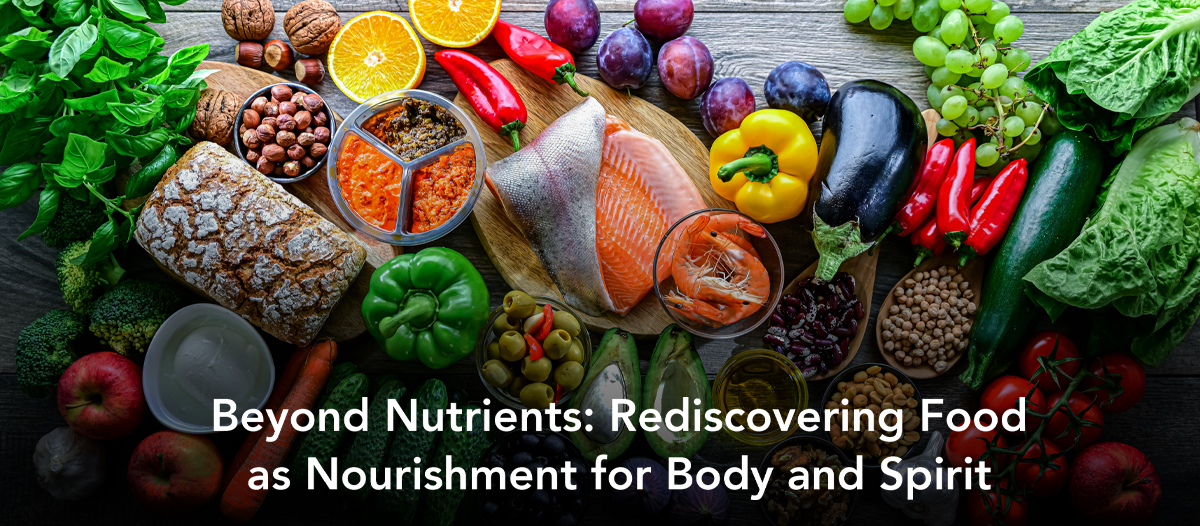
Beyond Nutrients:
Rediscovering Food as Nourishment for Body and Spirit
by Mark J Kaylor
Key Takeaways:
• How you eat matters as much as what you eat. Stress during meals impairs digestion and disrupts nutrient absorption — the same food eaten in calm produces different outcomes than food eaten in fight-or-flight mode.
• Shared meals nourish beyond the food itself. Blue Zone research consistently shows that unhurried, communal eating supports longevity in ways that go well beyond nutrition alone.
• Gratitude prepares the body to receive. A simple pause before eating activates the parasympathetic nervous system, improving digestion, blood sugar regulation, and satiety — it’s practical physiology, not just ritual.
• Mindful preparation extends into mindful eating. When we cook with presence, we naturally sit down, slow down, and actually receive what we’ve made.
Something shifts when we pause before eating. The hurried grab between tasks becomes a moment of presence. The solitary meal becomes an opportunity for gratitude. The reheated leftovers become nourishment we actually receive.
We live in an age of unprecedented nutritional knowledge. We can quantify antioxidants, calculate glycemic loads, and track micronutrients with precision. This knowledge has value. It helps us make informed choices. And yet, for many of us, something essential feels missing from our relationship with food.
Traditional cultures have always understood what modern science is beginning to validate: how we eat matters as much as what we eat. The context in which we consume our meals, the care with which food is prepared, the presence we bring to eating all profoundly influence how our bodies receive and transform what we consume into vitality.

When the Body Cannot Digest
Your nervous system doesn’t distinguish between actual danger and the stress of eating lunch while scrolling through alarming news. Both trigger the same sympathetic response, the same cascade of stress hormones that redirect resources away from digestion toward immediate survival.
Research reveals what this means in practical terms. Stress during meals impairs gastric motility, reduces digestive enzyme secretion, and disrupts the signals that tell us we’re satisfied. Elevated cortisol interferes with insulin sensitivity and nutrient absorption. The same meal eaten while anxious produces different metabolic outcomes than the same meal eaten while calm.
This is the wisdom embedded in the Earth element of Traditional Chinese Medicine: transformation requires the right conditions. Just as soil cannot nourish seeds during drought, our digestive system cannot fully transform food into vitality when we remain in fight-or-flight mode. The Spleen and Stomach, governed by Earth, need the stability and calm that allow transformation to unfold.
When we eat in a parasympathetic state, the body shifts into its natural digestive rhythm. Gastric acid flows appropriately. Enzymes activate. Peristaltic movement supports absorption. This isn’t spiritual philosophy layered onto physiology. This is physiology revealing what contemplative traditions have long understood: reception and transformation require presence.

The Table as Medicine
Across cultures and throughout history, the shared meal has served as more than sustenance. It has been ritual, connection, the daily practice of belonging.
The research on communal eating reveals patterns that statistical analysis struggles to fully explain. People who regularly share meals consume more vegetables and show greater dietary diversity, but they also report higher life satisfaction. Children who eat family dinners demonstrate better academic performance and emotional regulation. Something about eating together nourishes us beyond the food itself.
The Blue Zones offer compelling evidence. In Okinawa, Sardinia, Ikaria, places where people regularly live past 100 in vibrant health, meals are unhurried social events. Food is consumed slowly, with conversation, amid laughter and the presence of others. Time itself seems to move differently at these tables.
Perhaps what happens here is another expression of Earth’s transformative power. The grounding that comes from connection, the stability of ritual and relationship, creates conditions where nourishment can be fully received. The nervous system relaxes. We chew more thoroughly. We notice when we’re satisfied rather than overriding those signals in our rush to the next task.

Gratitude as Gateway to Transformation
Nearly every spiritual tradition includes practices of acknowledging food before eating. Blessing, offering thanks, recognizing the sources of nourishment. These rituals have persisted across millennia and cultures.
Modern research on the vagus nerve offers insight into why. Gratitude practices activate this primary pathway of the parasympathetic nervous system, triggering measurable physiological shifts. Heart rate variability increases. Inflammation markers decrease. The digestive system optimizes its function.
That moment of appreciation before eating prepares the body to receive nourishment. The pause signals safety, abundance, the permission to digest what we’re about to consume. Studies on mindful eating consistently show benefits beyond dietary changes alone: improved blood sugar regulation, enhanced satiety, reduced compulsive eating, greater satisfaction with appropriate portions.
But perhaps gratitude does something else as well. When we acknowledge the soil that grew our food, the sun that ripened it, the hands that harvested and prepared it, we remember our place in cycles larger than ourselves. We recognize that eating is not extraction but participation in the web of relationships that sustains all life.
This too is Earth’s teaching: we are not separate from what nourishes us. We are held within systems of reciprocal care, always receiving, always being transformed by what we take in.
The Presence in Preparation
Accomplished chefs speak of putting themselves into their dishes, of sharing their story through food, of the intention that transfers from cook to meal. While we cannot measure love in a laboratory, we recognize that food prepared with care carries qualities that transcend nutritional analysis.
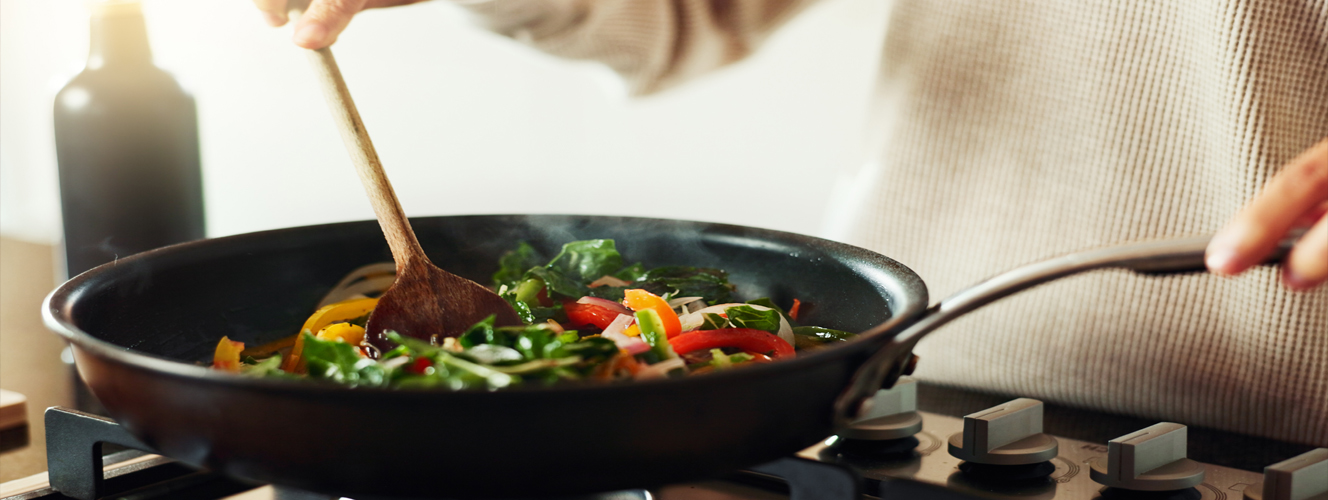
Consider what goes into a home-cooked meal made with attention: the selection of ingredients, the rhythm of chopping, the adjustment of heat and seasoning, the tasting and refining. Each action is an investment of presence. The cook considers who will eat this food and what will truly nourish them.
Compare this to food assembled through industrial efficiency, optimized for speed and throughput. The macronutrients may be identical. The experience differs entirely.
What matters here is not that attention mystically alters molecular structures but that the care invested in preparation naturally extends to consumption. When we’ve taken time to prepare something thoughtfully, we’re more likely to sit down with it, to eat slowly, to savor what we’ve made. The grounding that comes from the preparatory process itself nourishes us before we take the first bite.
This is another way Earth manifests in our relationship with food. The stability and centeredness we cultivate through mindful preparation creates the conditions for transformation. Rushing produces rushing. Presence invites presence.

Opening to Nourishment
You might notice how different food tastes when you actually sit down to eat it. How flavors become more distinct when you’re not distracted. How your body signals satisfaction more clearly when you pause between bites.
Perhaps you’ve experienced the difference between eating alone at your desk and sharing a meal with someone whose company you enjoy. How conversation naturally slows the pace. How laughter seems to make food more satisfying.
Maybe you’ve felt the subtle shift that comes from taking a breath before eating, from acknowledging in whatever way feels natural that you have food to eat, that this meal was made possible by countless unseen contributions.
If you cook, you may have noticed how bringing full attention to the process, even occasionally, changes not just the food but your entire state. How the repetitive motion of chopping can become meditative. How the transformation that heat creates mirrors other transformations unfolding in your life.
These aren’t prescriptions. They’re invitations to experiment with presence, to notice what shifts when you bring more awareness to something you do every day. Small changes in how you eat can ripple outward in unexpected ways.
The invitation is not to add more rules to an already complicated relationship with food but to soften some of the rigidity, to create space for eating to become what it naturally is: an opportunity to receive nourishment, to practice gratitude, to participate in the cycles that sustain life.

Nourishment and Radiance
Radiant health is not the absence of disease or the optimization of biomarkers. It’s a quality of aliveness, the capacity to be fully present, to feel connected, to engage with life from vitality rather than depletion.
How we relate to food directly influences this radiance. When we eat mechanically, stressed and disconnected, we may obtain adequate nutrition but miss the fullness of nourishment that creates genuine vitality. We can track every macro and still feel depleted. We can follow any diet protocol and still lack the glow of true wellbeing.
Radiance emerges when we nourish ourselves completely: body, mind, and spirit. When we bring presence to meals, when we eat in community, when we express gratitude for what sustains us, we do more than fuel cells. We participate in cycles of reciprocity that connect us to the earth, to each other, to the vast web of relationships that makes our existence possible.
This connection itself nourishes. It grounds us. It reminds us that we are not isolated biological machines requiring optimal inputs but living beings embedded in systems that sustain and enliven us.
The path to radiant health is not about eating perfectly. It’s about eating consciously, bringing your whole self to the table, letting meals become moments of presence rather than tasks to optimize. This is how food becomes medicine in its deepest sense: not through nutrient density alone but through the quality of awareness and connection we bring to receiving it.
Earth teaches us that transformation cannot be forced. We can only create conditions where it naturally unfolds through presence, gratitude, and honoring what sustains us.
Your healing journey is uniquely yours. The choices that support your path will reveal themselves when you bring curiosity and attention to how your body receives and transforms what you eat. Radiant health blooms when we remember that we are more than what we consume, that nourishment is more than what we absorb, that showing up to life with gratitude, bite by bite, breath by breath, is itself a practice of healing.

Mark J. Kaylor is a passionate advocate for holistic health and natural remedies, with a focus on extending both lifespan and healthspan. As the founder of the Radiant Health Project and host of Radiant Health Podcast, Mark blends in-depth research with traditional wisdom to empower others on their journey to vibrant health. Through his writing and speaking, he shares insights into the transformative power of herbs, nutrition, and lifestyle practices.
The Radiant Health Project is a not-for-profit initiative dedicated to cutting through wellness industry hype and sharing evidence-informed, traditional wisdom for genuine health.
Disclaimer: All information and results stated here is for educational and entertainment purposes only. The information mentioned here is not specific medical advice for any individual and is not intended to be used for self-diagnosis or treatment. This content should not substitute medical advice from a health professional. Always consult your health practitioner regarding any health or medical conditions.