


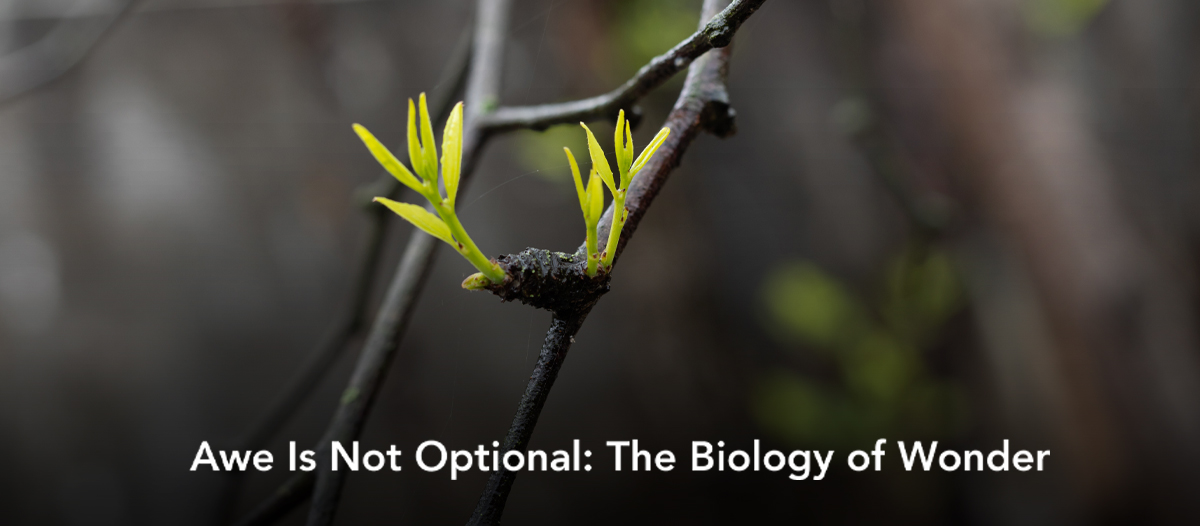
Awe Is Not Optional: The Biology of Wonder
By Mark J Kaylor
What a bare twig in early spring can teach us about the medicine we forgot to prescribe
AT A GLANCE
• Awe is a biological event, not just a feeling, with measurable effects on inflammation, stress hormones, and the nervous system.
• Modern life is structurally designed to minimize awe, and the cost is greater than we recognize.
• Research now links awe to reduced inflammation, lower cortisol, improved vagal tone, and longer telomeres, all key markers of healthy aging.
• You do not need grand landscapes to find it. Everyday awe, taken deliberately, is enough.
• Wonder may be one of the most underrated practices for radiant, lasting health.
It happens every year, and every year it stops you.
A branch you had given up on. Gray and bare through the long months, holding nothing. And then, one morning, something small and almost impossibly green pushes through. A bud. A curl of new leaf. The first pale flower of a tree just remembering what it knows how to do.
You did not plan to stop. You were on your way somewhere. But something in you paused anyway, pulled toward this small, unhurried act of becoming. And for a moment, the usual noise went quiet. Your chest opened. Time did something unusual: it slowed down, or stretched, or simply stopped mattering quite so much.
That is awe. Not the spectacular kind that requires a mountaintop or a cathedral ceiling. The quiet kind. The kind available to anyone paying attention.
And it turns out, it may be one of the most important things you can feel.
The Case for Wonder
We tend to think of awe as a luxury. A bonus. Something that happens on vacation or at a concert or the rare moment we manage to drag ourselves outside after dark to look up.
But consider what actually happens in your body when awe arrives. The breath deepens. The shoulders drop. The constant interior monologue that narrates, judges, and worries goes quiet. Something relaxes that you did not know was braced.
You feel, briefly, that you are part of something larger than your own story. And in that moment, the body responds as if it has finally been given permission to rest.
This is not imagination. The physical sensations of awe, that opening in the chest, the stilled mind, the sense of time expanding, are consistent across cultures, across ages, across the full range of human experience. Indigenous traditions, ancient healing systems, poets and philosophers across millennia: all pointed toward wonder as something essential. Not decorative. Essential.
What they understood intuitively, and what we are only now beginning to measure, is that the human organism was not designed to live without regular contact with something that exceeds it. We need to be moved. We need to be surprised. We need, on a fairly regular basis, to feel small in the best possible way.
The human organism was not designed to live without regular contact with something that exceeds it.
When that contact is absent, something dims. Not dramatically, not all at once, but gradually. A flatness settles in. A life that functions, even thrives by most measures, but feels somehow unlit from within. That quality of aliveness that has nothing to do with productivity or achievement grows quiet, and eventually, we stop noticing it is missing.
That is the awe-deficiency most of us carry, and we have almost no language for it.
A World Designed Against Wonder
We have built a civilization of extraordinary efficiency. Speed, sameness, predictability, optimization. These are not evil forces. But they are, by design, awe-resistant.
Awe requires the unexpected. It requires scale, or depth, or beauty beyond what you anticipated. It requires being surprised by existence. Algorithms learn your preferences and feed them back to you, eliminating surprise. Screens compress the world to the same luminous rectangle. Urban environments replace the wild and the organic with the managed and the legible. Even wellness culture, for all its genuine contributions, can work quietly against wonder by turning the inner life into another project to optimize.
The result is measurable. Studies show that people today spend dramatically less time outdoors, less time in natural environments, and less time in unstructured contemplation than any previous generation in recorded history. The experiences most reliably associated with awe, open landscapes, starry skies, old growth forests, encounters with art or music that breaks you open, have been systematically engineered out of daily life.
We are not broken. We are awe-starved. And the body keeps the score.
What the Research Reveals
In the past two decades, researchers have begun to study awe with the same rigor once reserved for sleep, nutrition, and exercise. The findings are striking.
Dacher Keltner, a psychologist at UC Berkeley and one of the world’s leading researchers on awe, has shown that experiencing awe measurably reduces pro-inflammatory cytokines, the molecular signals that drive chronic inflammation. This is not a small finding. Chronic, low-grade inflammation is now understood to be a central driver of heart disease, depression, metabolic dysfunction, and accelerated biological aging. The body, it turns out, does not experience wonder and health as unrelated.
Keltner’s research also found that awe expands the subjective sense of time. People who had recently experienced awe reported feeling less hurried, more patient, and more willing to offer their time to others. In a culture organized almost entirely around the scarcity of time, this effect is worth pausing over.
Additional research has shown that awe activates the parasympathetic nervous system, the branch associated with rest, repair, and recovery. It improves heart rate variability, a key marker of vagal tone and cardiovascular resilience. It quiets the brain’s default mode network, the self-referential loop that generates worry, rumination, and the exhausting work of managing how we appear to the world.
Under the influence of awe, the small, defended self grows quiet. Something larger moves in. This is not metaphor. This is measurement.
Under the influence of awe, the small defended self grows quiet. This is not metaphor. This is measurement.
Awe and the Long Game: Wonder as a Longevity Practice
Here is where the conversation opens into something even more interesting.
Longevity researchers have long known that chronic stress is one of the most reliable accelerants of biological aging. Sustained elevation of cortisol degrades tissue, impairs immune function, shortens telomeres, and quietly erodes the systems that keep us vital. What is less discussed is the other side of that equation: what actively reverses or buffers those effects.
Awe, it turns out, is a candidate.
The reduction in pro-inflammatory cytokines that Keltner’s research documents maps directly onto longevity pathways. Inflammation is not just a risk factor for disease; it is a driver of cellular aging. Bringing it down, through whatever means, tends to extend healthy lifespan. Awe does this. Regularly.
Research on telomeres, the protective caps on our chromosomes whose length is one of the best available markers of biological age, shows that chronic psychological stress accelerates their shortening. Practices that reduce stress and restore nervous system balance, including meditation, time in nature, and positive emotional states, help preserve them. Awe sits at the intersection of all three.
There is also the matter of meaning. The Blue Zones research, which identified communities with unusually high concentrations of people living past one hundred in robust health, consistently found a sense of purpose and connection to something larger than oneself among the common factors. Awe, by its nature, connects us to something larger. It dissolves the boundary between self and world long enough for us to remember that we are embedded in something vast, ongoing, and worth being part of.
That sense of embeddedness, of mattering within a larger story, is not merely philosophical. It is physiological. Bodies that carry it age differently than bodies that do not.
Bodies that carry a sense of wonder age differently than bodies that do not.
An Invitation Back to Wonder
The good news is that awe is not rare. It is waiting in ordinary places, for anyone willing to slow down enough to receive it.
The research is clear: you do not need the Grand Canyon. You need presence. Brief, regular encounters with everyday awe can shift mood, reduce stress hormones, and restore the quality of aliveness that tends to drain away in a busy life. The threshold is lower than you think.
Consider what already surrounds you. The architecture of a spider web catching morning light. The way a piece of music arrives at exactly the right moment and undoes something in you. A night sky far enough from city lights to show you what is actually up there. A child saying something that lands like a small truth. A bare branch, in early spring, deciding it is time.
You do not have to go anywhere. You have to notice what is already happening.
A few ways to begin:
- Take an awe walk. Researchers have used this term for short walks taken with the explicit intention of finding something that evokes wonder. Go outside. Move slowly. Look for what is larger, older, more beautiful, or more surprising than you expected. Even fifteen minutes shifts measurable markers of wellbeing.
- Build a small practice of noticing. At the end of each day, name one moment that surprised you, moved you, or reminded you that existence is not ordinary. This is not journaling for productivity. It is attention as medicine.
- Let yourself be stopped. The next time something pauses you, a sky that has no business being that color, a piece of music, a bird doing something birds do, stop. Give it thirty seconds. Let it land. The body knows what to do with it.
- Seek out scale. Mountains, coastlines, old-growth trees, a truly dark night sky. Research suggests that encounters with vastness have outsized effects on the nervous system. Our bodies evolved in a world that was immense and mostly wild, and something in us still remembers.
- Protect your capacity for wonder. Limit the inputs that flatten and predict. Create space in your days for the unscheduled, the unoptimized, and the unexplained. Awe cannot be engineered, but it can be invited.
The twig you stopped to look at this spring was not a small thing. It was a reminder that life is always beginning somewhere, even in what looks finished.
You paused because something in you recognized that. And in that recognition, something opened. Your nervous system calmed. Your sense of time expanded. The defended self grew quiet, and what was underneath it got a little air.
That is not a detour from radiant health. That is what radiant health feels like from the inside.
Key Takeaways
- Awe is a biological event. It measurably reduces pro-inflammatory cytokines, activates the parasympathetic nervous system, improves heart rate variability, and quiets the brain’s self-referential default mode network.
- Modern life is structurally awe-resistant. Screens, algorithms, speed, and optimization reduce the unexpected encounters that wonder requires, and most of us are paying a cost we cannot name.
- Awe is a longevity practice. Through its effects on inflammation, telomere preservation, cortisol reduction, and the cultivation of meaning, wonder is upstream of many of the factors that determine how we age.
- Ancient healing traditions understood what science is now confirming: the luminous, open quality of a spirit fully alive is not a bonus feature of health. It is closer to its foundation.
- Everyday awe is enough. Brief, regular encounters with wonder, taken deliberately and with attention, shift mood, reduce stress, and restore aliveness without requiring grand landscapes or extraordinary circumstances.
- Radiant health is not an achievement. It is the quality of aliveness that returns when we remember to stop, look up, and let ourselves be surprised by what is still becoming.

Mark J. Kaylor is a passionate advocate for holistic health and natural remedies, with a focus on extending both lifespan and healthspan. As the founder of the Radiant Health Project and host of Radiant Health Podcast, Mark blends in-depth research with traditional wisdom to empower others on their journey to vibrant health. Through his writing and speaking, he shares insights into the transformative power of herbs, nutrition, and lifestyle practices.
The Radiant Health Project is a not-for-profit initiative dedicated to cutting through wellness industry hype and sharing evidence-informed, traditional wisdom for genuine health.
Disclaimer: All information and results stated here is for educational and entertainment purposes only. The information mentioned here is not specific medical advice for any individual and is not intended to be used for self-diagnosis or treatment. This content should not substitute medical advice from a health professional. Always consult your health practitioner regarding any health or medical conditions.