


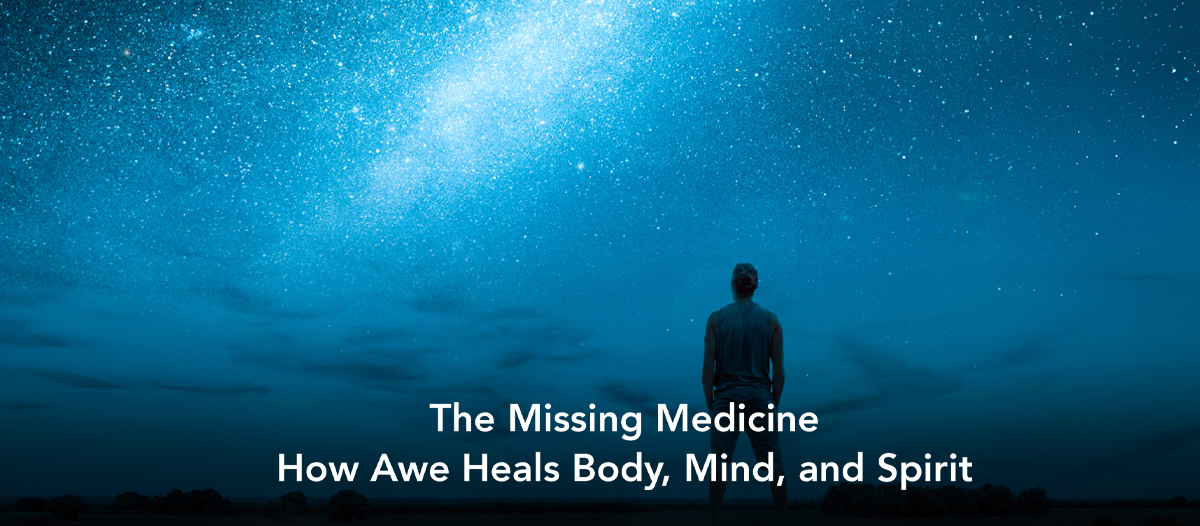
The Missing Medicine:
How Awe Heals Body, Mind, and Spirit
by Mark J Kaylor
Rediscovering the ancient practice of wonder for complete health transformation
When was the last time you felt truly awestruck? Not just impressed or entertained, but genuinely moved by something so beautiful, vast, or profound that it momentarily dissolved your sense of self and connected you to something larger?
If you’re struggling to remember, you’re not alone. We’re living through what researchers are beginning to recognize as an “awe deficit,” and the consequences extend far beyond missing out on meaningful experiences. Emerging science reveals that awe isn’t just an emotion. It’s a biological intervention with measurable effects across virtually every system in your body: immune function, cardiovascular health, nervous system regulation, mental wellbeing, cellular aging, and even pain perception.
Traditional cultures understood this intuitively. They built awe into daily life through ritual, ceremony, time in nature, communal gatherings, and spiritual practices. They knew that moments of transcendent wonder weren’t luxuries but necessities for holistic health, healing body, mind, and spirit as an integrated whole.
Modern life has systematically stripped away these opportunities. We live indoors, stare at small screens, navigate concrete environments, and replace direct experience with digital mediation. We’re glued to our phones, disconnected from nature, and consuming wonder secondhand through filtered images rather than encountering it directly. The costs are showing up not just in our mental health but throughout our entire being.
What Awe Actually Is
Awe is a complex emotion that arises when we encounter something vast that challenges our existing mental frameworks. It can be triggered by nature’s grandeur (mountains, oceans, starry skies), human excellence or virtue (acts of profound compassion, artistic genius, moral courage), spiritual experiences, or even intellectual insights that shift how we see the world.
The hallmark of awe is a phenomenon researchers call “small self.” Your usual preoccupation with personal concerns temporarily fades. You feel part of something larger. Your problems feel smaller, not through dismissal but through perspective shift. There’s often a physical sensation, a “chill” or opening in the chest, a quickening of breath.
What distinguishes awe from other positive emotions like joy or contentment is this quality of self-transcendence. You’re momentarily lifted out of the narrow focus on personal identity and concerns into connection with something greater.
The Whole-Body Medicine That Changes Everything
Here’s where ancient wisdom meets cutting-edge science in fascinating ways. Research across multiple disciplines reveals that awe produces measurable changes throughout your entire being. This isn’t about a single mechanism or one system. Awe is truly holistic medicine, affecting body, mind, and spirit simultaneously.
Immune System and Inflammation
Dr. Dacher Keltner’s research at UC Berkeley has documented that awe experiences significantly reduce pro-inflammatory cytokines, particularly interleukin-6 (IL-6). This cytokine drives systemic inflammation implicated in cardiovascular disease, diabetes, depression, Alzheimer’s disease, and accelerated aging. People who regularly experience awe show inflammatory markers comparable to those who eat anti-inflammatory diets or exercise regularly.
Even more remarkably, research by Dr. Steven Cole shows that awe and other self-transcendent emotions actually change gene expression patterns in immune cells. They down-regulate genes involved in inflammatory responses and up-regulate genes involved in antiviral responses. Your experiences of wonder are literally changing which genes get activated.
Cardiovascular Health
Awe experiences produce immediate cardiovascular benefits. Studies show:
- Decreased blood pressure that persists beyond the immediate experience
- Improved heart rate variability, a key marker of cardiovascular health and stress resilience
- Reduced heart rate during and after awe experiences
- Lower risk of cardiovascular events in people who report regular awe
These aren’t trivial changes. The cardiovascular improvements from regular awe experiences rival those from moderate exercise or stress management programs.
Nervous System Regulation
The mechanism connecting awe to physical health appears to center on the vagus nerve, that crucial connection between brain and body that regulates your stress response and inflammation. Awe experiences strongly activate vagal tone, shifting you into parasympathetic “rest and restore” mode.
When you’re in awe, your breathing deepens and slows, stress hormones decrease, and your entire nervous system recalibrates. This vagal activation sends anti-inflammatory signals throughout your body, telling your system it’s safe to stand down from high alert. For people living with chronic stress and sympathetic nervous system dominance, regular awe experiences provide powerful nervous system retraining.
Mental and Emotional Wellbeing
The psychological benefits of awe are profound and well-documented:
- Significant reductions in symptoms of depression and anxiety
- Decreased rumination and negative self-focus
- Improved treatment outcomes for PTSD and trauma
- Enhanced life satisfaction and subjective wellbeing
- Greater resilience in the face of challenges
- Reduced symptoms of burnout and emotional exhaustion
Importantly, these aren’t just subjective feelings. Brain imaging studies show that awe changes activity patterns in regions associated with self-referential thinking, literally quieting the overactive “default mode network” that drives anxiety and depression.
Cognitive Function and Creativity
Awe appears to enhance certain cognitive abilities:
- Improved critical thinking and curiosity
- Enhanced creativity and novel problem-solving
- Greater intellectual humility and openness to new ideas
- Better perspective-taking and reduced cognitive rigidity
By temporarily dissolving rigid thought patterns and self-focus, awe creates space for fresh insights and expanded thinking.
Longevity and Cellular Aging
Perhaps most remarkably, awe may affect the aging process itself. Research shows associations between regular awe experiences and:
- Longer telomeres (protective caps on chromosomes that shorten with age)
- Reduced cellular senescence (accumulation of “zombie cells”)
- Lower biological age relative to chronological age
- Enhanced cellular repair mechanisms
The longevity benefits likely result from the combination of reduced inflammation, improved stress resilience, enhanced social connection, and greater sense of meaning, all of which awe promotes simultaneously.
Pain Perception
Studies reveal that awe experiences actually reduce pain sensitivity and improve pain tolerance. This isn’t distraction or placebo. Awe appears to modulate pain processing in the brain and may trigger release of endogenous opioids. For people living with chronic pain, cultivating awe could be a valuable complementary approach.
Social Connection and Prosocial Behavior
Awe consistently increases prosocial behavior, generosity, cooperation, and feelings of connection to others. This social dimension has its own health implications. Social connection is one of the strongest predictors of longevity and resistance to disease. When awe experiences strengthen social bonds, you get compounding benefits across all health domains.
Meaning and Purpose
Finally, awe cultivates what psychologists call “eudaimonic wellbeing,” a deep sense of meaning, purpose, and connection to something larger than yourself. This isn’t just feel-good philosophy. Research shows that people with strong sense of meaning and purpose have:
- Better immune function across multiple markers
- Lower rates of chronic disease
- Enhanced stress resilience
- Longer healthspan and lifespan
- Better recovery from illness and injury
Awe is one of the most reliable pathways to this kind of deep, sustaining sense of meaning.

What Traditional Wisdom Always Understood
Long before anyone measured cytokine levels or heart rate variability, traditional cultures recognized that experiences of transcendence and wonder were essential to complete health. They didn’t separate physical health from mental or spiritual wellbeing. They understood healing as holistic, and awe experiences as medicine for the whole person.
Indigenous Practices
Indigenous cultures worldwide built awe experiences into regular life: vision quests, ceremonies under vast skies, rituals in powerful natural settings, communal dancing and singing that dissolved individual boundaries. These weren’t superstitions; they were sophisticated health practices that maintained individual and collective wellbeing.
Contemplative Traditions
Buddhist, Hindu, Sufi, and Christian mystical traditions all cultivated states of wonder and transcendence through meditation, prayer, chanting, and pilgrimage to awe-inspiring natural or sacred sites. The goal wasn’t just spiritual elevation but holistic healing of body, mind, and spirit.
Connection to Nature
Traditional healing systems recognized nature as medicine, not just for the plants it provided but for the awe it inspired. Time in forests, by oceans, in mountains, under stars wasn’t recreation but restoration. Shinrin-yoku (forest bathing) in Japanese tradition, walkabout in Aboriginal culture, and countless other practices understood that encountering nature’s vastness recalibrates human health.
Sacred Art and Architecture
Traditional cultures invested enormous resources in creating awe-inspiring art, music, and architecture. Soaring cathedrals, intricate mandalas, transcendent music, epic poetry. These weren’t frivolous expenditures but community health investments. They provided regular opportunities for people to experience wonder and transcendence.
The thread running through all these traditions? They understood that humans need regular doses of awe to thrive. That small, self-focused living leads to physical and spiritual illness. That expansive experiences of wonder are preventive medicine.
How Modern Life Dismantled Awe
We didn’t lose access to awe by accident. Modern life systematically removed the conditions that generate it.
Indoor Living
Most people now spend over 90% of their time indoors, in human-scaled environments designed for function rather than wonder. We rarely encounter the vastness of sky, the intricate patterns of nature, or the scale that naturally induces awe. Our visual field is dominated by walls, screens, and human-made objects.
Nature Disconnection
Even when outdoors, we’re often in manicured parks or urban spaces rather than wild nature. We’ve lost regular contact with forests, mountains, oceans, and open skies. The stars, once a nightly reminder of cosmic scale, are hidden by light pollution for most of the world’s population.
Screen Mediation
We consume images of awe-inspiring things through screens rather than encountering them directly. A photo of the Grand Canyon on Instagram is not the same as standing at its edge. The mediated experience lacks the physical presence, the sensory immersion, and the direct encounter that generates true awe. We’re consuming wonder secondhand, and it doesn’t produce the same physiological effects.
Constant Distraction
Even when we’re in potentially awe-inspiring settings, we’re often distracted by phones, thoughts, to-do lists. Awe requires attention and presence. It needs space to emerge. Our attention-fractured, multitasking culture rarely provides that space.
Loss of Ritual and Ceremony
Modern secular culture has largely abandoned regular communal rituals that once generated collective awe. We’ve replaced meaningful ceremony with entertainment consumption, which may be enjoyable but rarely induces the self-transcendent quality of awe.
Individualism and Self-Focus
Contemporary culture emphasizes individual achievement, personal branding, and self-focus. Awe, by definition, requires letting go of that small self-perspective. A culture that constantly reinforces “me” makes it harder to access experiences of transcendent connection to something larger.
Comfort and Control
We’ve engineered away uncertainty, wildness, and the unknown. Climate control, GPS, instant information access. But awe often arises from encountering something beyond our control or comprehension. Our comfort-maximizing culture inadvertently minimizes opportunities for awe.
The result? An entire generation growing up with minimal exposure to awe-inspiring experiences, spending their days in small rooms staring at small screens, disconnected from nature, community, and the transcendent.

The Research That Validates Ancient Wisdom
Modern science is catching up to what traditional cultures knew, documenting the holistic health impacts of awe with increasing precision across multiple domains.
The Berkeley Studies
Dacher Keltner’s team has conducted extensive research showing that:
- Regular awe experiences correlate with lower inflammatory markers and better immune function
- People who score higher on “dispositional awe” show better cardiovascular health and stress resilience
- Even brief awe inductions produce measurable changes across multiple physiological systems
- Awe reduces symptoms of chronic diseases linked to inflammation, stress, and aging
The Nature Connection Research
Multiple studies confirm that time in nature, particularly awe-inspiring natural settings, improves health across all domains:
- Forest bathing increases natural killer cell activity, reduces stress hormones, and improves cardiovascular markers
- Ocean and mountain environments produce measurable changes in nervous system regulation
- Even viewing nature scenes (though less powerful than direct experience) produces health benefits
- Regular nature contact is associated with lower rates of depression, anxiety, and chronic disease
The Longevity Link
Research in Blue Zones (areas with exceptional longevity) reveals that these communities maintain regular contact with nature, strong social rituals, and spiritual practices that cultivate awe and meaning. This isn’t coincidental; it’s causal. The combination of awe-inspiring experiences, social connection, and sense of purpose contributes significantly to their remarkable healthspan.
Mental and Physical Health Integration
Studies consistently demonstrate that awe’s psychological benefits translate to physical health improvements:
- Reductions in depression and anxiety correlate with improvements in inflammatory markers
- Enhanced sense of meaning predicts better cardiovascular outcomes
- Increased social connection from awe experiences shows up in immune function
- The mind-body connection isn’t metaphorical; awe demonstrates how psychological experiences directly affect every system in your body
Reclaiming Awe: Practical Medicine for Modern Life
The hopeful news? Awe is accessible, free, and more available than you might think once you know what you’re looking for. You don’t need to travel to exotic locations or wait for rare peak experiences. You can cultivate awe as a regular practice.
Intentional Nature Immersion
Even small doses of nature can induce awe when you’re truly present. Try:
- Morning or evening sky watching (sunrise, sunset, clouds, stars)
- Finding the most wild, unmanicured natural space within reach
- Sitting quietly in one spot in nature for 20+ minutes without distraction
- Looking closely at natural patterns (leaf veins, tree bark, rock formations, insect complexity)
- Seasonal awareness practices (noticing changes, migrations, blooming patterns)
The key is presence and receptivity. Put the phone away. Stand still. Allow yourself to really see.
Vastness Seeking
Regularly expose yourself to scale that exceeds human comprehension:
- Open skies, mountains, oceans, canyons
- Stargazing in dark sky areas
- Watching storms, waves, wind in trees
- Contemplating geological time scales, astronomical distances
- Even city skylines from high vantage points can work
Excellence and Virtue
Awe doesn’t require nature. It can arise from encountering human excellence:
- Live music, dance, or theater
- Visiting art museums with intention rather than rushing through
- Reading about or witnessing acts of profound courage or compassion
- Watching masterful skill (athletes, artisans, performers)
- Contemplating scientific or mathematical beauty
Ceremony and Ritual
Even simple personal rituals can create space for awe:
- Lighting candles with intention
- Creating personal ceremonies marking transitions (seasons, life passages)
- Participating in communal singing, dancing, or celebration
- Meditation practices focused on vastness (sky gazing meditation, loving-kindness extending to all beings)
Perspective Shifts
Sometimes awe arises simply from shifting perspective:
- Contemplating the complexity of your own body (trillions of cells coordinating)
- Considering the improbability of your existence
- Reflecting on the chain of ancestors that led to you
- Imagining the cosmic view of Earth
- Sitting with paradoxes and mysteries rather than needing answers
Micro-Awe Moments
Train yourself to notice smaller moments of wonder:
- Light through leaves
- Children’s laughter
- A perfect piece of fruit
- Bird songs
- The first flower of spring
These “micro-awe” experiences may not produce the intensity of peak awe, but regular practice cultivates a more awe-receptive state that benefits from accumulation.
Digital Detox and Presence
Perhaps most importantly, create phone-free time, especially in potentially awe-inspiring settings. The device in your pocket is an awe-killer. Leave it behind or turn it completely off. Your immune system will thank you.
What This Means for Your Journey to Radiant Health
Awe is one of the most overlooked yet accessible tools on the path to radiant health. It can’t be bottled, patented, or sold, which is perhaps why wellness culture rarely discusses it. But the research is clear: regular awe experiences provide benefits across every dimension of health, affecting body, mind, and spirit as an integrated whole.
It Completes the Picture
You can optimize nutrition, take the right supplements, exercise regularly, and manage stress, but if you’re living a small, indoor, disconnected life devoid of wonder, you’re missing something fundamental. Radiant health isn’t just about optimizing individual systems or managing disease risk factors. It requires experiences that expand your perspective, connect you to something larger, fill you with wonder, and remind you that you’re part of the magnificent whole of existence.

It’s Truly Holistic Medicine
Unlike interventions that target a single system or mechanism, awe simultaneously affects:
- Physical health (immune function, cardiovascular health, inflammation, cellular aging)
- Mental health (depression, anxiety, PTSD, cognitive function)
- Emotional wellbeing (life satisfaction, resilience, positive emotions)
- Social health (connection, prosocial behavior, relationships)
- Spiritual health (meaning, purpose, transcendence)
This is what holistic healing actually means: addressing the whole person, not just isolated symptoms or systems. Awe does this naturally, without fragmentation.
It’s Freely Accessible
Unlike many health interventions, awe requires no special equipment, expertise, or expenditure. The sky is free. Trees are free. Stars are free. Music, art, and acts of human goodness are available to anyone willing to pay attention. This aligns perfectly with the Radiant Health Project’s mission: genuine health solutions accessible to all, not profit-driven protocols that keep you dependent on products and services.
It Reconnects You to What Matters
Perhaps most importantly, cultivating awe helps you remember what you’re optimizing health for. Not just to avoid disease or live longer, but to fully experience the wonder and beauty of being alive. To feel connected to nature, community, and the mysterious gift of consciousness. Radiant health without awe is just well-functioning machinery. Radiant health with awe is vibrant, meaningful, fully-engaged living.
It Transforms Rather Than Manages
Most health interventions focus on management: managing blood sugar, managing inflammation, managing symptoms. Awe transforms. It shifts your fundamental relationship with yourself, with others, and with the world. That transformation ripples through every aspect of health in ways that managing individual markers never could.
The Path Forward
We can’t individually fix the modern disconnection from nature, the online orientation of culture, or the indoor, screen-dominated default of contemporary life. But we can make different choices for ourselves. We can intentionally seek awe. We can prioritize direct experience over mediated consumption. We can turn off phones and step outside. We can choose presence over distraction.
Start with one practice: this week, spend 20 minutes in the most natural setting you can access, with no phone, no agenda, just receptive attention. Notice what you notice. Feel what you feel. Allow yourself to be small in the best possible way, connected to something vast and beautiful.
Your whole being needs this. Your immune system will respond. Your nervous system will recalibrate. Your mind will settle. Your heart will open. Your sense of meaning will deepen. But more than any individual marker or system, your experience of being alive will expand. And that expansion, that regular remembrance of wonder, is as essential to radiant health as any nutrient or practice.
Traditional healers knew that humans need regular doses of transcendence to thrive, that body, mind, and spirit heal together as an integrated whole. Modern science is finally catching up, documenting the multi-system benefits of something Indigenous cultures never forgot. The medicine of awe has been available all along, written in starlight, whispered in forests, echoing in canyons. We just need to remember to look up from our screens and receive it.
The sky is waiting. The wonder is there. Your whole being is ready to respond. All you need to do is step outside, pay attention, and allow yourself to be awestruck.
The Radiant Health Project bridges ancient wisdom with modern science to help you reclaim the full spectrum of practices that heal body, mind, and spirit as an integrated whole. Explore our other articles on nature as medicine, mind-body connection, and the traditional approaches validated by contemporary research that support your journey to complete, vibrant health.

Mark J. Kaylor is a passionate advocate for holistic health and natural remedies, with a focus on extending both lifespan and healthspan. As the founder of the Radiant Health Project and host of Radiant Health Podcast, Mark blends in-depth research with traditional wisdom to empower others on their journey to vibrant health. Through his writing and speaking, he shares insights into the transformative power of herbs, nutrition, and lifestyle practices.
Disclaimer: All information and results stated here is for educational and entertainment purposes only. The information mentioned here is not specific medical advice for any individual and is not intended to be used for self-diagnosis or treatment. This content should not substitute medical advice from a health professional. Always consult your health practitioner regarding any health or medical conditions.