


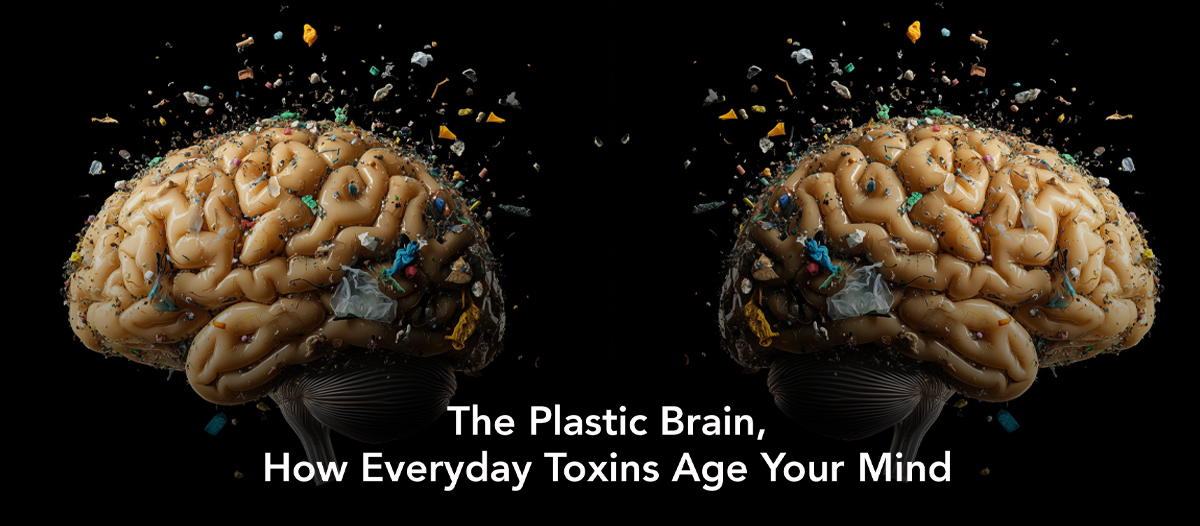
The Plastic Brain, How Everyday Toxins Age Your Mind
Quick Summary
Our brains were never meant to be soaked in plastic. Yet from the moment we wake up to the moment we sleep, we’re surrounded by synthetic chemicals — many of which mimic hormones and quietly sabotage our neurological health. This blog explores how plastics and phthalates act as endocrine disruptors, accelerating brain aging, fueling neuroinflammation, and contributing to brain fog, memory loss, and even early cognitive decline.
Key Takeaways
- Plastics and phthalates are potent endocrine disruptors, mimicking or blocking hormones like estrogen, testosterone, and thyroid hormones.
- The brain is a hormone-sensitive organ — disrupting hormone signaling can lead to premature brain aging, neuroinflammation, and cognitive dysfunction.
- Microplastics cross the blood-brain barrier, raising concern about long-term accumulation and neurotoxicity.
- Recent research links phthalate exposure to reduced memory, altered brain structure, and higher risk of dementia.
- You can take proactive steps to reduce exposure and support brain detox pathways using diet, lifestyle, herbs, and targeted nutrients.
The Plastic Brain, How Everyday Toxins Age Your Mind
by Mark J Kaylor
“Plastic isn’t just in your water bottle. It may be in your neurons.”
Modern life has a plastic problem — and not just the kind that clogs oceans or clutters landfills. Increasingly, science is revealing that the same compounds used to soften plastics and preserve products are slipping silently into our bodies, disrupting hormones and aging our brains from the inside out.
Plastics like phthalates and bisphenols are everywhere: in packaging, cosmetics, clothing, food containers, receipts, medical devices, and even the dust in your home. And because these are endocrine-disrupting chemicals (EDCs), they don’t just sit passively in the body — they mimic or interfere with hormones, many of which are vital to brain function and longevity.
The brain, it turns out, is exquisitely sensitive to hormones. Estrogen, testosterone, thyroid hormones, and cortisol don’t just govern reproduction or metabolism — they shape neural structure, guide synaptic signaling, regulate inflammation, and protect against degeneration. So when these hormones are disrupted by synthetic chemicals, the result isn’t just hormonal chaos — it’s neurological harm.
This isn’t a far-off concern. Microplastics have now been detected in human blood, lungs, breast milk — and yes, even brain tissue.
What does this mean for your memory, focus, and long-term cognitive health? And more importantly, what can you do about it?
Let’s take a closer look.
Hormones and the Brain: Why Endocrine Disruptors Are So Dangerous
The human brain is not just a thinking machine — it’s a hormonally attuned organ, deeply responsive to the ebb and flow of chemical messengers. These hormones don’t merely influence mood or sex drive — they regulate neurodevelopment, memory formation, immune response, and even structural brain integrity.
Let’s take estrogen, for example. Often pigeonholed as a reproductive hormone, estrogen also acts as a neuroprotective agent, enhancing synaptic plasticity, reducing inflammation, supporting mitochondrial health, and guarding against oxidative stress. In both women and men, estrogen plays a crucial role in maintaining cognitive clarity, emotional balance, and brain resilience.
But what happens when synthetic chemicals masquerade as estrogen or block its effects?
That’s the insidious power of endocrine-disrupting chemicals (EDCs) like phthalates, bisphenol A (BPA), and their cousins. These compounds bind to hormone receptors or interfere with hormone synthesis, metabolism, and signaling. The result is a biological confusion that ripples outward — especially in the delicate, hormone-sensitive environment of the brain.
Studies have linked EDC exposure to:
- Increased neuroinflammation
- Altered brain structure, particularly in areas tied to memory and executive function
- Disrupted neurotransmitter signaling (including dopamine and serotonin)
- Greater risk for depression, anxiety, ADHD, and dementia
- Impaired thyroid hormone action, which is essential for brain metabolism and energy
And it’s not just about what’s happening in the brain now — it’s about the acceleration of brain aging.
In other words, exposure to everyday plastic compounds isn’t just unhealthy — it may be aging your mind prematurely.
The Rise of the Plastic Brain: What the Research Shows
Until recently, the idea that microplastics and chemical residues from plastics could accumulate in the brain sounded far-fetched. But emerging studies are now sounding the alarm:
- A 2023 study in Environment International found that phthalate exposure was significantly associated with reduced working memory and slower processing speed in adults — even at common exposure levels.
- Animal studies reveal that BPA and similar compounds can cross the blood-brain barrier, triggering inflammation and altering hippocampal function (the region central to learning and memory).
- Research from 2022 showed that nanoplastics can accumulate in brain tissue, potentially disrupting neuron-to-neuron communication and increasing oxidative stress.
- In prenatal and early childhood exposure studies, children born to mothers with high phthalate levels have been found to exhibit lower IQ, attention problems, and reduced cortical thickness — all early signs of neurodevelopmental disruption.
We are only beginning to understand the full implications, but the trend is clear: chronic low-level exposure to plastic-derived chemicals is neurologically disruptive, especially over time.
Everyday Exposure: Where Are These Chemicals Hiding?
You don’t need to live near a chemical plant to be affected. Plastics and phthalates are woven into the fabric of daily life:
- Plastic food packaging and water bottles (especially when heated)
- Canned food linings (BPA and BPA analogues)
- Cosmetics and personal care products (fragrance often = phthalates)
- Vinyl flooring and shower curtains
- Fast food (especially meat and cheese wrapped in plastic)
- Receipts (thermal paper is often coated with BPA or BPS)
- Household dust — yes, really
These chemicals are not chemically bound to the products they’re in, meaning they can leach, flake, or volatilize into air, food, and skin.
And once they’re in your body, they can mimic hormones, scramble signaling, and stoke inflammation.
Defending the Brain: Diet, Detox, and Daily Shifts
We may not be able to eliminate all plastic exposures — but we can reduce our body burden and fortify our brains against the damage. The key is to shift from passive exposure to active resilience — through food, lifestyle, and a deeper awareness of what supports long-term neurological health.
🧠 Filter Your Food, Filter Your Future
- Avoid heating food in plastic containers — heat accelerates chemical leaching. Use glass or stainless steel.
- Minimize processed and packaged foods. Especially avoid fast foods wrapped in plastic and microwavable meals.
- Choose fresh, organic produce and lean into local food sources — less packaging, fewer contaminants.
- Use a quality water filter, ideally one certified to remove microplastics, BPA, phthalates, and other endocrine-disrupting chemicals.
Filter Type |
Removes Microplastics |
Removes BPA/Phthalates |
Removes Pharmaceuticals |
Typical Cost |
NSF/ANSI 53/401 Certified Options |
| Reverse Osmosis (RO) | ✔️ | ✔️ | ✔️ | High | ✔️ |
| Activated Carbon (Block) | ➖ | ✔️ | ➖ | Moderate | ✔️ |
| Ion Exchange (Combo) | ➖ | ✔️ | ➖ | Moderate | ✔️ |
| Simple Pitcher Filters | ❌ | ❌ | ❌ | Low | Rare |
Look for NSF/ANSI 53 or 401 certifications, which indicate filters tested for plasticizers and pharmaceuticals.

🌿 Strengthen Detox Pathways with Food and Herbs
- Cruciferous vegetables like broccoli and arugula (rich in sulforaphane)
- Chlorella, cilantro, and parsley for chelation and detox support
- Turmeric, green tea, and rosemary to reduce oxidative stress and support the liver
- Milk thistle, dandelion root, and schisandra as traditional liver tonics
🏃♂️ Move Your Body, Clear Your Brain
- Enhances lymphatic and circulatory flow
- Increases sweating, which may excrete plasticizers
- Boosts neurogenesis and cognitive resilience
- Helps the body reset inflammation levels
🧘 Minimize the Load, Maximize the Mind
- Switch to phthalate-free personal care products
- Decline receipts or handle minimally
- Ventilate and dust your home regularly
- Consider natural alternatives to vinyl or synthetic furnishings
A Brain Worth Protecting
Your brain is not replaceable. It holds your memories, your creativity, your instincts, your voice, your love, your dreams. It is the seat of your awareness, your presence, your ability to care and connect.
And it is under siege.
Plastics and phthalates aren’t just cluttering the oceans — they’re crowding into our biology, mimicking hormones, and disrupting the finely tuned systems that support mental clarity, emotional balance, and long-term cognitive health. Quietly, invisibly, they accumulate — contributing to the very symptoms we often chalk up to stress or aging: brain fog, fatigue, forgetfulness, scattered focus, and even early cognitive decline.
But this doesn’t have to be your story.
You have more power than you’ve been told.
Science shows that when we reduce exposures — even slightly — the body responds. Hormone levels rebalance. Inflammation decreases. Energy returns. The fog begins to lift.
Protecting your brain isn’t about fear — it’s about reverence. It’s about honoring the sacred intelligence of the body and reclaiming a deeper sovereignty over your health. Because radiant health is not just a state — it’s a relationship. With your body. With the world around you. And with the choices you make each day.
The Invitation: Rewire the Story, Reclaim the Mind
You don’t need to live in a bubble to protect your brain — you need to live on purpose.
- Swap plastic containers for glass and stainless steel.
- Choose clean foods over convenience packaging.
- Sweat often, laugh freely, rest deeply.
- Get curious about the chemicals in your life, and compassionate with the process of letting them go.
- Feed your brain with real nourishment — nutritionally, emotionally, spiritually.
At Journey to Radiant Health, we believe that healing begins with awareness and grows through small, meaningful steps. You don’t need perfection. You need intention.
💡 Start here:
Pick just one plastic-reducing change to make this week.
Then one more next week.
Notice how you feel. Notice what clears.
Your brain is not plastic. But it is responsive. It is alive. It is listening.
And it is absolutely worth protecting.

Mark J. Kaylor is a passionate advocate for holistic health and natural remedies, with a focus on extending both lifespan and healthspan. As the founder of the Radiant Health Project and host of Radiant Health Podcast, Mark blends in-depth research with traditional wisdom to empower others on their journey to vibrant health. Through his writing and speaking, he shares insights into the transformative power of herbs, nutrition, and lifestyle practices.
Disclaimer: All information and results stated here is for educational and entertainment purposes only. The information mentioned here is not specific medical advice for any individual and is not intended to be used for self-diagnosis or treatment. This content should not substitute medical advice from a health professional. Always consult your health practitioner regarding any health or medical conditions.