


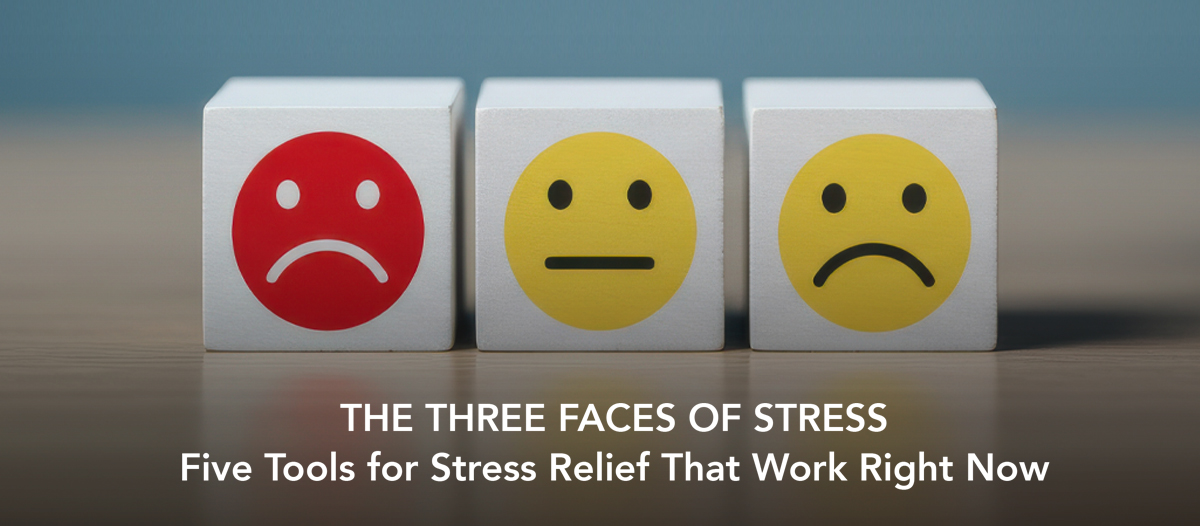
The Three Faces of Stress:
Five Tools for Stress Relief That Work Right Now
Part One
By Mark J Kaylor
Not all stress is the same. The body knows this even when our language doesn’t. The jolt of an unexpected crisis feels nothing like the slow erosion of chronic pressure, and neither of those resembles the quiet exhaustion of a mind that keeps returning to the same worry. Each has its own face, its own biology, and its own path through. This three-part series explores all three.
AT A GLANCE
- Acute stress is the body’s intelligent rapid-response system, not a malfunction
- Five research-backed tools can shift your stress response in real time
- These tools work with your biology, not against it
- Practical application matters more than perfect technique
In our last conversation, we explored something that tends to get lost in how stress is usually discussed: what you believe about stress shapes how your body responds to it. The appraisal is part of the biology. The story you carry about whether you have the resources to meet a stressor influences your hormonal profile, your cardiovascular response, and the conditions in which healing either flourishes or struggles.
That was the foundation. This is where it gets practical.
Acute stress is the first face. It is the kind that doesn’t ask permission. It arrives in a phone call, a near-miss on the highway, a conversation that turns sideways without warning. Your heart rate climbs. Your thinking narrows. Your body shifts into a mode it has been rehearsing for a very long time.
Before reaching for tools to manage it, it is worth pausing on something that tends to get flattened in the usual stress conversation: this response is not a flaw. The physiological cascade that accompanies acute stress is one of the more elegant pieces of biological engineering we carry. It sharpens perception, mobilizes energy, and focuses attention with a speed no conscious effort can match. The problem is not that it activates. The problem is when it cannot find its way back to baseline.
That is where the tools below come in. None of them are about suppressing the stress response. They are about completing it, giving the nervous system what it needs to move through activation and return to equilibrium. That distinction matters more than it might initially seem.
-
The Physiological Sigh
Of all the tools available for acute stress, this one has among the most immediate physiological effects, and it requires nothing but breath.
The technique is simple: two inhales through the nose, the second one brief and sharp to fully inflate the lungs, followed by one long, slow exhale through the mouth. That sequence activates the parasympathetic nervous system with a directness that slower breathing techniques don’t match.
The mechanism involves the tiny air sacs in the lungs called alveoli. Under stress, many of them collapse slightly. The double inhale re-inflates them, which stretches receptors in the lung tissue and triggers a parasympathetic signal that travels up through the vagus nerve to the brain. Stanford neuroscientist Andrew Huberman and colleagues have studied this response in detail, and the findings consistently show that even a single physiological sigh produces measurable reductions in physiological arousal.
You already do this naturally, by the way. That involuntary double-breath that sometimes overtakes you during a long cry or a tense moment is the body doing this on its own. The practice is simply learning to initiate it consciously.
-
Cognitive Reappraisal
If you read the previous piece in this series, you already know that how you appraise a stressor shapes your physiological response to it. Threat appraisal and challenge appraisal produce genuinely different hormonal profiles, different cardiovascular signatures, different conditions for recovery. That is not a metaphor. It is measurable biology.
Reappraisal is not positive thinking. It is not telling yourself that something difficult isn’t really difficult. It is the practice of asking whether the story you are telling about a situation is the only possible story. Often, under acute stress, we are operating from an interpretation that feels like fact. The pressure to perform becomes evidence that we are inadequate. The conflict with a colleague becomes a sign that things are fundamentally broken. The difficulty itself becomes a verdict.
A single honest question, asked with genuine curiosity rather than forced optimism, can shift that. What else might be true here? What would I tell a friend in this situation? Is there any part of this that could be approached rather than survived?
The physiological shift that follows a genuine reappraisal is not subtle. Cortisol patterns change. Cardiovascular reactivity changes. The body responds to the new interpretation as readily as it responded to the original one.
-
Cold Water Face Immersion
This one tends to surprise people, which is part of why it is worth including.
Submerging your face in cold water, or splashing cold water on your face and the back of your neck, triggers what physiologists call the diving reflex. This is an ancient mammalian response, shared across species, that slows the heart rate and redistributes blood flow when the face detects cold water. It activates via the trigeminal nerve and produces parasympathetic effects through vagal stimulation.
The result is a rapid drop in heart rate that can begin within seconds. For moments of acute stress where the physiological activation is pronounced, this is one of the fastest mechanical interventions available.
It is also worth noting that cold water has a long history across many healing traditions as a tool for clearing heat, settling agitation, and restoring groundedness. What modern physiology describes in terms of the diving reflex, Ayurveda and traditional hydrotherapy practitioners intuited through careful observation long before the mechanism was mapped.
-
A Brief Body Scan
Acute stress pulls awareness upward and inward, into the head, into the narrative, into the loop of worry and anticipation. One of the most effective interruptions to that pattern is not a counter-thought but a shift of attention itself.
A body scan in this context doesn’t need to be a formal meditation. It is simply the practice of deliberately moving awareness through the body for two or three minutes, noticing physical sensation without trying to change it. Feet on the floor. Weight in the chair. Breath in the chest. Tension in the shoulders. Temperature of the hands.
The research on brief mindfulness practices for acute stress shows consistent effects on perceived stress and autonomic arousal. But the mechanism is worth understanding at a deeper level. Acute stress is partly maintained by a narrowing of attention onto the threat. The body scan doesn’t eliminate the stressor. It widens the field of awareness to include the body as a whole, which naturally dilutes the intensity of the stress experience.
In TCM terms, this can be understood as a way of returning Qi to the lower body and the center, countering the upward and outward scatter that characterizes the stress state. When Shen is unsettled by acute stress it tends to scatter. The simple, deliberate act of feeling your feet on the floor is one of the quietest ways to begin gathering it back. The grounding quality of that practice is not metaphorical. It has a real regulatory effect.
-
Genuine Social Contact
Perhaps the most underestimated tool on this list.
When we think of managing acute stress, we tend to think in terms of solitary techniques. Breathing exercises, reframing, cold water. But human beings are profoundly social organisms, and our nervous systems are designed to co-regulate with the nervous systems of others. A short, genuine exchange with someone we trust, not distraction through a phone screen but real contact, real presence, real exchange, produces measurable physiological effects.
The primary mechanism involves oxytocin, which is released during positive social contact and directly counters some of the effects of cortisol. But there is something more than chemistry at work. Polyvagal theory, developed by neuroscientist Stephen Porges, describes how cues of safety from another person, their facial expression, tone of voice, and body language, directly regulate our own autonomic state through pathways that predate our capacity for language.
This is why a few minutes with the right person can shift an acute stress state in a way that solo techniques sometimes cannot. We are wired for it. The stressed nervous system is partly asking to be met.
Coming Back to Center
These five tools share something worth naming. None of them fight the stress response.
This is worth sitting with, because most of what we are taught about stress relief is framed as opposition. Calm down. Suppress it. Override it. Get it under control. That framing positions the stress response as an adversary, something to be defeated or at least contained. It also, not coincidentally, tends not to work very well.
The stress response is not a malfunction asking to be corrected. It is a system asking to be completed. Activation wants to move through to resolution. The nervous system that fires up under acute stress is looking for a return path, and the tools that work best are the ones that offer it one.
The physiological sigh gives the nervous system a direct biological signal that the threat has passed. Reappraisal changes the input the system is responding to. Cold water immersion engages an ancient reflex that the body already knows. The body scan widens awareness back out from the narrowed tunnel of threat. Social contact offers the co-regulatory signal that we are safe enough to settle.
Each of these is less an intervention than an invitation. Come back. The moment has passed. You can let go now.
This is what working with biology looks like, as opposed to working against it. And it points toward something larger about what radiant health actually means. Not the suppression of our responses to life, but the cultivation of a nervous system supple enough to move through them fully and find its way home.
✨ SERIES NOTE
Part Two of The Three Faces of Stress explores chronic stress, the slow accumulating kind, and the practices that build genuine resilience over time.
KEY TAKEAWAYS
- Acute stress is a biological intelligence, not a malfunction. The goal is to work with it, not against it.
- The physiological sigh, a double inhale followed by a long exhale, is one of the fastest known methods for downshifting autonomic arousal.
- How we interpret a stressor shapes our physiological response to it. Reappraisal is not optimism; it is biology.
- Cold water face immersion triggers the diving reflex and can produce rapid reductions in heart rate.
- A brief body scan widens the field of awareness and counters the attentional narrowing of acute stress.
- Genuine social contact activates co-regulatory biology that solitary techniques cannot fully replicate.
- A nervous system that can move fluidly through activation and return to ease is not just resilient. It is one of the hallmarks of a radiant, fully alive life.

Mark J. Kaylor is a passionate advocate for holistic health and natural remedies, with a focus on extending both lifespan and healthspan. As the founder of the Radiant Health Project and host of Radiant Health Podcast, Mark blends in-depth research with traditional wisdom to empower others on their journey to vibrant health. Through his writing and speaking, he shares insights into the transformative power of herbs, nutrition, and lifestyle practices.
The Radiant Health Project is a not-for-profit initiative dedicated to cutting through wellness industry hype and sharing evidence-informed, traditional wisdom for genuine health.
Disclaimer: All information and results stated here is for educational and entertainment purposes only. The information mentioned here is not specific medical advice for any individual and is not intended to be used for self-diagnosis or treatment. This content should not substitute medical advice from a health professional. Always consult your health practitioner regarding any health or medical conditions.
Leave A Comment