


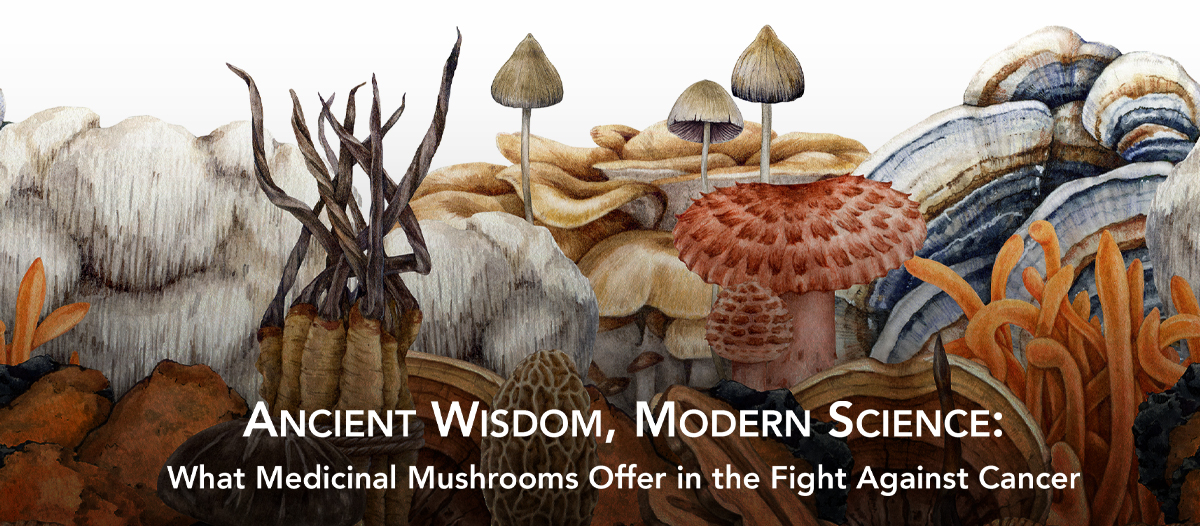
Ancient Wisdom, Modern Science:
What Medicinal Mushrooms Offer in the Fight Against Cancer
by Mark J Kaylor
Based on peer-reviewed research published in the International Journal of Molecular Sciences, 2022
If you or someone you love has faced a cancer diagnosis, you know what it feels like to want every possible ally on your side. You scrutinize everything. You ask questions your oncologist may not have time to answer. And somewhere along the way, you may have heard that certain mushrooms, the kind long revered in Asian healing traditions, might have something to offer.
That instinct deserves a serious response, not a sales pitch and not a dismissal. What follows is an honest look at what the science actually shows, drawn from a 2022 review published in the International Journal of Molecular Sciences that examined the current clinical and laboratory evidence for medicinal mushrooms in cancer treatment. The findings are genuinely encouraging in places, still evolving in others, and always more nuanced than the headlines suggest.
A Tradition That Predates the Lab
Healers across East Asia have drawn on mushrooms for thousands of years. Reishi (Ganoderma lucidum), Shiitake (Lentinula edodes), Turkey Tail (Trametes versicolor), Maitake (Grifola frondosa), and Chaga (Inonotus obliquus) are among the species that appear most prominently in both traditional texts and modern research. The researchers who authored this review noted that among roughly 14,000 mushroom species, approximately 700 have demonstrated some degree of medicinal activity.
Traditional medicine did not need molecular biology to recognize that these organisms supported vitality and resilience in ways that went beyond ordinary nutrition. Today, science is beginning to understand why, and the picture that emerges is one of remarkable biological complexity.
What Mushrooms Actually Contain
The primary anticancer compounds in medicinal mushrooms fall into a few broad families. Polysaccharides, and among them a class called beta-glucans, are the most studied. Beta-glucans are long-chain sugars that the human immune system recognizes as foreign, triggering a cascade of immune activation that includes natural killer cells, T cells, B cells, and macrophages, all of which play roles in identifying and eliminating cancer cells.
Think of beta-glucans as a kind of training exercise for the immune system. Rather than fighting cancer directly, they rouse and organize the body's own defenses. This is a fundamentally different approach from most chemotherapy drugs, which aim to poison or destroy cancer cells directly, and it explains why mushroom compounds are attracting attention as potential partners, not replacements, for conventional treatment.
Beyond beta-glucans, mushrooms also contain triterpenoids (in Reishi, these include ganoderic acids), polyphenols like hispolon (from Phellinus linteus and related species), and cordycepin (from Cordyceps), a compound structurally similar to a building block of DNA that has shown the ability to interfere with cancer cell replication. Each of these compounds works through distinct mechanisms, and researchers believe their combined presence in whole mushroom preparations may produce synergistic effects, meaning the whole works better than any single part.
Clinical Evidence: Where We Actually Stand
This is where intellectual honesty matters most. The research review documents real clinical findings, and they are worth knowing. It also documents real limitations.
In a randomized controlled trial, patients with advanced adenocarcinoma who received Antrodia cinnamomea alongside chemotherapy experienced significantly less severe gastrointestinal side effects, including abdominal pain and diarrhea, compared to those receiving chemotherapy alone. Patients with gynecological cancers who used Agaricus blazei Murill during chemotherapy reported fewer side effects overall, including less hair loss, less weakness, and better appetite, while also showing measurably enhanced natural killer cell activity. These are the immune cells whose job is to find and destroy cancer cells.
In breast cancer patients, Reishi (Ganoderma lucidum) reduced cancer-related fatigue in one randomized controlled trial. A phase I/II trial with Maitake extract in breast cancer patients found that it functioned as an immunomodulator, measurably increasing the production of key immune-signaling proteins called cytokines. In advanced liver cancer, Turkey Tail (Trametes versicolor) was associated with longer overall survival compared to a placebo group in a controlled trial. In advanced lung cancer, patients receiving Reishi polysaccharides showed notably improved cancer-related symptoms including fatigue, cough, and insomnia.
Multiple myeloma patients treated with Agaricus blazei Murill extract maintained healthier white blood cell counts and experienced fewer infections than the placebo group. In Japan, three mushroom-derived compounds (lentinan from Shiitake, schizophyllan from Schizophyllum commune, and PSK from Turkey Tail) are already approved as prescription anticancer drugs.
The consistent pattern across these trials is not that mushrooms cure cancer. The pattern is that they support the body's capacity to endure treatment, sustain immune function, and in some contexts, slow disease progression. These are not trivial contributions.
At the same time, the review is frank about the gaps. Sample sizes in many trials are small. Preparation and dosing are not yet standardized. Long-term follow-up data are limited. More and larger trials are needed before firm clinical protocols can be established.
How Mushrooms Work: The Molecular Story
For those who want to understand the mechanisms, here is a plain-language summary of what researchers have found.
Cancer cells are, among other things, masters of evasion. One of their most important tricks is hijacking the immune system's own off-switch. Your immune system has built-in braking mechanisms, called immune checkpoints, that prevent it from attacking the body's own tissues. Cancer cells exploit these checkpoints to hide in plain sight.
Researchers have found that beta-glucans from medicinal mushrooms can work alongside immune checkpoint therapies, the same class of drugs that has revolutionized cancer treatment in recent years, by helping re-engage immune surveillance when it has gone dormant. In laboratory studies, Reishi reduced levels of a key checkpoint protein called PD-1 in human immune cells. Chaga was found to block a different checkpoint interaction (CTLA-4/CD80) that cancer cells use to suppress T cell activity. These are the same pathways targeted by some of the most celebrated immunotherapy drugs now in clinical use.
Another major obstacle in cancer treatment is multidrug resistance, a phenomenon in which cancer cells develop the ability to pump chemotherapy drugs back out before they can do their work. Compounds from Trametes versicolor and certain compounds from Taiwanofungus camphoratus have shown the ability to inhibit this pumping mechanism, potentially restoring sensitivity to drugs that cancer cells had learned to resist.
Several mushroom compounds also interfere with cellular signaling pathways that cancer cells depend on for growth, spread, and survival. The PI3K/AKT pathway (a series of molecular signals that tell cells to grow and divide) is a target for hispolon from Phellinus linteus and ganoderic acid from Reishi. The Wnt/beta-catenin pathway (which, when abnormally activated, drives colon and other cancers) is disrupted by compounds from Antrodia camphorata, Phellinus linteus, and Chaga. The NF-kB pathway (which promotes inflammation and helps cancer cells survive) is inhibited by cordycepin from Cordyceps and by compounds from Reishi and Maitake.
In plain terms: these mushrooms appear to speak a molecular language that cancer cells use, and they may be able to interrupt conversations that cancer depends on to thrive.
The Gut Connection
One dimension of mushroom research that receives less attention but may prove to be deeply important is their effect on the gut microbiome, the vast community of microorganisms living in the digestive tract that profoundly influences immune function, inflammation, and overall health.
Medicinal mushrooms contain chitin, beta-glucans, and other complex carbohydrates that function as prebiotics, meaning they selectively nourish beneficial bacteria in the gut rather than being digested directly. A well-nourished gut microbiome supports more robust immune responses, and researchers are increasingly recognizing that the health of the microbiome may influence how well both conventional and integrative cancer therapies work. This is an area of active investigation, and mushrooms may have a meaningful role to play in it.
How to Hold This Information
If you are navigating a cancer diagnosis or supporting someone who is, the most important thing to understand is that medicinal mushrooms, based on the current evidence, are best understood as supportive companions to conventional treatment rather than alternatives to it. The clinical evidence suggests real benefits in quality of life, immune support, and reduced side effects during chemotherapy and radiation. Some data suggests effects on disease progression as well.
They are not magic. They are not cures. But they are biologically active, they have been used safely for centuries, and the modern science behind them is steadily deepening. Dismissing them entirely would be as inaccurate as overstating what they can do.
If you are considering adding medicinal mushrooms to a treatment protocol, the conversation belongs with your oncologist or integrative medicine practitioner. Some mushroom compounds may interact with certain medications, and some preparations vary widely in quality and potency. Choosing well-standardized, reputable preparations matters. Transparency with your medical team matters.
What also matters is this: the tradition that has reached across millennia to offer these organisms as allies in human health was not wrong. Science is now beginning to understand the depth of what was already known.
Mushrooms Worth Knowing
The following species have the most substantial research behind them in the context of cancer support. Reishi (Ganoderma lucidum) is perhaps the most extensively studied, with documented effects on fatigue, immune function, and several key signaling pathways. Turkey Tail (Trametes versicolor) has clinical trial data supporting its use in liver cancer and breast cancer, and its beta-glucan fraction (PSK) is an approved pharmaceutical in Japan. Shiitake (Lentinula edodes) contributes lentinan, another approved drug in Japan, with documented immune-stimulating effects. Maitake (Grifola frondosa) has shown immunomodulatory activity in breast cancer patients. Chaga (Inonotus obliquus) has demonstrated multiple mechanisms relevant to cancer, including immune checkpoint modulation and anti-inflammatory action. Cordyceps contributes cordycepin, a compound that directly interferes with cancer cell replication.
Each of these has a distinctive profile, and the choice of which to use, and how, is best guided by knowledgeable practitioners who can match the mushroom's properties to an individual's situation.
A Final Thought
There is something quietly profound about the fact that organisms that spend their lives breaking down and transforming matter in the forest are now being studied for their capacity to help the human body resist one of its most devastating conditions. The forest has always been a pharmacy. We are only beginning to read its labels with the tools we now have.
The science is young in some respects and ancient in others. What it consistently points toward is the wisdom of supporting the body's own intelligence, its immune vigilance, its ability to distinguish self from threat, its resilience under pressure. Medicinal mushrooms have been doing this for a very long time. The modern laboratory is catching up.
Source: Park, H-J. "Current Uses of Mushrooms in Cancer Treatment and Their Anticancer Mechanisms." International Journal of Molecular Sciences, 23(18), 10502. Published September 2022. doi:10.3390/ijms231810502

Mark J. Kaylor is a passionate advocate for holistic health and natural remedies, with a focus on extending both lifespan and healthspan. As the founder of the Radiant Health Project and host of Radiant Health Podcast, Mark blends in-depth research with traditional wisdom to empower others on their journey to vibrant health. Through his writing and speaking, he shares insights into the transformative power of herbs, nutrition, and lifestyle practices.
The Radiant Health Project is a not-for-profit initiative dedicated to cutting through wellness industry hype and sharing evidence-informed, traditional wisdom for genuine health.
Disclaimer: All information and results stated here is for educational and entertainment purposes only. The information mentioned here is not specific medical advice for any individual and is not intended to be used for self-diagnosis or treatment. This content should not substitute medical advice from a health professional. Always consult your health practitioner regarding any health or medical conditions.
Leave A Comment