


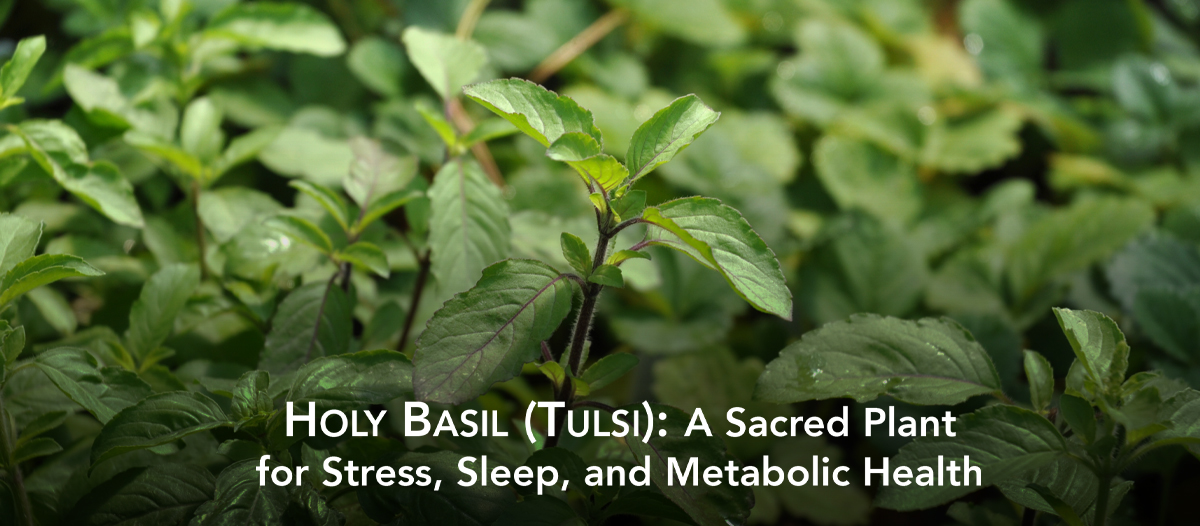
Holy Basil (Tulsi):
A Sacred Plant for Stress, Sleep, and Metabolic Health
by Mark J Kaylor
Of all the adaptogens I’ve worked with over the years, Tulsi holds a special place. Not just for what it does, but for how it invites relationship. In many Indian homes, Tulsi is not a supplement but a household presence, enshrined in courtyards and woven into daily ritual. This distinction between plant-as-medicine and plant-as-relationship is exactly what drew me to it, and it’s what gets lost when Tulsi is reduced to “holy basil capsules for stress.”
The cultural reality is worth pausing over. In traditional contexts, Tulsi isn’t kept in a medicine cabinet. It grows at the threshold, receives daily offerings, and functions as both guardian and teacher. Households tend it, honor it, relate to it as something alive and reciprocal. Compare this with how we typically encounter herbs in modern wellness culture: isolated compounds, standardized extracts, dosing schedules divorced from context or rhythm.
What follows is an invitation to meet Tulsi on different terms. Not as another calming adaptogen in an already crowded market, but as a small family of sacred basils that act on what I’ve come to think of as the whole stress ecology: the web of interactions between nervous system, hormones, immune function, metabolism, sleep, and the capacity to remain present under load. This is what traditional practitioners sensed, and what modern research is beginning to measure.
A Sacred Herb with Many Faces: History and Varieties
Sacred and Historical Role
In Vaishnava traditions, Tulsi is understood not merely as a useful plant but as an embodiment of the divine. The practice involves daily offerings, circumambulation, and the plant’s protective presence at the household threshold. This is not metaphor or symbolic gesture. It reflects a cosmology in which certain plants serve as bridges between the material and the subtle, the earthly and the transcendent.
Classical Ayurveda positions Tulsi as a rasayana, a category of herbs used for rejuvenation, longevity, and the cultivation of clarity. The term translates roughly as “that which promotes the path of essence,” and rasayanas are employed not to treat specific diseases but to support the organism’s fundamental coherence. In this framework, Tulsi addresses respiratory resilience, digestive balance, mental fog, and devotional focus. It is described as blending soma (nourishment, cooling, building) with tapas (clarity, discipline, purification).
Traditional uses include support for colds, coughs, fevers, asthma, digestive upset, and as a daily tonic taken “for all reasons.” This last phrase is telling. Tulsi isn’t reserved for crisis. It’s a maintenance herb, a practice of tending to baseline resilience so that when stressors arise, the system has more bandwidth to respond.
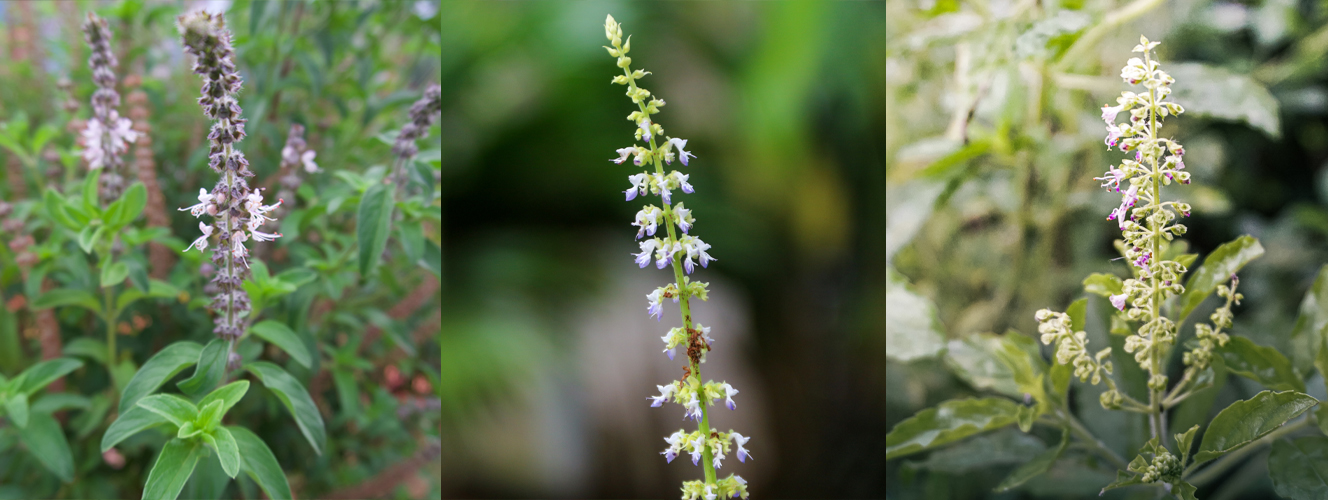
Not One Plant: The Main Tulsi Types
Here’s where things get interesting for those of us who work with plants beyond the level of brand names and ingredient lists. “Tulsi” is not a single botanical entity. It’s a family of closely related basils, each with distinct chemistry, energetics, and traditional applications. Knowing the varieties allows for constitutional matching, which is how plant medicine becomes genuinely personalized rather than generic.
Rama (Sri) Tulsi — Ocimum tenuiflorum, green type
Appearance: green leaves and stems, white or pale flowers.
Flavor and aroma: sweet, clove-like, relatively gentle.
Energetics: slightly cooling, gently calming and clarifying. This is the all-purpose daily Tulsi, often used in teas. It’s well-suited for people who tend to run hot or tense but need steady clarity without sedation. Good for vata-pitta constitutions requiring soothing without heaviness.
Krishna (Shyama) Tulsi — Ocimum tenuiflorum, purple type
Appearance: darker green to purple foliage, more dramatic coloration.
Flavor and aroma: spicier, peppery, often described as “more medicinal.”
Energetics: more warming and stimulating. This variety is often favored for kapha patterns: sluggishness, respiratory congestion, heavy digestion, slow mornings. If you need to move stagnation rather than calm agitation, Krishna Tulsi is the better choice.
Vana Tulsi — Ocimum gratissimum, “forest” Tulsi
Appearance: larger, jagged green leaves, often more wild in growth habit.
Flavor and aroma: bright, lemony, uplifting.
Energetics: gently warming and uplifting. This is the Tulsi for stagnant moods, foggy mornings, digestive sluggishness. It brings lightness and lift rather than sedation. If you need to clear the cobwebs and restore a sense of possibility, Vana is worth considering.
Other Named Types
Amrita Tulsi (Krishna × Vana hybrid) is marketed as a robust, balanced Tulsi. Kapoor or temperate Tulsi grows well in cooler climates and tends to be very aromatic, often closer in feel to Rama.
The point here is not to memorize botanical taxonomy but to recognize that these are all “Tulsi” with different signatures. This matters. It offers a chance to match plant to person rather than treating all holy basil as interchangeable.

Tulsi as Stress Ecology Medicine
Rethinking Stress as Ecology, Not Just Cortisol
Pay attention to how you experience stress for a moment. Not the concept of it, but the actual felt sense. It’s not just one thing, is it? There’s the racing thoughts, yes. But there’s also the tightness in the chest, the disrupted sleep, the sugar cravings at 3pm, the way you get a cold every time you push hard for two weeks. Stress doesn’t live in one system. It reverberates through the whole organism.
This is what I mean by stress ecology. It’s the web of interactions between nervous system signaling, hormonal cascades, immune function, metabolic regulation, sleep architecture, and behavioral patterns. Change the load on one node, and the whole web shifts. Support one system, and you’re indirectly supporting several others.
Most wellness discourse fixates on cortisol. Lower your cortisol, manage your HPA axis, optimize your stress response. It’s not wrong, but it’s like trying to understand a forest by only measuring rainfall. You’re missing the soil composition, the mycorrhizal networks, the way light filters through the canopy.
When traditional practitioners described Tulsi as a rasayana that addresses “all reasons,” they weren’t being vague. They were observing systemic coherence. The herb doesn’t just target one pathway. It modulates multiple nodes in the stress ecology simultaneously. This is what modern trials are starting to measure, though the language has changed.
Neuroendocrine and Mood Benefits
Here’s what people actually report when they use Tulsi consistently: not dramatic transformations, but a kind of settling. You still encounter the same stressors, the same difficult conversations, the same traffic and deadlines and family tensions. But the baseline hum of reactivity quiets down. You’re not so quick to flare up, not so easily pulled off center.
The clinical data bears this out. Human trials show decreased perceived stress, lower anxiety scores, fewer depressive symptoms. Sleep quality improves. Cognitive function sharpens. These aren’t massive effect sizes, but they’re consistent and clinically meaningful.
What’s happening underneath? Tulsi appears to modulate the HPA axis, the body’s central stress response system. It provides antioxidant protection in the brain (oxidative stress accelerates neurodegeneration and mood disorders). There’s some evidence for GABA and glutamate modulation, and clear attenuation of stress-related inflammation in neural tissue.
But here’s the crucial distinction: Tulsi doesn’t work like a sedative. You don’t get drowsy or mentally dulled. The effect is more like someone turning down the gain on an overdriven amplifier. The signal remains clear, but the distortion drops out. You stay alert and responsive, but the anxious static in the background quiets.
I’ve watched this pattern repeatedly in people who commit to daily Tulsi for a month or more. They don’t report feeling “calmed down” in the way you might with chamomile or valerian. They report feeling clearer. More available to what’s actually happening rather than caught in loops of anticipatory anxiety or rumination.

Metabolic and Cardiometabolic Resilience
This is where Tulsi separates itself from most adaptogens, and it’s worth lingering over.
Stress and metabolism are not separate territories. They’re the same territory viewed from different angles. Chronic activation of stress pathways drives insulin resistance. It promotes visceral fat accumulation. It disrupts lipid metabolism and accelerates cardiovascular aging. When cortisol is chronically elevated, your cells become less responsive to insulin’s signal to take up glucose. Your liver starts churning out more cholesterol and triglycerides. Your blood pressure creeps upward.
Tulsi addresses both sides of this equation. Clinical trials show modest but consistent improvements: fasting and postprandial glucose drop. Lipid profiles improve (total cholesterol, LDL, triglycerides all trending in the right direction). Blood pressure comes down slightly. Markers of oxidative stress decrease.
None of this is dramatic enough to reverse established metabolic disease on its own. But for people navigating that murky territory where labs are starting to drift out of range, where fasting glucose is creeping from 95 to 105, where triglycerides are edging upward, Tulsi offers something genuinely useful. It’s addressing the whole pattern: the stress load that’s driving metabolic dysfunction, and the metabolic dysfunction itself.
Think of it this way: if you’re trying to recalibrate metabolism while cortisol is still running hot, you’re fighting uphill. Tulsi helps normalize the terrain so that dietary changes, exercise, and other metabolic interventions have better traction.

Immune and Respiratory Boundary Support
The traditional use of Tulsi for respiratory infections isn’t folk superstition. The plant’s essential oils have demonstrable antimicrobial and anti-inflammatory activity. Small trials show improved immune markers and better clinical outcomes during respiratory infections. People who use Tulsi regularly often report getting sick less frequently, and when they do get sick, recovering more quickly.
But there’s a layer here that goes beyond measurable immune markers. Think about the mucosal surfaces of the respiratory tract as a boundary between self and environment. This is where your immune system makes constant decisions: what’s food, what’s threat, what’s tolerable microbial presence, what needs to be expelled. It’s a tremendously complex surveillance and response system.
Tulsi seems to support this boundary function. And if you’re willing to think in slightly more expansive terms, there’s an interesting parallel between physical boundaries (mucosal defenses) and psychological boundaries (the capacity to remain present and clear under pressure without becoming porous to others’ emotional states or external demands).
This isn’t mysticism pretending to be medicine. It’s a recognition that immune function, stress response, and the psychological sense of coherence are all aspects of the same underlying pattern: the organism’s capacity to maintain integrity in the face of challenge.
When Tulsi supports respiratory resilience, it’s not doing something separate from its effects on stress and mood. It’s the same systemic coherence expressing through different channels.
Redox and Inflammation: Cellular Housekeeping
Stay with me through one more technical piece, because it illuminates something important about how Tulsi works over time.
Oxidative stress is what happens when the production of reactive oxygen species (free radicals) outpaces the body’s ability to neutralize them. Some oxidative stress is normal and even beneficial. It’s part of how your immune system kills pathogens, how your muscles adapt to exercise. But chronic, excessive oxidative stress accelerates aging, damages cellular machinery, and drives chronic inflammation.
Tulsi upregulates your endogenous antioxidant defenses: superoxide dismutase (SOD), catalase, glutathione. These are your body’s own cleanup crew. Rather than just dumping in exogenous antioxidants (which has shown mixed results in trials), Tulsi appears to improve your intrinsic capacity to manage oxidative load.
It also demonstrates anti-inflammatory effects across multiple tissue systems: joints, brain, metabolic organs, cardiovascular tissue. This matters because inflammation isn’t separate from stress. Psychological stress accelerates inflammatory signaling. Inflammation, in turn, exacerbates mood disorders, metabolic dysfunction, and cardiovascular risk.
By buffering both oxidative stress and inflammation, Tulsi gives the system more headroom to adapt. It’s not addressing the stressor itself, but it’s improving the organism’s capacity to metabolize stress without accumulating damage.
This is why Tulsi’s effects tend to be subtle at first and more noticeable over time. You’re not getting a rapid symptomatic intervention. You’re getting a gradual recalibration of baseline function. The organism becomes more resilient, more able to maintain coherence under variable conditions.

Matching Tulsi Type to Constitution and Need
Energetic Matching: Rama, Krishna, Vana as Different Tools
Rama Tulsi
Best for people who run hot or tense but need steady clarity and gentle calm. If you’re prone to irritability, heat sensations, tight muscles, or racing thoughts, Rama’s cooling, clarifying quality is well-suited. It’s a good daily rasayana tea, particularly for vata-pitta blends needing soothing without heaviness.
Krishna Tulsi
Best for colder, sluggish, congested patterns. If you struggle with low energy, slow mornings, thick respiratory secretions, or heavy digestion, Krishna’s warming, stimulating quality is more appropriate. It pairs well with situations needing wakeful clarity and decongestion. Think of it as the Tulsi for kaphatendencies: it moves stagnation rather than calming agitation.
Vana Tulsi
Great for stagnant moods, foggy mornings, digestive sluggishness. Vana is bright and uplifting. It’s the right choice when you need lightness and lift more than sedation. If your issue is less about anxiety and more about a kind of dull heaviness or lack of mental clarity, Vana offers a different vector of support.
Form and Timing
Teas and infusions allow for ritual and mucosal contact. There’s something about the act of brewing tea, the aroma, the warmth, the deliberate pause in the day. This isn’t incidental to Tulsi’s effects. The quality of attention you bring to taking the herb matters.
Tinctures and standardized extracts offer consistent dosing and are useful when you need precision or when you’re following research protocols. Most clinical trials use leaf powder or standardized extracts at doses ranging from 300 to 2000 mg daily.
Timing also matters. Morning Tulsi (especially Vana or Krishna) supports clarity, metabolic priming, and immune system activation. Evening Tulsi (especially Rama, possibly blended with other nervines like passionflower or skullcap) helps with stress decompression and sleep support.

Tulsi in Combination: Building a Multi-Layered Protocol
While Tulsi is effective on its own, it can be thoughtfully combined with other herbs and nutrients for complementary effects. The key is understanding what each element brings to the table and avoiding the trap of stacking for its own sake.
With Rhaponticum (Maral Root) and Other Anabolic Allies
If you’ve read my previous work on Rhaponticum, you know it addresses muscle and metabolic structure: it’s anabolic, supports protein synthesis, enhances physical capacity. Tulsi, by contrast, handles stress ecology and metabolic regulation. Together, they address different but complementary territories.
For midlife metabolic shifts where muscle mass is declining, stress is high, and metabolic parameters are drifting in the wrong direction, a protocol combining Tulsi, Rhaponticum, adequate protein, and resistance training makes conceptual sense. Tulsi lowers the stress and inflammatory noise, Rhaponticum supports the anabolic side, movement provides the signal.
With Medicinal Mushrooms
Cordyceps supports mitochondrial function, ATP generation, and physical capacity. Tulsi addresses stress regulation, respiratory support, and immune function. They work on different metabolic systems but with overlapping benefits for energy and resilience.
Reishi offers deeper Shen (spirit/mind) support: it’s calming, immune-modulating, and helps with sleep. Tulsi provides day-to-day stress and boundary support. Used together, they address different layers of the stress-recovery cycle.
The emphasis should be on complementarity rather than redundancy. Each element brings something distinct to the protocol.
With NAD+-Related Compounds
There’s conceptual synergy between Tulsi and NAD+ precursors like NMN (nicotinamide mononucleotide). Tulsi lowers stress and inflammatory noise, improves metabolic parameters, and supports redox balance. NMN supports NAD+ levels, which are critical for mitochondrial function, genomic maintenance, and cellular repair.
To be clear, this is mechanistic speculation derived from separate bodies of research, not direct clinical trial data. But the logic is sound: Tulsi creates a more favorable internal environment (lower oxidative and inflammatory load, better metabolic regulation), which may allow NAD+-dependent repair processes to function more efficiently.

What the Evidence Shows — and What It Doesn’t
Strengths of the Current Data
More than 20 human trials have examined Tulsi across stress, metabolic, and immune endpoints. The safety profile is generally favorable, with mild side effects and good tolerability. What’s compelling is the convergence between traditional patterns of use and modern findings. The things Ayurvedic practitioners observed over centuries are showing up in randomized controlled trials.
Tulsi consistently shows benefits for perceived stress, anxiety, cognitive function, blood sugar regulation, lipid profiles, blood pressure, and immune markers. These aren’t dramatic reversals of disease, but they’re clinically meaningful shifts in the right direction.
Limitations and Cautions
Many trials are small, short-term, or open-label. We need more large, long-term randomized controlled trials to fully characterize Tulsi’s effects and optimal dosing.
There is no evidence that Tulsi alone treats major psychiatric disorders, cardiometabolic disease, or autoimmune conditions. It’s an adjunct to lifestyle interventions and medical care, not a replacement.
Cautions for pregnancy and lactation remain, as data in these populations is limited. For people on antidiabetic or anticoagulant medications, there’s a theoretical risk of additive effects, so monitoring and medical supervision are warranted.

From Sacred Plant to Daily Practice: Invitation to Relationship
The invitation Tulsi offers is not to biochemical optimization but to a different quality of relationship with stress itself. Where modern wellness culture often frames stress as something to be eliminated or managed, Tulsi’s traditional context suggests something more nuanced: stress as a territory we learn to move through with greater coherence, adaptability, and presence.
Consider this less as a protocol and more as an experiment in attention. Choose a variety that speaks to your constitution: Rama’s gentle clarity, Krishna’s warming focus, Vana’s bright lift. Commit to a simple daily ritual. Morning cup, evening wind-down, whatever rhythm feels sustainable. Give it at least four to eight weeks, not because that’s when results appear, but because that’s how long it takes to notice the subtle recalibrations: shifts in sleep quality, steadier energy through the day, fewer stress-triggered colds, a little more space between trigger and reaction.
Tulsi has always lived at the intersection of physiology and devotion, cellular function and sacred attention. In a fragmented health landscape where metabolism, mood, and meaning are treated as separate territories, it offers a way to re-weave them into something more coherent. Not because it fixes everything, but because it’s one of the few plants that actually addresses the whole ecology of how we respond to being alive.
For those of us drawn to plants that nourish both the system and the spirit, Tulsi is a worthy companion.

Mark J. Kaylor is a passionate advocate for holistic health and natural remedies, with a focus on extending both lifespan and healthspan. As the founder of the Radiant Health Project and host of Radiant Health Podcast, Mark blends in-depth research with traditional wisdom to empower others on their journey to vibrant health. Through his writing and speaking, he shares insights into the transformative power of herbs, nutrition, and lifestyle practices.
The Radiant Health Project is a not-for-profit initiative dedicated to cutting through wellness industry hype and sharing evidence-informed, traditional wisdom for genuine health.
Disclaimer: All information and results stated here is for educational and entertainment purposes only. The information mentioned here is not specific medical advice for any individual and is not intended to be used for self-diagnosis or treatment. This content should not substitute medical advice from a health professional. Always consult your health practitioner regarding any health or medical conditions.
Leave A Comment