


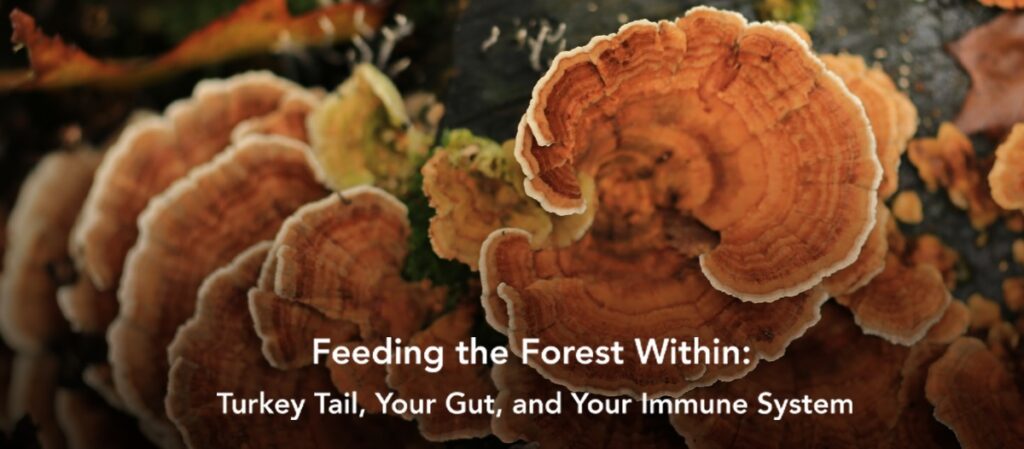
Feeding the Forest Within: Turkey Tail, Your Gut, and Your Immune System
By Mark J Kaylor
Discovering the surprising relationship between Coriolus, your gut microbiome, and immune health.
If you have ever walked through a hardwood forest after a rain, you have almost certainly passed Turkey Tail. It grows in overlapping ruffles on fallen oaks and old stumps, banded in browns, grays, and soft blues like the fanned tail of the bird it is named for. Most people step right past it.
What it is doing there is worth a second look. Turkey Tail is a decomposer. Its threads work quietly through dead wood, breaking down tough fibers that few other organisms can touch, and in the process it turns what has fallen into nourishment for the soil, the insects, the bacteria, and eventually the next generation of trees. In the forest, Turkey Tail’s work is feeding a community.
Researchers are finding that it may play a remarkably similar role inside us.
When we talk about mushrooms and immune health, we usually focus on how their compounds interact with immune cells. That story is real and well studied. But part of the story begins somewhere else entirely.
In your gut.
Here is the short version, for anyone who likes to see the map before the walk.
At a Glance
- Coriolus (Trametes versicolor), better known as Turkey Tail, contains complex polysaccharides that our own enzymes cannot digest, but our gut bacteria can.
- In a small randomized human trial and in several laboratory studies, Coriolus preparations shifted the gut microbiome in ways consistent with a prebiotic: food for beneficial microbes.
- What happens in the gut does not stay in the gut. Microbial byproducts such as butyrate help train the immune system’s “peacekeeper” cells, maintain the intestinal lining, and send signals as far as the bone marrow and lungs.
- Turkey Tail appears to reach the immune system by two roads at once: directly, through immune sampling sites in the intestinal wall, and indirectly, by feeding the microbes that shape immunity.
- Traditional Chinese Medicine and Ayurveda have long placed digestion at the root of resilience. Modern research is now mapping some of the same territory in its own language.
Read on for the five pathways that connect your gut to your immune system, and why they make such a strong case for seeing the body as one living conversation rather than a collection of parts.
Your Gut and Immune System Are Constantly Talking: Inside the Gut-Immune Connection
Most people picture the immune system as white blood cells circulating through the bloodstream. Yet some of the immune system’s most important work happens along the lining of your digestive tract.
Consider what the gut does every day. It absorbs nutrients while keeping an enormous population of microorganisms in their place, all across a lining that in most places is a single layer of cells thick. Every meal brings a flood of new proteins, microbes, and plant compounds, and the immune system must sort the welcome from the unwelcome without overreacting to the very food you depend on.
A careful 2023 census of the body’s immune cells found that most of them live in the lymph nodes, spleen, and bone marrow, with the gut holding only a few percent. Yet the gut is home to the bulk of the body’s antibody-producing plasma cells, which makes it the largest center of antibody-based immunity in the body. Even more important, it is where much of the immune system learns. Tolerance, the ability to recognize what belongs and leave it alone, is largely taught in the intestine.
Your gut bacteria are teachers in that school. Animals raised entirely without microbes develop immune systems that are underbuilt and poorly calibrated. The microbes help the immune system grow up, and the immune system, in turn, helps decide which microbes get to stay. It is a relationship that runs both ways, every day, for a lifetime.
Supporting a healthy gut environment is one way to support the foundations of normal immune function.
Coriolus: A Mushroom With a Prebiotic Side
Coriolus has a long history of traditional use in East Asia, where it is known as Yun Zhi, the “cloud mushroom.” Herbalists and mycologists such as Christopher Hobbs, Robert Rogers, and Paul Stamets have written about it in depth, and it has attracted considerable scientific attention for its distinctive polysaccharides, including the protein-bound compounds known as PSK (developed in Japan) and PSP (developed in China).
Polysaccharides are complex carbohydrates built from long chains of sugar molecules. Unlike simple sugars, their biological activity depends on their structure: chain length, branching patterns, and the way they fold. Those same features determine who can eat them.
And here is the key. Human digestive enzymes cannot break down most mushroom polysaccharides. They pass through the stomach and small intestine largely intact and arrive in the colon, where trillions of bacteria are waiting.
Some of those bacteria come remarkably well equipped. Researchers studying Bacteroides thetaiotaomicron, a common resident of the human gut, found a dedicated set of genes whose job is to dismantle a specific type of glucan found in fungal cell walls, and they named mushrooms such as Shiitake among its dietary sources. Similar gene clusters turned up across many related gut bacteria, which the researchers took as evidence that using fungal polysaccharides is a widespread adaptation within the human microbiome. Our gut community, it seems, has been eating mushrooms alongside us for a very long time.
When microbes ferment these polysaccharides, the result can be what researchers call prebiotic activity. A prebiotic is a substance that microorganisms use in a way that benefits the host. Think of it as feeding selected members of your internal community, much as Turkey Tail feeds the forest floor.
What Does the Research Tell Us? The Coriolus and Microbiome Evidence
Laboratory work came first. In a 2013 study, researchers cultured human stool bacteria with PSP from Coriolus. PSP increased Bifidobacterium and Lactobacillus, two groups generally considered beneficial, while reducing Clostridium, Staphylococcus, and Enterococcus species. Fermentation also raised levels of lactate and short-chain fatty acids and lowered the pH, signs that the microbes were actively using what they had been given.
Then came a human trial. A year later, a team at Beth Israel Deaconess Medical Center in Boston published a small, randomized trial in the journal Gut Microbes. Twenty-four healthy volunteers took PSP, the antibiotic amoxicillin, or nothing at all, and researchers tracked their stool microbiome seven times over eight weeks. PSP produced clear and consistent shifts in the microbiome, in line with prebiotic activity. Amoxicillin, by contrast, caused substantial disruption, including a rise in Escherichia and Shigella, and those changes were still visible 42 days after the antibiotic was stopped. PSP was well tolerated: one participant reported extra gas, and another reported more regular bowel movements.
One more finding from that trial deserves attention, because it says something lovely about us. Each person’s microbiome was distinctive and remarkably stable over time, so stable that individual baselines often outweighed the effects of either treatment. Your microbial community is something like a fingerprint, and it resists being pushed around. That resilience is part of why gentle, steady nourishment tends to make more sense than dramatic interventions.
Newer work points the same way. A 2025 laboratory study using a model of the human colon tested whole powders from several mushrooms, including Turkey Tail, and found increased production of short-chain fatty acids, including butyrate, along with growth in bacterial populations associated with good health. The study was funded by the company that makes those powders, which is worth keeping in mind. Animal research adds to the picture: in a 2024 study, Turkey Tail polysaccharides helped rebalance the gut bacteria, and even the gut fungi, of mice fed a high-fat diet.
These findings are encouraging, and they come with limits. The human trial was small and used PSP, an extract of cultured Coriolus mycelium, so its results do not automatically apply to every Coriolus product, including fruiting body extracts. The specific bacterial increases come from laboratory work rather than from the human trial itself. And a shift in the microbiome is not yet a health outcome; larger human studies are needed to learn how these changes translate into meaningful benefits.
Still, the research points toward an intriguing relationship between Coriolus polysaccharides and the microbial life of the gut. Which raises the bigger question: why would feeding gut bacteria matter for immunity at all?
From Gut to Immune System: Five Pathways That Connect Them
This is where the story widens. Each pathway below has been mapped in research on the gut and immunity in general rather than in Coriolus studies specifically. Together, they show how a change in the gut can ripple outward through the whole body.
- Butyrate and the peacekeepers. When gut bacteria ferment fiber and polysaccharides, one of their most important products is butyrate, a short-chain fatty acid. In a landmark 2013 study in mice, Japanese researchers showed that butyrate made by gut microbes prompts immature immune cells to become regulatory T cells, often called Tregs. It does this by loosening the molecular packaging around a key gene so that it can switch on.
Tregs are the immune system’s peacekeepers. Their job is to calm excessive inflammation and keep the immune system from attacking food, friendly microbes, or the body’s own tissues. In the study, mice given more butyrate developed more Tregs and were protected against colitis. It is a vital reminder that healthy immunity is about balance as much as strength. A well-fed microbiome helps the immune system know when to stand down.
- Feeding the wall that keeps the peace. Butyrate is also the preferred fuel of the cells lining your colon. As those cells burn it, they use up oxygen, which keeps the inner colon nearly oxygen-free. That matters because many beneficial gut bacteria thrive without oxygen, while some troublemakers, including certain strains of E. coli and Salmonella, use oxygen and related compounds to gain a foothold. In 2017, researchers at UC Davis showed in mice that when antibiotics wiped out butyrate-producing bacteria, this protective system faltered and those potentially harmful bacteria expanded.
It is an elegant loop. Good bacteria feed the gut lining, and a well-fed lining keeps the environment right for good bacteria. A strong, well-maintained barrier also means fewer bacterial fragments slipping into circulation, where they can drive the kind of low-grade inflammation that wears on the whole body.
- Scouts in the intestinal wall. Not everything Turkey Tail offers has to wait for bacteria. Scattered along the small intestine are Peyer’s patches, clusters of immune tissue topped with specialized cells that sample what passes by. Beta-glucans, a family of polysaccharides found in mushrooms, yeast, and grains, can be picked up at these sampling sites. In a 2004 study in mice, researchers tracked fluorescently labeled beta-glucans given by mouth and watched immune cells called macrophages carry them to the spleen, lymph nodes, and bone marrow. There, the macrophages broke them into smaller pieces that primed other immune cells for action.
This is why it makes sense to say Turkey Tail may reach the immune system by two roads at once: directly, through these immune scouts, and indirectly, by feeding the microbes that shape immunity. The 2004 study used yeast and barley glucans rather than Coriolus, so it shows the route exists rather than proving Turkey Tail travels it in exactly the same way.
- Signals that reach the bone marrow and lungs. One of the more striking discoveries in this field is that the gut shapes immunity in places far from the gut. In a 2014 study published in Nature Medicine, mice fed more fermentable fiber had higher levels of short-chain fatty acids circulating in their blood. Those fatty acids changed how the bone marrow produced certain immune cells, which then traveled to the lungs and made allergic airway inflammation less severe. Mice on a low-fiber diet fared worse.
Researchers now call this the gut-lung axis. It is a vivid example of what becomes visible when we stop thinking of organs as separate departments. What you feed your gut bacteria on Tuesday may influence how your lungs respond to dust on Friday.
- Evidence from people. Much of this research comes from animals, which makes a 2019 human study led by Stanford researchers especially valuable. Healthy adults took a five-day course of broad-spectrum antibiotics starting just before their seasonal flu shot, while others received the vaccine alone. The antibiotics reduced gut bacteria dramatically. In volunteers who already had strong immunity to the flu strains, antibody responses held up. But among volunteers with low prior immunity, the antibiotic group mounted a weaker antibody response to one strain, H1N1. The antibiotic group also showed signs of heightened inflammation, along with a steep drop in certain bile acids that gut bacteria normally help produce.
This study tested what happens when the microbiome is disrupted, not what happens when it is nourished, and those are different questions. Still, it offers some of the clearest human evidence that the community in your gut helps shape how your immune system performs elsewhere in the body.
Turkey Tail’s immune story also has human evidence of its own. In a 2012 Phase 1 trial at the University of Minnesota and Bastyr University, women who had completed treatment for breast cancer took freeze-dried Turkey Tail mycelium, supplied by Paul Stamets, for six weeks. Up to 9 grams a day was well tolerated, and researchers saw trends toward recovering lymphocyte counts and stronger natural killer cell activity at certain doses. That trial did not examine the microbiome, so it cannot tell us which road the mushroom took. It does tell us the destination is real.
An Older Map of the Same Territory: Digestion and Defense in TCM and Ayurveda
None of this would surprise a classically trained practitioner of Traditional Chinese Medicine. In TCM, the Spleen and Stomach, which describe the functions of digestion and transformation more than the anatomical organs, are the root of the Qi we produce after birth. Defensive Qi, called Wei Qi, is said to arise from the essence of food transformed by the Spleen and Stomach and is then spread to the body’s surface by the Lungs. In the 13th century, the physician Li Dongyuan built an entire school of medicine around a simple premise: when the Spleen and Stomach are injured, a hundred diseases can follow.
TCM also pairs the Lung with the Large Intestine as interior and exterior partners. Modern researchers describing a gut-lung axis are working in an entirely different framework and did not set out to confirm an ancient idea. Still, it is hard not to notice the echo.
Coriolus itself, as Yun Zhi, is traditionally described as sweet and slightly cooling, and is used to strengthen the Spleen and resolve Dampness, a TCM term for the heaviness and stagnation that can follow weak digestion. Tradition placed this mushroom’s work right at the digestive center long before anyone sequenced a microbiome.
Ayurveda tells a parallel story. Agni, the digestive fire, is considered central to health. When Agni is strong, food is transformed into nourishment and, ultimately, into Ojas, the refined essence associated with vitality and resilience. When Agni falters, undigested residue called Ama accumulates and burdens the whole system.
These are traditional frameworks, honored on their own terms, and modern science has not validated them as such. But they share an insight that research keeps circling back to: resilience is built from the center outward, and the center is the gut.
Tending the Whole Garden: Putting the Gut-Immune Connection Into Practice
If there is a practical lesson here, it is that immune support rarely comes down to a single compound or a single cell type. It is ecological. A few ways to honor that:
- Feed the community broadly. Diverse vegetables, legumes, whole grains, and culinary mushrooms like Shiitake, Maitake, and Oyster offer a wide range of fibers and polysaccharides, and different microbes favor different foods. Variety is the point.
- Think in seasons, not days. Each person’s microbiome is remarkably stable. Steady, consistent nourishment works with that stability better than short bursts.
- Treat antibiotics as the important tools they are. When you need them, take them as prescribed. Afterward, give your gut time and good food to recover, since the disruption can linger for weeks.
- If you choose Coriolus, know what you are taking. Products vary in which part of the mushroom is used and how it is prepared. Much of the human research used mycelium preparations, so results from one form do not automatically carry over to another.
- Check in with your practitioner. Coriolus is generally well tolerated, with occasional mild digestive effects, but anyone undergoing cancer treatment, taking immune-modifying medications, or managing an autoimmune condition should talk with their healthcare provider first.
A Different Way to Think About Immune Support
Perhaps the most interesting part of this story is how much of immune health depends on relationship.
Healthy immune function depends on communication, coordination, and balance. The immune system needs to recognize what is happening, respond appropriately, and live in harmony with the many microorganisms that share our bodies. Nowhere is that relationship more intimate than in the digestive tract.
Coriolus offers a beautiful example of how a single mushroom may take part in several layers of this network at once: greeting immune scouts in the intestinal wall, feeding the microbes that make butyrate, and through them influencing the peacekeeping cells, the gut lining, and signals that travel as far as the bone marrow and lungs.
We often think of supporting immune health and maintaining a healthy gut as two separate goals. Increasingly, research suggests they are one goal seen from two angles. And that may be the deeper lesson. The body was never a set of separate parts waiting for separate fixes. It is a living, talking whole, and what we offer one part, we offer to all of it.
The same is true on the forest floor. Turkey Tail does not help the forest by targeting a single tree. It feeds the community, and the community does the rest.
Sometimes, supporting the immune system begins by paying attention to the community that helps support it.
Key Takeaways
- Turkey Tail’s polysaccharides pass undigested to the colon, where gut bacteria equipped with specialized genetic toolkits can ferment them.
- Laboratory studies and a small human trial suggest Coriolus acts as a prebiotic, though larger human studies are still needed to connect those shifts to health outcomes.
- Short-chain fatty acids such as butyrate help train regulatory T cells, fuel the gut lining, and keep the colon’s environment favorable for beneficial microbes.
- The gut’s influence travels. Gut-derived signals reach the bone marrow and lungs, and in people, disrupting gut bacteria weakened some vaccine responses.
- Turkey Tail may reach the immune system by two roads: through immune sampling sites in the gut wall and through the microbes it feeds.
- TCM and Ayurveda have long placed digestion at the root of resilience, a perspective that resonates with the direction of modern research.
- Radiant health is a quality of aliveness that grows out of relationship: between you and the trillions of lives you carry, and between every part of you and the whole.
References
1. Coriolus PSP Shifts the Human Gut Microbiome
Supports: The randomized trial in healthy volunteers; PSP microbiome changes; amoxicillin disruption lasting 42 days; stability of individual microbiomes; tolerability
Pallav K, Dowd SE, Villafuerte J, et al. Effects of polysaccharopeptide from Trametes versicolor and amoxicillin on the gut microbiome of healthy volunteers: a randomized clinical trial. Gut Microbes. 2014;5(4):458-467.
https://doi.org/10.4161/gmic.29558
2. Coriolus Feeds Beneficial Bacteria in the Lab
Supports: Increases in Bifidobacterium and Lactobacillus; decreases in Clostridium, Staphylococcus, and Enterococcus; higher short-chain fatty acids and lower pH
Yu ZT, Liu B, Mukherjee P, Newburg DS. Trametes versicolor extract modifies human fecal microbiota composition in vitro. Plant Foods for Human Nutrition. 2013;68(2):107-112.
https://doi.org/10.1007/s11130-013-0342-4
3. Whole Mushroom Powders in a Colon Model
Supports: Turkey Tail and other mushroom powders increasing short-chain fatty acids including butyrate (industry-funded)
Daoust J, et al. Prebiotic activity of functional whole mushroom powders in short-term in vitro colonic simulations. Journal of Functional Foods. 2025;106912.
https://doi.org/10.1016/j.jff.2025.106912
4. Turkey Tail Polysaccharides Rebalance the Gut in Mice
Supports: Animal evidence for improved gut bacteria and gut fungi in high-fat diet mice
Bai M, Huang Z, Zheng X, Hou M, Zhang S. Polysaccharides from Trametes versicolor as a potential prebiotic to improve the gut microbiota in high-fat diet mice. Microorganisms. 2024;12(8):1654.
https://doi.org/10.3390/microorganisms12081654
5. Gut Bacteria Built to Eat Fungal Glucans
Supports: Dedicated genes in Bacteroides for fungal cell-wall glucans; widespread adaptation in the human microbiota; mushrooms as dietary sources
Temple MJ, Cuskin F, Baslé A, et al. A Bacteroidetes locus dedicated to fungal 1,6-β-glucan degradation: unique substrate conformation drives specificity of the key endo-1,6-β-glucanase. Journal of Biological Chemistry. 2017;292(25):10639-10650.
https://doi.org/10.1074/jbc.M117.787606
6. A Census of the Body’s Immune Cells
Supports: Most immune cells reside in lymph nodes, spleen, and bone marrow; the gut holds a small share but most plasma cells
Sender R, Weiss Y, Navon Y, et al. The total mass, number, and distribution of immune cells in the human body. Proceedings of the National Academy of Sciences. 2023;120(44):e2308511120.
https://doi.org/10.1073/pnas.2308511120
7. Butyrate Creates Immune Peacekeepers
Supports: Microbial butyrate inducing regulatory T cells in mice; protection against colitis
Furusawa Y, Obata Y, Fukuda S, et al. Commensal microbe-derived butyrate induces the differentiation of colonic regulatory T cells. Nature. 2013;504(7480):446-450.
https://doi.org/10.1038/nature12721
8. Butyrate Keeps the Colon’s Environment in Balance
Supports: Butyrate-driven colonocyte metabolism limiting oxygen and the expansion of E. coli and Salmonella in mice
Byndloss MX, Olsan EE, Rivera-Chávez F, et al. Microbiota-activated PPAR-γ signaling inhibits dysbiotic Enterobacteriaceae expansion. Science. 2017;357(6351):570-575.
https://doi.org/10.1126/science.aam9949
9. How Oral Beta-Glucans Reach the Immune System
Supports: Macrophages carrying orally administered beta-glucans to spleen, lymph nodes, and bone marrow in mice
Hong F, Yan J, Baran JT, et al. Mechanism by which orally administered beta-1,3-glucans enhance the tumoricidal activity of antitumor monoclonal antibodies in murine tumor models. Journal of Immunology. 2004;173(2):797-806.
https://doi.org/10.4049/jimmunol.173.2.797
10. Fiber, the Bone Marrow, and the Lungs
Supports: Fermentable fiber raising circulating short-chain fatty acids, altering bone marrow immune cell production, and reducing allergic airway inflammation in mice
Trompette A, Gollwitzer ES, Yadava K, et al. Gut microbiota metabolism of dietary fiber influences allergic airway disease and hematopoiesis. Nature Medicine. 2014;20(2):159-166.
https://doi.org/10.1038/nm.3444
11. Disrupting Gut Bacteria Alters Vaccine Response in People
Supports: Antibiotics weakening H1N1 antibody responses in adults with low prior immunity; inflammatory signatures; loss of secondary bile acids
Hagan T, Cortese M, Rouphael N, et al. Antibiotics-driven gut microbiome perturbation alters immunity to vaccines in humans. Cell. 2019;178(6):1313-1328.e13.
https://doi.org/10.1016/j.cell.2019.08.010
12. Turkey Tail and Immune Recovery in Women After Breast Cancer Treatment
Supports: Safety up to 9 grams a day; trends in lymphocyte counts and natural killer cell activity; mycelium supplied by Paul Stamets
Torkelson CJ, Sweet E, Martzen MR, et al. Phase 1 clinical trial of Trametes versicolor in women with breast cancer. ISRN Oncology. 2012;2012:251632.

Mark J. Kaylor is a passionate advocate for holistic health and natural remedies, with a focus on extending both lifespan and healthspan. As the founder of the Radiant Health Project and host of Radiant Health Podcast, Mark blends in-depth research with traditional wisdom to empower others on their journey to vibrant health. Through his writing and speaking, he shares insights into the transformative power of herbs, nutrition, and lifestyle practices.
The Radiant Health Project is a not-for-profit initiative dedicated to cutting through wellness industry hype and sharing evidence-informed, traditional wisdom for genuine health.
Disclaimer: The content on this site is for educational purposes and is not a substitute for advice from a qualified health practitioner. Please talk with your healthcare provider before changing your health routine, especially if you are pregnant, nursing, taking medication, or managing a health condition. It is not intended as a substitute for professional advice of any kind. This content should not substitute medical advice from a health professional.
Leave A Comment