


Did the Study Actually Say That?
By Mark J Kaylor
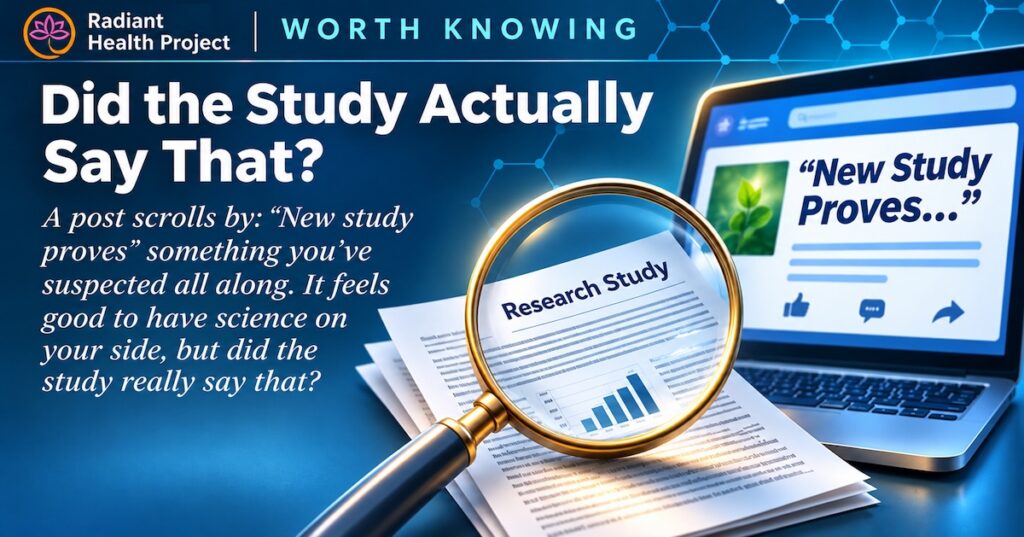
A post scrolls by: “New study proves” something you’ve suspected all along. There’s a link, a confident caption, maybe a graph. It feels good to have science on your side, so you nod, maybe share, and keep scrolling.
Most of us do this, especially when a claim agrees with what we already believe. That’s when we’re least likely to check, because nothing feels off.
Here’s how easily it happens. A widely shared statistic says 59 percent of links on social media are never clicked, proof that people share without reading. A statistician went back to the original paper and found it couldn’t show that. It counted links nobody clicked, and it said nothing about whether the people sharing them had read the article. Judging by how it spread, many people passing along that statistic hadn’t read the study either.
The good news is that checking takes about a minute. Most studies have a free summary, called an abstract, on PubMed (pubmed.ncbi.nlm.nih.gov). Search the study’s title or topic, open the abstract, and read the last sentence or two, where the researchers state their conclusion. Then compare it to the post. Does it match? Did the study involve people, or mice?
Did it find a link, or prove a cause?
This works best on the claims you like most. Those are the ones that slip past us.
Before you believe or share, ask: did the study actually say that?
References
1. The Original “Shared but Never Clicked” Study
Supports: Source of the widely cited 59 percent figure for shared links that were never clicked
Gabielkov M, Ramachandran A, Chaintreau A, Legout A. Social clicks: what and who gets read on Twitter? ACM SIGMETRICS / IFIP Performance 2016; Antibes Juan-les-Pins, France. pp. 179-192. DOI: 10.1145/2896377.2901462
https://doi.org/10.1145/2896377.2901462
2. A Statistician Reads the Paper
Supports: The 59 percent figure counts links never clicked by anyone and does not show whether the people sharing them had read the article
StatsChat. Read me first? 17 February 2018.

Mark J. Kaylor is a passionate advocate for holistic health and natural remedies, with a focus on extending both lifespan and healthspan. As the founder of the Radiant Health Project and host of Radiant Health Podcast, Mark blends in-depth research with traditional wisdom to empower others on their journey to vibrant health. Through his writing and speaking, he shares insights into the transformative power of herbs, nutrition, and lifestyle practices.
The Radiant Health Project is a not-for-profit initiative dedicated to cutting through wellness industry hype and sharing evidence-informed, traditional wisdom for genuine health.
Disclaimer: All information and results stated here is for educational and entertainment purposes only. The information mentioned here is not specific medical advice for any individual and is not intended to be used for self-diagnosis or treatment. This content should not substitute medical advice from a health professional. Always consult your health practitioner regarding any health or medical conditions.
Leave A Comment