


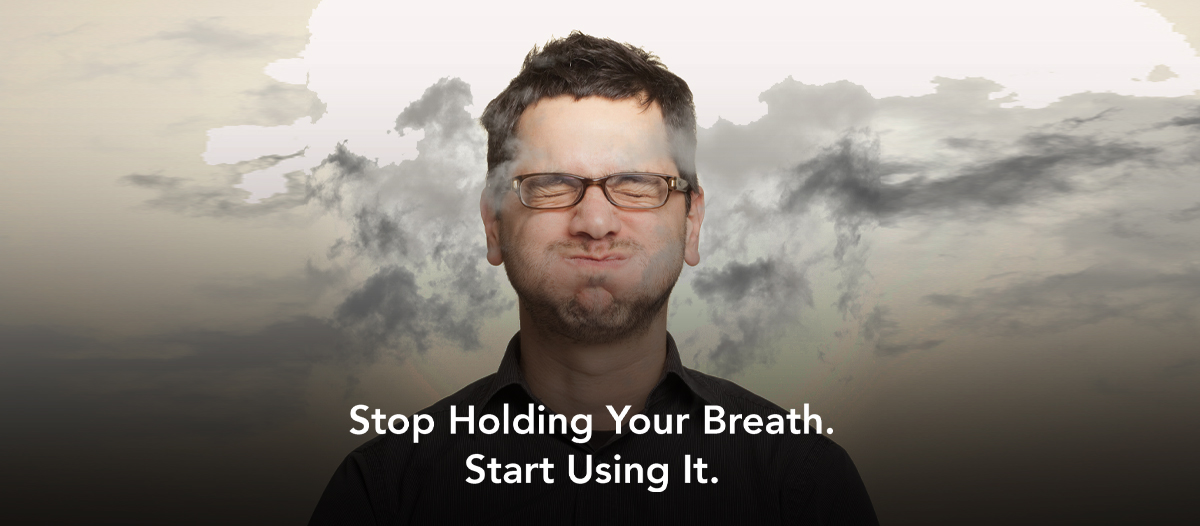
Stop Holding Your Breath. Start Using It.
By Mark J Kaylor
AT A GLANCE
Breath work isn’t a skill you have to learn or a subscription you need to buy. It’s a tool that’s been in your hands since your first cry, free every single time, available at every red light, every waiting room, every hard moment. This piece traces where that idea comes from, what’s actually happening in the body when you use it, and how to start using what you already have.
The Same Word, Every Time
Something curious happens when you look across the world’s oldest languages for the word “spirit.” In Greek it’s pneuma. In Sanskrit it’s prana. In Hebrew it’s ruach. In Latin it’s spiritus, the root of “inspire,” literally “to breathe in.” Even qi in Chinese medicine carries this same double life, breath and vitality braided into one idea.
These aren’t cultures borrowing from each other. They’re separated by oceans, centuries, entirely different cosmologies, and they all arrived at the identical intuition: whatever animates a living thing and whatever moves through the air are somehow the same substance.
In Greek, pneuma comes from pneo, “to blow” or “to breathe,” and ancient physicians built entire systems of medicine on it. Praxagoras and Erasistratus described a “vital pneuma” traveling from the lungs to the heart to the arteries, sustaining the body’s warmth and motion. Centuries later the Stoics pushed the idea further, describing pneuma as a mixture of air and fire that ran through the whole cosmos, organizing matter itself the way breath organizes a body.
Sanskrit tells a strikingly similar story from the other side of the world. Prana comes from a root meaning something close to “primary breath,” a cousin of that same Latin anima and Greek anemos, wind, hinting at one idea reaching back before any of these languages went their separate ways. The Rigveda personifies prana as a cosmic force animating the entire universe, the Upanishads divide it into five vayus governing digestion, elimination, and circulation, and pranayama, the formal breath practice at the center of yoga, literally means the extension of this same prana.
Latin gives us spiritus, from spirare, “to breathe,” and it’s still doing quiet work in English every day. To inspire is to breathe in. To expire is to breathe your last. To conspire, literally, is to breathe together. To aspire is to breathe toward something. Spiritus also has a cousin, anima, also meaning breath, sitting inside “animal,” “animate,” and “unanimous,” a word built from a root that meant breath long before it meant mind.
Hebrew carries the same doubling. Ruach means both wind and spirit, and alongside it sits neshama, the word for soul, which comes directly from the word for breath, the same word Genesis uses to describe the breath of life breathed into the first human.
And in Chinese, the character for qi is commonly traced to a picture of steam rising from a pot of cooking rice, breath made visible by warmth. Linguists don’t fully agree on how literally that reading holds up, which is worth saying plainly rather than glossing over. But the instinct behind it doesn’t need to be airtight to be telling: warmth, air, and vitality kept showing up as the same idea, independently, everywhere anyone looked closely enough to write it down.
There’s a plain reason for the convergence, and it has less to do with mysticism than with observation. Long before anyone understood physiology, breath was the one sign of life a person at the bedside could actually see. A mirror held to the lips fogs or it doesn’t. Breath shows itself in cold air, present one moment and permanently gone the next. Every culture, independently, was watching the same simple fact: the difference between a living body and a dead one is, quite literally, breath. Naming that difference “spirit” wasn’t a metaphor so much as a description.
And breath is still the one biological process that sits right on the line between voluntary and involuntary. You can hold it, slow it, deepen it. And the moment you stop paying attention, it keeps going without you. No other function in the body works quite like this. Maybe that’s why every tradition trying to name “life force” reached for it first, and why English speakers still reach for it, unknowingly, every time they say someone “inspires” them.
How a Free Tool Became a Product
Here’s where it gets frustrating. Something that costs nothing, needs no equipment, and works for every person alive has been repackaged, again and again, into apps you subscribe to, courses you enroll in, retreats you fly to. None of that is wrong exactly. Structure and guidance help many people. But somewhere in the packaging, the plain truth got buried: you already own this. You’ve been using it, unconsciously, your entire life.
The version of breath work worth writing about isn’t the ten-minute session on a cushion, though that has its place. It’s the thirty seconds available to you constantly, at the moments you’d otherwise never think to use it.
What’s Actually Happening
The diaphragm is an odd muscle, worth pausing on for a moment. It’s the one skeletal muscle in the body you can move at will and that also runs completely on its own, all day, without a single thought from you. That dual citizenship, voluntary and automatic at once, is exactly why breath makes such a direct line into the nervous system.
Here’s the mechanism in plain terms. When you breathe slow and low with the diaphragm rather than shallow and high in the chest, that downward movement stretches receptors involved in blood pressure regulation. This stretch increases activity along the vagus nerve, the main channel of the parasympathetic system, the half of the nervous system responsible for rest, digestion, and repair. Heart rate naturally quickens a touch on the inhale and slows on the exhale. The size of that swing is what shows up as heart rate variability, a number increasingly used as a readout of how much calming influence is present in a given moment.
The exhale, specifically, seems to be doing most of the work. Research on paced breathing found that adding a brief pause after the exhale, rather than breathing evenly in and out, increased the specific marker tied to vagal influence more than symmetric breathing did. There’s a chemical piece running alongside the mechanical one too. A longer exhale clears more carbon dioxide from the blood, and rising CO2 is itself one of the body’s internal alarm signals. So the long exhale is doing two jobs at once, one mechanical, one chemical, both pointing the body in the same direction.
For a recent, well-designed piece of evidence, a 2023 Stanford trial compared several breathing protocols against daily mindfulness meditation over a month. The exhale-focused practice, called cyclic sighing, produced the largest gains in mood and the largest drop in resting breathing rate, outperforming meditation itself on those measures. Worth saying plainly: that same study found no significant change in heart rate variability despite the mood benefit, a reminder that even good research rarely wraps up as neatly as a headline suggests.
Where It’s Already Hiding
You don’t need a plan for this. You need a moment you’re already in.
Red light, foot still on the brake. Two or three slow exhales, longer than the inhale, before the light changes.
The waiting room, sitting with nothing to do but watch a door. That’s not dead time, that’s an open invitation.
The pause before you hit send on the email you’ve rewritten four times. One long breath out before your thumb moves.
None of these require you to set anything aside, learn anything new, or believe anything in particular. They ask only that you notice the tool was already there.
KEY TAKEAWAYS
-
- Breath and spirit share a word across nearly every ancient language, likely because breath is the one process straddling voluntary and involuntary control
- The exhale, more than the inhale, is what shifts the body toward rest and repair, through both a nerve pathway and a chemical one
- Recent research backs the exhale-focused approach specifically, though even strong studies leave open questions rather than tidy conclusions
- This was never about learning a new skill. It’s about remembering that radiant health, as a quality of aliveness rather than the absence of stress, has been sitting in your own chest the whole time
REFERENCES
- Rest periods extend the calming effect of diaphragmatic breathing
Supports: the exhale, specifically, as the more active lever in shifting the nervous system toward rest
- Exhale-focused breathing outperforms meditation for mood, Stanford trial finds
Supports: the modern evidence base for exhale-focused breath work, including the honest caveat on heart rate variability
Yilmaz Balban, M. et al., “Brief Structured Respiration Practices Enhance Mood and Reduce Physiological Arousal,” Cell Reports Medicine, 2023.
- Deep breathing stretches baroreceptors and raises vagal activity
Supports: the core mechanism connecting diaphragmatic breathing to the parasympathetic nervous system
“The effectiveness of an osteopathic manual technique compared with a breathing exercise on vagal tone, as indicated by heart rate variability: a crossover study,” ScienceDirect, 2024.

Mark J. Kaylor is a passionate advocate for holistic health and natural remedies, with a focus on extending both lifespan and healthspan. As the founder of the Radiant Health Project and host of Radiant Health Podcast, Mark blends in-depth research with traditional wisdom to empower others on their journey to vibrant health. Through his writing and speaking, he shares insights into the transformative power of herbs, nutrition, and lifestyle practices.
The Radiant Health Project is a not-for-profit initiative dedicated to cutting through wellness industry hype and sharing evidence-informed, traditional wisdom for genuine health.
Disclaimer: All information and results stated here is for educational and entertainment purposes only. The information mentioned here is not specific medical advice for any individual and is not intended to be used for self-diagnosis or treatment. This content should not substitute medical advice from a health professional. Always consult your health practitioner regarding any health or medical conditions.
Leave A Comment